
皮质微结构梯度捕获颞叶癫痫记忆网络的重组。
Cortical microstructural gradients capture memory network reorganization in temporal lobe epilepsy.
机构信息
Multimodal Imaging and Connectome Analysis Laboratory, Montreal Neurological Institute and Hospital, McGill University, Montreal, QC H3A 2B4, Canada.
Analytical Neurophysiology Laboratory, Montreal Neurological Institute and Hospital, McGill University, Montreal, QC H3A 2B4, Canada.
出版信息
Brain. 2023 Sep 1;146(9):3923-3937. doi: 10.1093/brain/awad125.
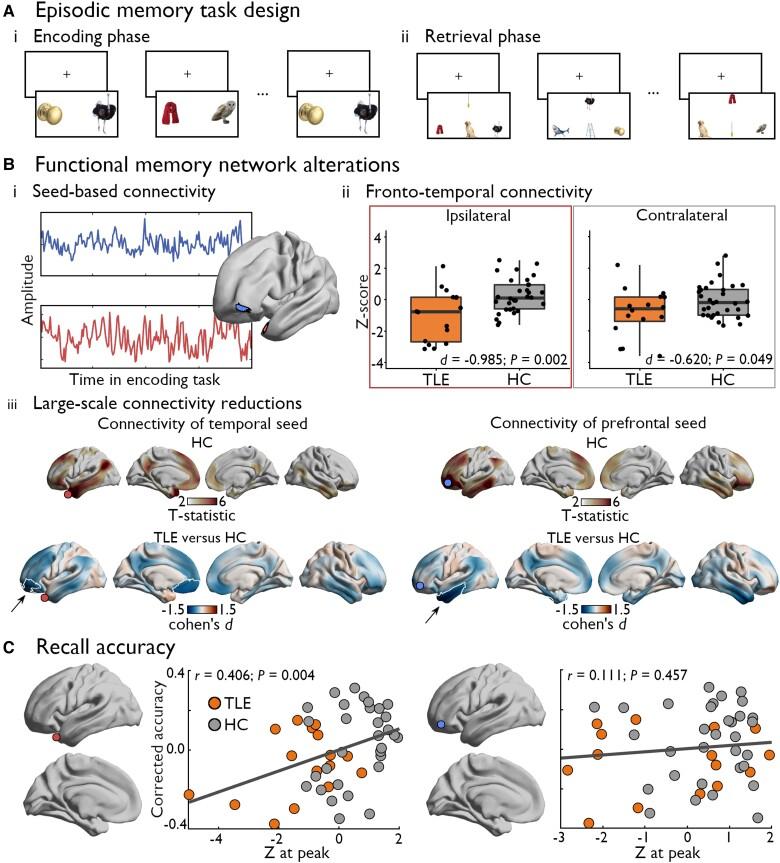
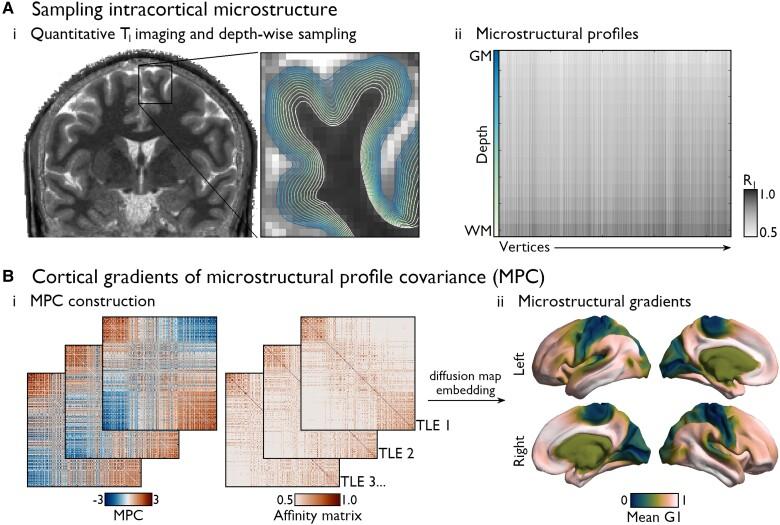
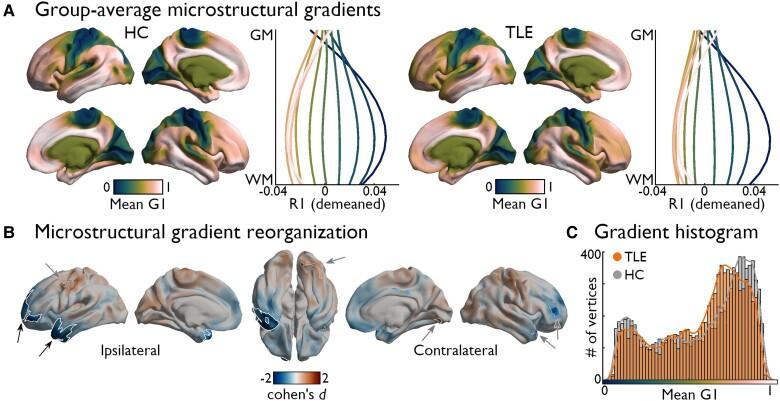
Temporal lobe epilepsy (TLE), one of the most common pharmaco-resistant epilepsies, is associated with pathology of paralimbic brain regions, particularly in the mesiotemporal lobe. Cognitive dysfunction in TLE is frequent, and particularly affects episodic memory. Crucially, these difficulties challenge the quality of life of patients, sometimes more than seizures, underscoring the need to assess neural processes of cognitive dysfunction in TLE to improve patient management. Our work harnessed a novel conceptual and analytical approach to assess spatial gradients of microstructural differentiation between cortical areas based on high-resolution MRI analysis. Gradients track region-to-region variations in intracortical lamination and myeloarchitecture, serving as a system-level measure of structural and functional reorganization. Comparing cortex-wide microstructural gradients between 21 patients and 35 healthy controls, we observed a reorganization of this gradient in TLE driven by reduced microstructural differentiation between paralimbic cortices and the remaining cortex with marked abnormalities in ipsilateral temporopolar and dorsolateral prefrontal regions. Findings were replicated in an independent cohort. Using an independent post-mortem dataset, we observed that in vivo findings reflected topographical variations in cortical cytoarchitecture. We indeed found that macroscale changes in microstructural differentiation in TLE reflected increased similarity of paralimbic and primary sensory/motor regions. Disease-related transcriptomics could furthermore show specificity of our findings to TLE over other common epilepsy syndromes. Finally, microstructural dedifferentiation was associated with cognitive network reorganization seen during an episodic memory functional MRI paradigm and correlated with interindividual differences in task accuracy. Collectively, our findings showing a pattern of reduced microarchitectural differentiation between paralimbic regions and the remaining cortex provide a structurally-grounded explanation for large-scale functional network reorganization and cognitive dysfunction characteristic of TLE.
颞叶癫痫(TLE)是最常见的药物难治性癫痫之一,与边缘脑区,特别是内侧颞叶的病理学有关。TLE 患者常伴有认知功能障碍,特别是对情景记忆的影响。至关重要的是,这些困难挑战了患者的生活质量,有时甚至超过了癫痫发作,这强调了需要评估 TLE 认知功能障碍的神经过程,以改善患者的管理。我们利用了一种新的概念和分析方法,基于高分辨率 MRI 分析来评估皮质区域之间微观结构分化的空间梯度。梯度追踪皮质内分层和髓鞘结构的区域间变化,作为结构和功能重组的系统水平度量。我们比较了 21 名患者和 35 名健康对照者的全脑微结构梯度,发现 TLE 患者的这种梯度发生了重组,由边缘皮质与剩余皮质之间的微观结构分化减少驱动,同侧颞极和背外侧前额叶区域的异常明显。在一个独立的队列中,我们观察到了这种发现的可重复性。使用独立的尸检数据集,我们观察到,在体内发现反映了皮质结构的拓扑变化。我们确实发现,TLE 中微观结构分化的宏观变化反映了边缘和主要感觉/运动区域之间的相似性增加。疾病相关的转录组学还可以证明我们的发现对 TLE 的特异性,而不是其他常见的癫痫综合征。最后,微观结构去分化与情景记忆功能磁共振成像范式期间观察到的认知网络重组有关,并与任务准确性的个体间差异相关。总的来说,我们的研究结果表明,边缘区和剩余皮质之间的微观结构分化减少模式为 TLE 特有的大规模功能网络重组和认知功能障碍提供了结构基础的解释。

 Zotero 插件