
评估 COVID-19 早期对住院环境中抗生素耐药威胁的影响:混合泊松回归方法。
Assessing the impact of the early COVID-19 era on antibiotic-resistant threats in inpatient settings: A mixed Poisson regression approach.
机构信息
Department of Population Health and Pathobiology, North Carolina State University, Raleigh, NC.
出版信息
Am J Infect Control. 2023 Oct;51(10):1089-1094. doi: 10.1016/j.ajic.2023.04.159. Epub 2023 Apr 19.
BACKGROUND
During the COVID-19 pandemic, increased antibiotic prescribing and infection prevention challenges coincided with antibiotic-resistant (AR) infection increases. Clostridioides difficile (C difficile) and methicillin-resistant Staphylococcus aureus (MRSA) are serious, costly AR threats. Health inequities in pandemic-era AR infections are not well-characterized.
METHODS
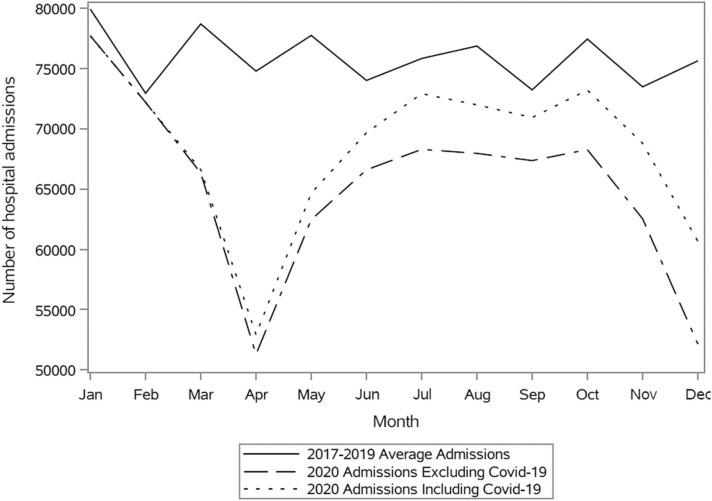
North Carolina statewide inpatient admissions were used to determine monthly admission rates and admission rate ratios (RRs) for C difficile and MRSA infections comparing 2017-2019 (prepandemic) to 2020 (pandemic exposure) using mixed-model Poisson regression adjusted for age, sex, comorbidities, and COVID-19. We assessed effect measure modification by admissions... community-level income, county rurality, and race and ethnicity. Mean total costs by infection type were compared.
RESULTS
With pandemic exposure, C difficile (adjusted RR.ß=.ß0.90 [95% confidence interval [CI] 0.86, 0.94]) and MRSA pneumonia (adjusted RR.ß=.ß0.97 [95% CI 0.91, 1.05]) decreased, while MRSA septicemia (adjusted RR.ß=.ß1.13 [95% CI 1.07, 1.19]) increased. Effect measure modification was not detected. C difficile or MRSA coinfection nearly doubled mean costs among COVID-19 admissions.
CONCLUSIONS
Despite decreases in C difficile and most MRSA infections, the early COVID-19 pandemic period saw continued increases in MRSA septicemia admissions in North Carolina. Equitable interventions to curb increases and reduce health care costs should be developed.
背景
在 COVID-19 大流行期间,抗生素的使用增加和感染预防挑战与抗生素耐药(AR)感染的增加同时发生。艰难梭菌(C difficile)和耐甲氧西林金黄色葡萄球菌(MRSA)是严重且代价高昂的 AR 威胁。大流行时期 AR 感染中的健康不平等现象尚未得到充分描述。
方法
我们利用北卡罗来纳州全州住院患者入院数据,采用混合模型泊松回归(调整了年龄、性别、合并症和 COVID-19 因素),比较了 2017-2019 年(大流行前)和 2020 年(大流行暴露期)每月艰难梭菌和 MRSA 感染的入院率和入院率比(RR)。我们评估了入院量...社区收入水平、县农村程度和种族与民族等因素对效应测量的修饰作用。比较了不同感染类型的平均总费用。
结果
大流行暴露后,艰难梭菌(调整 RR.ß=0.90 [95%置信区间(CI)0.86,0.94])和 MRSA 肺炎(调整 RR.ß=0.97 [95% CI 0.91,1.05])的入院率降低,而 MRSA 败血症(调整 RR.ß=1.13 [95% CI 1.07,1.19])的入院率增加。未检测到效应测量的修饰作用。COVID-19 入院患者中,艰难梭菌或 MRSA 合并感染使平均费用增加了近一倍。
结论
尽管艰难梭菌和大多数 MRSA 感染有所减少,但北卡罗来纳州在 COVID-19 大流行早期仍出现了 MRSA 败血症入院人数的持续增加。应制定公平的干预措施来遏制这种增加并降低医疗保健成本。
 Zotero 插件