
微生物生物制造用于太空探索——该带什么和何时制造。
Microbial biomanufacturing for space-exploration-what to take and when to make.
机构信息
Center for the Utilization of Biological Engineering in Space (CUBES), Berkeley, CA, USA.
Department of Civil and Environmental Engineering, Stanford University, Stanford, CA, USA.
出版信息
Nat Commun. 2023 Apr 21;14(1):2311. doi: 10.1038/s41467-023-37910-1.
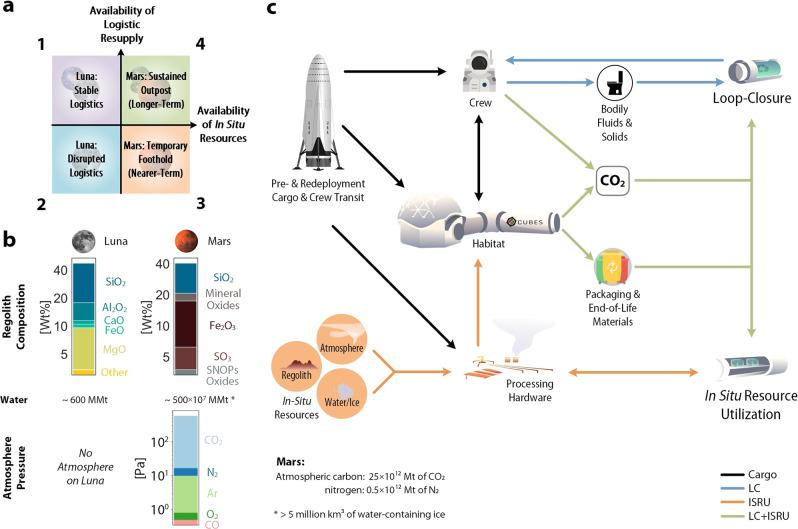
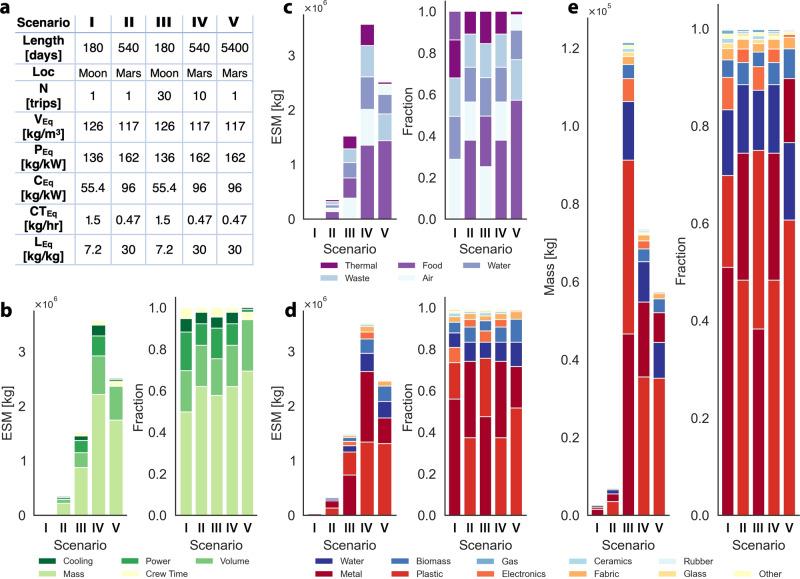
As renewed interest in human space-exploration intensifies, a coherent and modernized strategy for mission design and planning has become increasingly crucial. Biotechnology has emerged as a promising approach to increase resilience, flexibility, and efficiency of missions, by virtue of its ability to effectively utilize in situ resources and reclaim resources from waste streams. Here we outline four primary mission-classes on Moon and Mars that drive a staged and accretive biomanufacturing strategy. Each class requires a unique approach to integrate biomanufacturing into the existing mission-architecture and so faces unique challenges in technology development. These challenges stem directly from the resources available in a given mission-class-the degree to which feedstocks are derived from cargo and in situ resources-and the degree to which loop-closure is necessary. As mission duration and distance from Earth increase, the benefits of specialized, sustainable biomanufacturing processes also increase. Consequentially, we define specific design-scenarios and quantify the usefulness of in-space biomanufacturing, to guide techno-economics of space-missions. Especially materials emerged as a potentially pivotal target for biomanufacturing with large impact on up-mass cost. Subsequently, we outline the processes needed for development, testing, and deployment of requisite technologies. As space-related technology development often does, these advancements are likely to have profound implications for the creation of a resilient circular bioeconomy on Earth.
随着人们对人类太空探索的兴趣重新高涨,制定连贯且现代化的任务设计和规划策略变得愈发重要。生物技术是一种很有前途的方法,可以通过有效利用原位资源和从废物流中回收资源,来提高任务的恢复力、灵活性和效率。在这里,我们概述了月球和火星上的四个主要任务类别,这些类别推动了分阶段和累积式生物制造策略。每个类别都需要一种独特的方法将生物制造整合到现有的任务架构中,因此在技术开发方面面临着独特的挑战。这些挑战直接源于给定任务类别的可用资源——原料在多大程度上源自货物和原位资源,以及在多大程度上需要闭环。随着任务持续时间和与地球的距离的增加,专门的、可持续的生物制造过程的好处也会增加。因此,我们定义了特定的设计方案,并量化了太空生物制造的有用性,以指导太空任务的技术经济。特别是材料,作为生物制造的一个潜在关键目标,对上行成本有重大影响。随后,我们概述了开发、测试和部署必要技术所需的过程。由于与太空相关的技术发展通常如此,这些进展很可能对地球建立有弹性的循环生物经济产生深远影响。

 Zotero 插件