
TUT4/7 介导的冠状病毒亚基因组 RNA 的尿苷酸化可延迟病毒复制。
TUT4/7-mediated uridylation of a coronavirus subgenomic RNAs delays viral replication.
机构信息
Reproductive and Developmental Biology Laboratory, National Institute of Environmental Health Sciences, National Institutes of Health, Durham, NC, 27709, USA.
Viral Vector Core Facility, National Institute of Environmental Health Sciences, National Institutes of Health, Durham, NC, 27709, USA.
出版信息
Commun Biol. 2023 Apr 21;6(1):438. doi: 10.1038/s42003-023-04814-1.
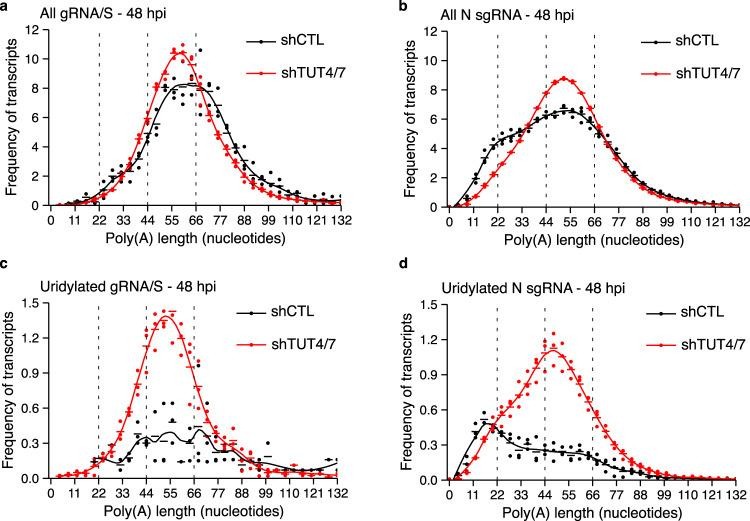
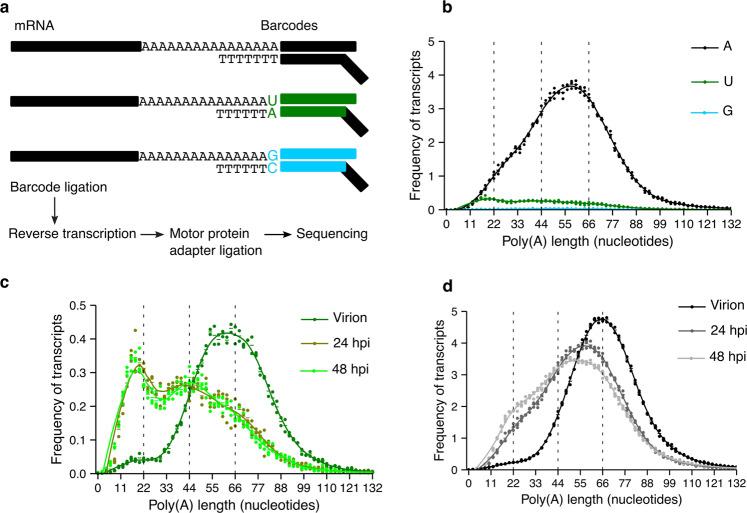
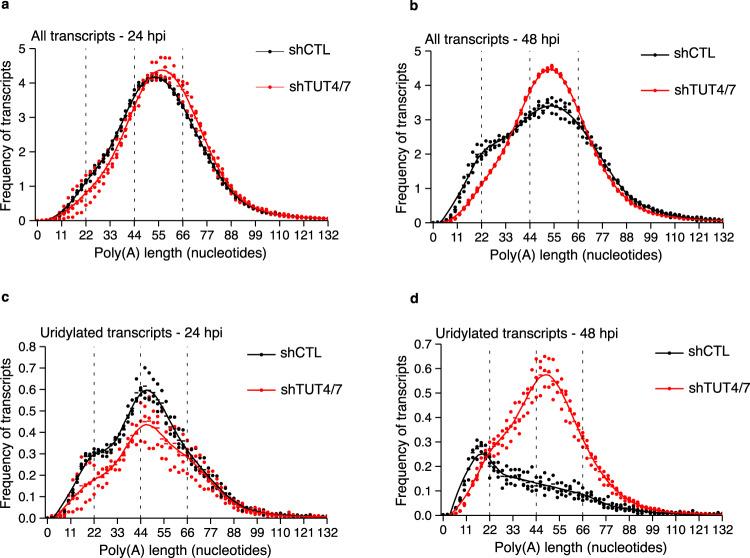
Coronaviruses are positive-strand RNA viruses with 3' polyadenylated genomes and subgenomic transcripts. The lengths of the viral poly(A) tails change during infection by mechanisms that remain poorly understood. Here, we use a splint-ligation method to measure the poly(A) tail length and poly(A) terminal uridylation and guanylation of the mouse hepatitis virus (MHV) RNAs. Upon infection of 17-CL1 cells with MHV, a member of the Betacoronavirus genus, we observe two populations of terminally uridylated viral transcripts, one with poly(A) tails ~44 nucleotides long and the other with poly(A) tails shorter than ~22 nucleotides. The mammalian terminal uridylyl-transferase 4 (TUT4) and terminal uridylyl-transferase 7 (TUT7), referred to as TUT4/7, add non-templated uracils to the 3'-end of endogenous transcripts with poly(A) tails shorter than ~30 nucleotides to trigger transcript decay. Here we find that depletion of the host TUT4/7 results in an increased replication capacity of the MHV virus. At late stages of infection, the population of uridylated subgenomic RNAs with tails shorter than ~22 nucleotides is reduced in the absence of TUT4/7 while the viral RNA load increases. Our findings indicate that TUT4/7 uridylation marks the MHV subgenomic RNAs for decay and delays viral replication.
冠状病毒是带有 3' 聚腺苷酸化基因组和亚基因组转录本的正链 RNA 病毒。病毒聚(A)尾的长度在感染过程中会发生变化,但具体机制尚不清楚。在这里,我们使用一种拼接连接方法来测量小鼠肝炎病毒 (MHV) RNA 的聚(A)尾长度和聚(A)末端尿苷酸化和鸟苷酸化。在感染β冠状病毒属的 MHV 后,我们观察到两种末端尿苷酸化的病毒转录本群体,一种带有长约 44 个核苷酸的聚(A)尾,另一种带有短于约 22 个核苷酸的聚(A)尾。哺乳动物末端尿苷酰转移酶 4 (TUT4) 和末端尿苷酰转移酶 7 (TUT7),称为 TUT4/7,会将非模板尿嘧啶添加到聚(A)尾短于约 30 个核苷酸的内源性转录本的 3' 端,以触发转录本降解。在这里,我们发现宿主 TUT4/7 的消耗会导致 MHV 病毒的复制能力增强。在感染后期,在没有 TUT4/7 的情况下,带有短于约 22 个核苷酸的尾巴的尿苷酸化亚基因组 RNA 群体减少,而病毒 RNA 载量增加。我们的研究结果表明,TUT4/7 尿苷酸化标志着 MHV 亚基因组 RNA 进行降解,并延迟病毒复制。


 Zotero 插件