
塞拉利昂 2019 年人口健康调查二次数据分析:15-49 岁女性中体重过轻的流行状况及相关因素。
Prevalence and factors associated with underweight among 15-49-year-old women in Sierra Leone: a secondary data analysis of Sierra Leone demographic health survey of 2019.
机构信息
ICAP at Columbia University, Freetown, Sierra Leone.
Foothills Community Based Interventions, Monticello, KY, USA.
出版信息
BMC Womens Health. 2023 Apr 22;23(1):192. doi: 10.1186/s12905-023-02358-4.
BACKGROUND
Women are at higher risks of being underweight than men due to biological, socio-economic, and cultural factors. Underweight women have high risks of poor obstetric outcomes. We aimed to determine the prevalence and factors associated with being underweight among women of reproductive age (15-49 years) in Sierra Leone.
METHODS
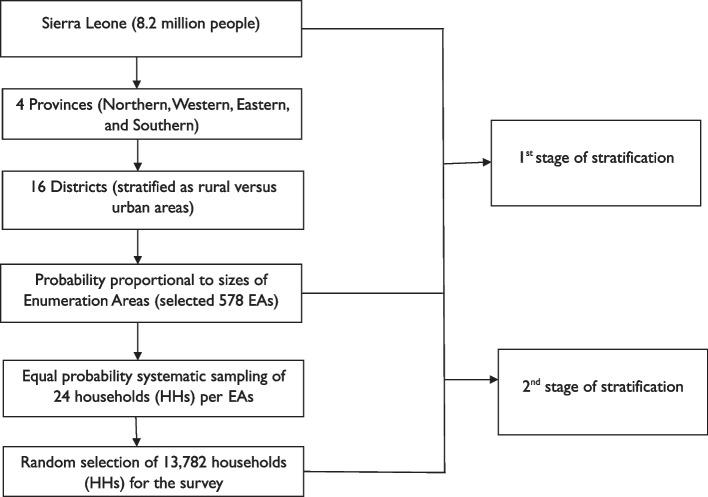
We used Sierra Leone Demographic and Health Survey (2019-SLDHS) data of 7,514 women aged 15 to 49 years, excluding pregnant, post-natal, lactating, and post-menopausal women. A multistage stratified sampling approach was used to select study participants, and data was collected using validated questionnaires. A multivariable logistic regression analysis was used to determine factors associated with underweight among 15-49-year-old women in Sierra Leone. Ethical approval for the study was obtained.
RESULTS
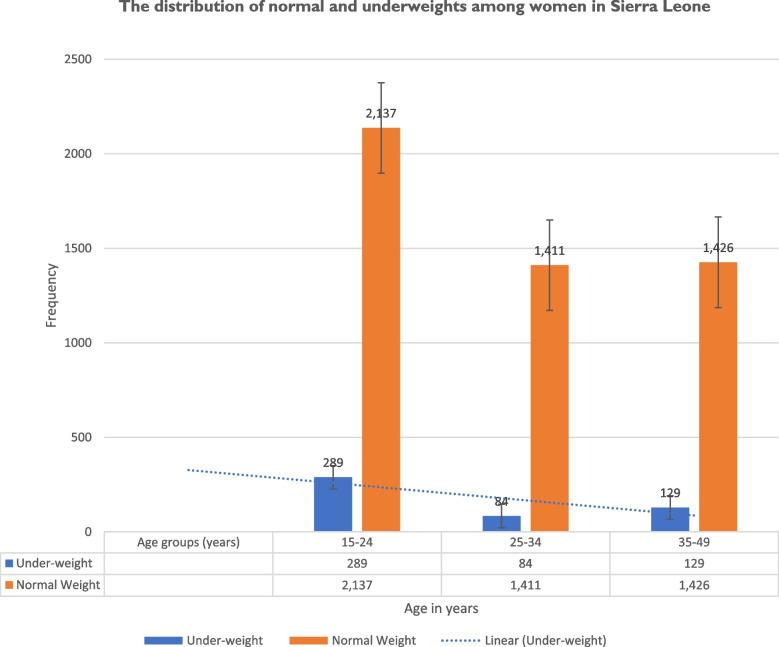
The prevalence of underweight was 6.7% (502/7,514). Underweight was likely among age-group of 15-24 years, AOR = 2.50,95%CI:2.39-2.60;p < 0.001 compared to 25-34 year age-group and likely among women with parity of one to four, AOR = 1.48,95%CI:1.08-2.03;p = 0.015 compared to women who never gave birth. Underweight was unlikely among women who did not listen to radios AOR = 0.67,95%CI:0.55-0.83;p < 0.001 compared to those who did; women from the north AOR = 0.73,95%CI:0.56-0.96;p = 0.026 compared to the east, and not married women AOR = 0.59,95%CI:0.47-0.76;p < 0.001 compared to married. All household wealth indices were not significantly associated with underweight.
CONCLUSION
The prevalence of underweight among women in the reproductive age (15-49 years) in Sierra Leone was 6.7% and it is lower compared to global and most sub-Saharan African data. Factors associated with underweight were 15-24-year age-group, and parity of one to four. Being underweight was unlikely among women who did not listen to radios, women from the north and not married. All household wealth indices were not significantly associated with underweight. Even though household wealth indices were not significantly associated with being underweight, most underweight women 68.7% (345/502) were in the poorest, poorer, and middle household wealth indices. The need to address socio-economic determinants of underweight among women (aged 15-49 years) due to household poverty is a priority in Sierra Leone.
背景
由于生物学、社会经济和文化因素,女性比男性更容易体重不足。体重不足的女性发生不良产科结局的风险较高。我们旨在确定塞拉利昂生育年龄(15-49 岁)妇女体重不足的流行率和相关因素。
方法
我们使用了塞拉利昂 2019 年人口与健康调查(2019-SLDHS)的数据,共纳入了 7514 名年龄在 15 至 49 岁之间的女性,排除了孕妇、产后、哺乳期和绝经后女性。采用多阶段分层抽样方法选择研究对象,使用经过验证的问卷收集数据。采用多变量逻辑回归分析确定塞拉利昂 15-49 岁妇女体重不足的相关因素。本研究获得了伦理批准。
结果
体重不足的流行率为 6.7%(502/7514)。与 25-34 岁年龄组相比,15-24 岁年龄组更有可能体重不足,AOR=2.50,95%CI:2.39-2.60;p<0.001,与从未生育过的女性相比,产次为 1-4 次的女性更有可能体重不足,AOR=1.48,95%CI:1.08-2.03;p=0.015。与听收音机的女性相比,不听收音机的女性体重不足的可能性较小,AOR=0.67,95%CI:0.55-0.83;p<0.001,来自北部的女性 AOR=0.73,95%CI:0.56-0.96;p=0.026,未婚女性 AOR=0.59,95%CI:0.47-0.76;p<0.001,与已婚女性相比。所有家庭财富指数与体重不足均无显著相关性。
结论
塞拉利昂生育年龄(15-49 岁)女性体重不足的流行率为 6.7%,低于全球和大多数撒哈拉以南非洲的数据。与体重不足相关的因素是 15-24 岁年龄组和产次为 1-4 次。不听收音机、来自北部和未婚的女性体重不足的可能性较小。所有家庭财富指数与体重不足均无显著相关性。尽管家庭财富指数与体重不足无显著相关性,但大多数体重不足的女性(502 名中的 345 名)处于最贫困、较贫困和中等家庭财富指数。由于家庭贫困,塞拉利昂需要解决妇女(15-49 岁)体重不足的社会经济决定因素,这是当务之急。
 Zotero 插件