
鼻窦磁共振成像评估-系统性红斑狼疮患者的临床指标相关性。
Paranasal sinus occupancy assessed from magnetic resonance images-associations with clinical indicators in patients with systemic lupus erythematosus.
机构信息
Department of Neuroimaging Sciences, Centre for Clinical Brain Sciences, University of Edinburgh, Edinburgh, UK.
College of Medicine and Veterinary Medicine, University of Edinburgh, Edinburgh, UK.
出版信息
Rheumatology (Oxford). 2024 Jan 4;63(1):149-157. doi: 10.1093/rheumatology/kead185.
OBJECTIVES
Nasal, paranasal sinus and mucosal disorders are common symptoms in autoimmune rheumatic diseases. Soft tissue changes and fluid accumulation in the osteomeatal complexes and paranasal sinuses manifest as opaqueness on radiological images which can be assessed using visual scoring and computational methods on CT scans, but their results do not always correlate. Using MRI, we investigate the applicability of different image analysis methods in SLE.
METHODS
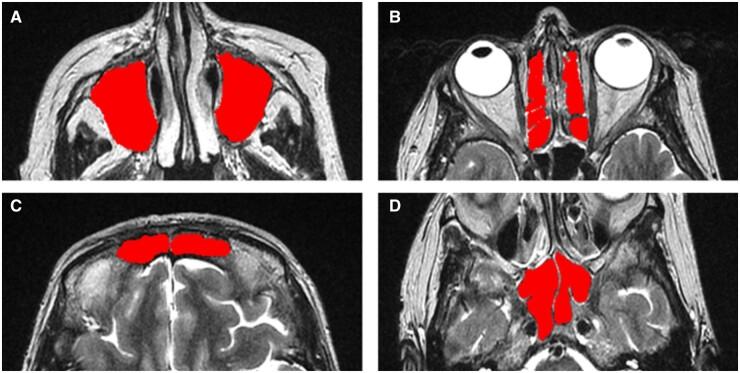
We assessed paranasal sinus opaqueness on MRI from 51 SLE patients, using three visual scoring systems and expert-delineated computational volumes, and examined their association with markers of disease activity, inflammation, endothelial dysfunction and common small vessel disease (SVD) indicators, adjusting for age and sex-at-birth.
RESULTS
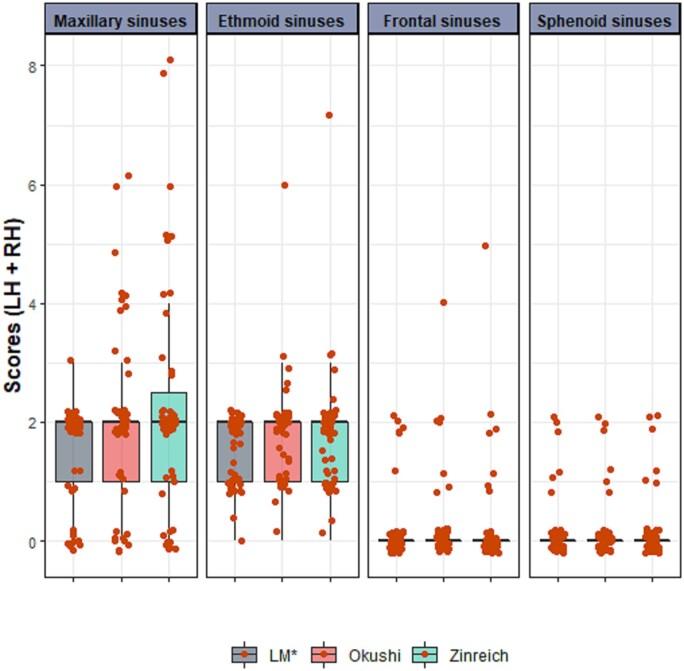
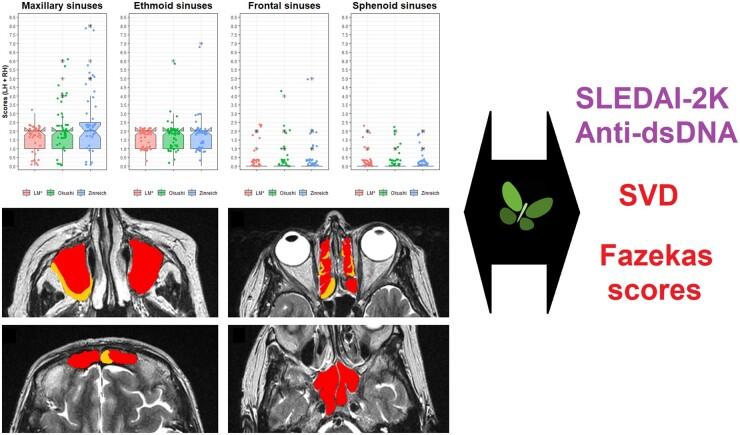
The average paranasal sinus volume occupation was 4.55 (6.47%) [median (interquartile range) = 0.67 (0.25-2.65) ml], mainly in the maxillary and ethmoid sinuses. It was highly correlated with Lund-Mackay (LM) scores modified at 50% opaqueness cut-off (Spearman's ρ: 0.71 maxillary and 0.618 ethmoids, P < 0.001 in all), and with more granular variations of the LM system. The modified LM scores were associated with SVD scores (0: B = 5.078, s.e. = 1.69, P = 0.0026; 2: B = -0.066, s.e. = 0.023, P = 0.0045) and disease activity (anti-dsDNA: B = 4.59, s.e. = 2.22, P = 0.045; SLEDAI 3-7: 2.86 < B < 4.30; 1.38 < s.e. < 1.63; 0.0083 ≤ P ≤ 0.0375). Computationally derived percent opaqueness yielded similar results.
CONCLUSION
In patients with SLE, MRI computational assessment of sinuses opaqueness and LM scores modified at a 50% cut-off may be useful tools in understanding the relationships among paranasal sinus occupancy, disease activity and SVD markers.
目的
鼻腔、鼻窦和黏膜疾病是自身免疫性风湿病的常见症状。中鼻甲和鼻窦的骨-黏膜复合体的软组织变化和液体积聚表现为影像学图像上的不透明,可通过 CT 扫描上的视觉评分和计算方法进行评估,但结果并不总是相关。使用 MRI,我们研究了不同图像分析方法在系统性红斑狼疮(SLE)中的适用性。
方法
我们评估了 51 例 SLE 患者的 MRI 鼻窦不透明度,使用了三种视觉评分系统和专家勾画的计算体积,并检查了它们与疾病活动、炎症、内皮功能障碍和常见小血管疾病(SVD)标志物的相关性,调整了年龄和出生时的性别。
结果
平均鼻窦容积占有率为 4.55(6.47%)[中位数(四分位距)= 0.67(0.25-2.65)ml],主要位于上颌窦和筛窦。它与 Lund-Mackay(LM)评分在 50%不透明度截断值处的修改高度相关(Spearman ρ:0.71 用于上颌窦,0.618 用于筛窦,P < 0.001 ),且与 LM 系统更细微的变化相关。修改后的 LM 评分与 SVD 评分相关(0:B=5.078,s.e.=1.69,P=0.0026;2:B= -0.066,s.e.=0.023,P=0.0045)和疾病活动度(抗 dsDNA:B=4.59,s.e.=2.22,P=0.045;SLEDAI 3-7:2.86<B<4.30;1.38<s.e.<1.63;0.0083<P≤0.0375)。计算得出的不透明度百分比得出了类似的结果。
结论
在 SLE 患者中,鼻窦不透明度的 MRI 计算评估和 50%截断值处的 LM 评分修改可能是理解鼻窦占据、疾病活动度和 SVD 标志物之间关系的有用工具。
 Zotero 插件