
花状非晶态 MoO 稳定的 Ru 单原子用于高效全水/海水分解。
Flower-Like Amorphous MoO Stabilized Ru Single Atoms for Efficient Overall Water/Seawater Splitting.
机构信息
State Key Laboratory of Advanced Technology for Materials Synthesis and Processing, Wuhan University of Technology, Wuhan, 430070, China.
Foshan Xianhu Laboratory of the Advanced Energy Science and Technology Guangdong Laboratory, Xianhu Hydrogen Valley, Foshan, 528200, China.
出版信息
Adv Sci (Weinh). 2023 Jun;10(18):e2300342. doi: 10.1002/advs.202300342. Epub 2023 Apr 24.
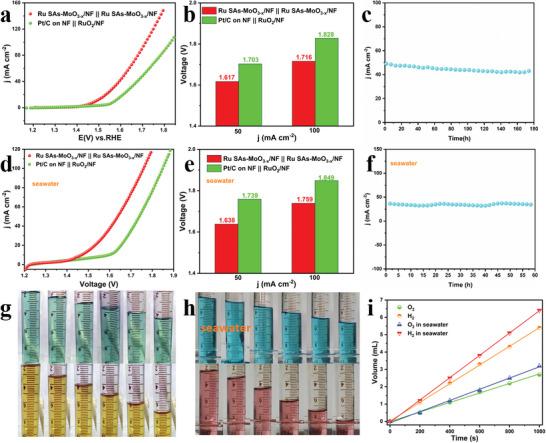
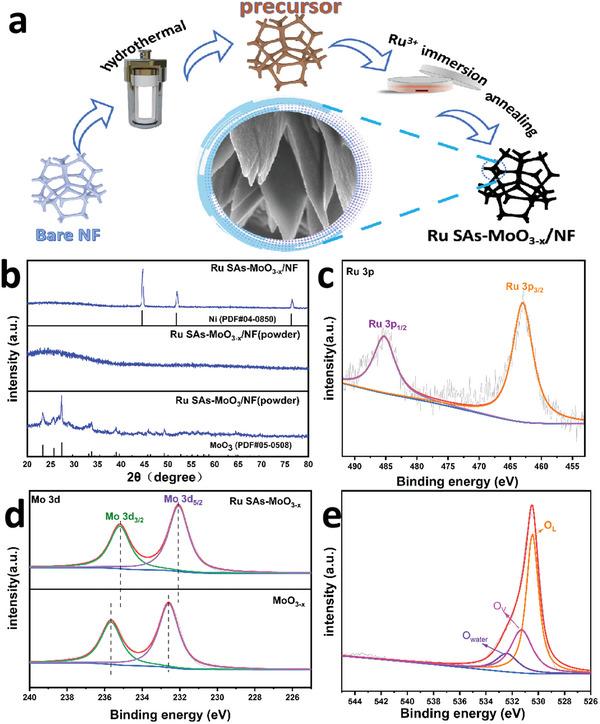
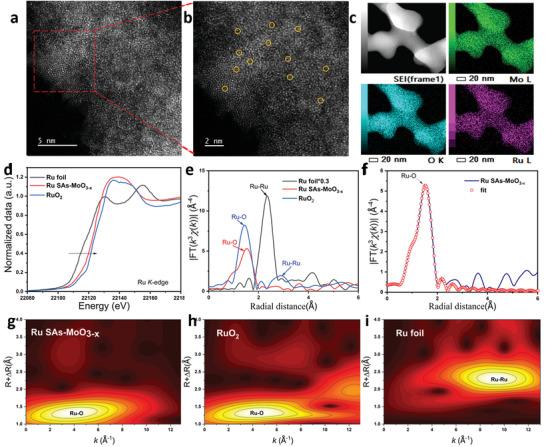
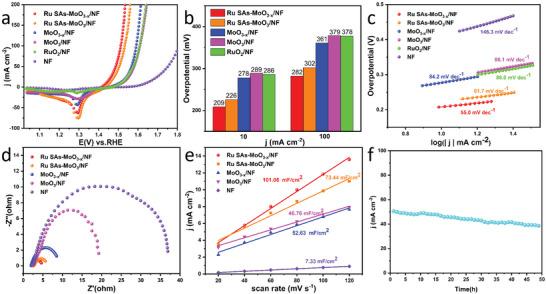
Benefitting from the maximum atom utilization efficiency, special size quantum effects and tailored active sites, single-atom catalysts (SACs) have been promising candidates for bifunctional catalysts toward water splitting. Besides, due to the unique structure and properties, some amorphous materials have been found to possess better performance than their crystalline counterparts in electrocatalytic water splitting. Herein, by combining the advantages of ruthenium (Ru) single atoms and amorphous substrates, amorphous molybdenum-based oxide stabilized single-atomic-site Ru (Ru SAs-MoO /NF) catalysts are conceived as a self-supported electrode. By virtue of the large surface area, enhanced intrinsic activity and fast reaction kinetics, the as-prepared Ru SAs-MoO /NF electrode effectively drives both oxygen evolution reaction (209 mV @ 10 mA cm ) and hydrogen evolution reaction (36 mV @ 10 mA cm ) in alkaline media. Impressively, the assembled electrolyzer merely requires an ultralow cell voltage of 1.487 V to deliver the current density of 10 mA cm . Furthermore, such an electrode also exhibits a great application potential in alkaline seawater electrolysis, achieving a current density of 100 mA cm at a low cell voltage of 1.759 V. In addition, Ru SAs-MoO /NF only has very small current density decay in the long-term constant current water splitting test.
得益于最高的原子利用率、特殊的尺寸量子效应和定制的活性位,单原子催化剂 (SACs) 已成为双功能催化剂用于水分解的有前途的候选者。此外,由于独特的结构和性质,一些无定形材料在电催化水分解中被发现比其晶态对应物具有更好的性能。在此,通过结合钌 (Ru) 单原子和无定形基底的优势,设计了一种无定形钼基氧化物稳定的单原子位 Ru (Ru SAs-MoO /NF) 催化剂作为自支撑电极。由于具有大的比表面积、增强的本征活性和快速的反应动力学,所制备的 Ru SAs-MoO /NF 电极有效地驱动了碱性介质中的析氧反应 (209 mV@10 mA cm ) 和析氢反应 (36 mV@10 mA cm )。令人印象深刻的是,组装的电解槽仅需要 1.487 V 的超低电池电压即可提供 10 mA cm 的电流密度。此外,该电极在碱性海水电解中也表现出很大的应用潜力,在 1.759 V 的低电池电压下可实现 100 mA cm 的电流密度。此外,在长期恒流水电解测试中,Ru SAs-MoO /NF 的电流密度衰减非常小。


 Zotero 插件