
探讨改善急性医疗到初级保健界面的骨质疏松症护理的障碍和机会:一项定性研究。
Exploring barriers and opportunities to improve osteoporosis care across the acute-to-primary care interface: a qualitative study.
机构信息
The Garvan Institute of Medical Research, 384 Victoria St, NSW, Darlinghurst, Australia.
St George and Sutherland Clinical School, UNSW Medicine, Sydney, Australia.
出版信息
Osteoporos Int. 2023 Jul;34(7):1249-1262. doi: 10.1007/s00198-023-06748-0. Epub 2023 Apr 24.
UNLABELLED
This qualitative study interviewed general practitioners, patients, and FLS clinicians and identified key challenges facing stakeholders seeking to improve post-fracture osteoporosis care. Local policies and care pathways as an initial strategy may address information and service delivery issues across the acute-primary care divide.
INTRODUCTION
Fracture liaison services (FLS) can be effective for secondary fracture prevention, but long-term adherence to therapies remains suboptimal. Few studies have explored how services manage the transition between tertiary and primary post-fracture care. This study mapped service processes and factors influencing integration of post-clinic care, identifying barriers, supports, and opportunities for seamless healthcare.
METHODS
Qualitative descriptive study using semi-structured interviews with FLS stakeholders at two metropolitan hospitals in New South Wales (NSW) and surrounding general practices.
RESULTS
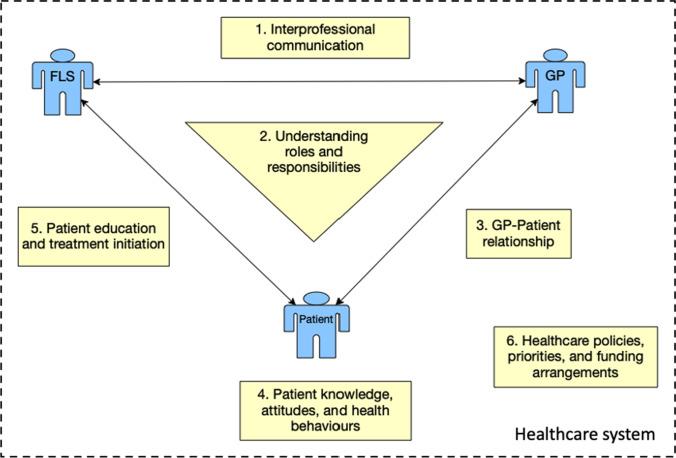
Seven FLS clinicians, 11 general practitioners (GPs), and seven patients were interviewed. Six key themes emerged on the transition of patient care from tertiary to primary care (PC). Interprofessional communication issues and role ambiguity posed threats to seamless care. Delayed, absent, inaccessible, or poor-quality communication frustrated GPs, while FLS clinicians lacked confidence in existing communication systems and desired bidirectional communication with PC. GPs were confident managing osteoporosis, but FLS clinicians had limited confidence that patients would discuss osteoporosis with their GP and that GPs would action recommendations. Effective PC follow-up required a positive GP-patient relationship and that patients perceived a need to engage with PC. Patient understanding of osteoporosis (influenced by patient education, knowledge, beliefs, and health behaviours) affected PC attendance. Limited public awareness of osteoporosis and healthcare policy deficits contributed to care gaps.
CONCLUSION
Key challenges were identified facing stakeholders seeking to improving post-clinic osteoporosis care. Development and implementation of local, integrated acute-community policies and care pathways as an initial intervention may address information and service delivery issues across the acute-PC divide.
未加标签
本定性研究采访了全科医生、患者和 FLS 临床医生,确定了利益相关者在寻求改善骨折后骨质疏松症护理方面面临的主要挑战。作为初始策略的地方政策和护理途径可能会解决急性-初级保健鸿沟中存在的信息和服务提供问题。
引言
骨折联络服务 (FLS) 可以有效地预防继发性骨折,但长期坚持治疗仍不理想。很少有研究探讨服务如何管理三级和初级骨折后护理之间的过渡。本研究绘制了服务流程,并确定了影响门诊后护理整合的因素,确定了障碍、支持和实现无缝医疗保健的机会。
方法
在新南威尔士州 (NSW) 两家大都市医院和周围的普通诊所对 FLS 利益相关者进行了定性描述性研究,使用半结构化访谈。
结果
采访了 7 名 FLS 临床医生、11 名全科医生 (GP) 和 7 名患者。在从三级护理向初级护理 (PC) 过渡的过程中出现了 6 个关键主题。跨专业沟通问题和角色模糊对无缝护理构成威胁。沟通延迟、缺失、无法访问或质量差使全科医生感到沮丧,而 FLS 临床医生对现有沟通系统缺乏信心,并希望与 PC 进行双向沟通。全科医生对管理骨质疏松症有信心,但 FLS 临床医生对患者会与全科医生讨论骨质疏松症以及全科医生会采取建议的信心有限。有效的 PC 随访需要良好的 GP-患者关系,并且患者认为需要与 PC 互动。患者对骨质疏松症的理解(受患者教育、知识、信仰和健康行为的影响)影响了 PC 的就诊率。公众对骨质疏松症的认识有限和医疗保健政策不足导致了护理差距。
结论
确定了利益相关者在寻求改善门诊后骨质疏松症护理方面面临的主要挑战。作为初始干预措施,制定和实施地方、综合的急性-社区政策和护理途径可能会解决急性-PC 鸿沟中的信息和服务提供问题。
 Zotero 插件