
鉴定出具有潜在毒性的 M1 型及其相关亚系。
Characterization of emergent toxigenic M1 and associated sublineages.
机构信息
Department of Infectious Disease, Imperial College London, London, UK.
MRC Centre for Molecular Bacteriology & Infection (CMBI), Imperial College London, London, UK.
出版信息
Microb Genom. 2023 Apr;9(4). doi: 10.1099/mgen.0.000994.
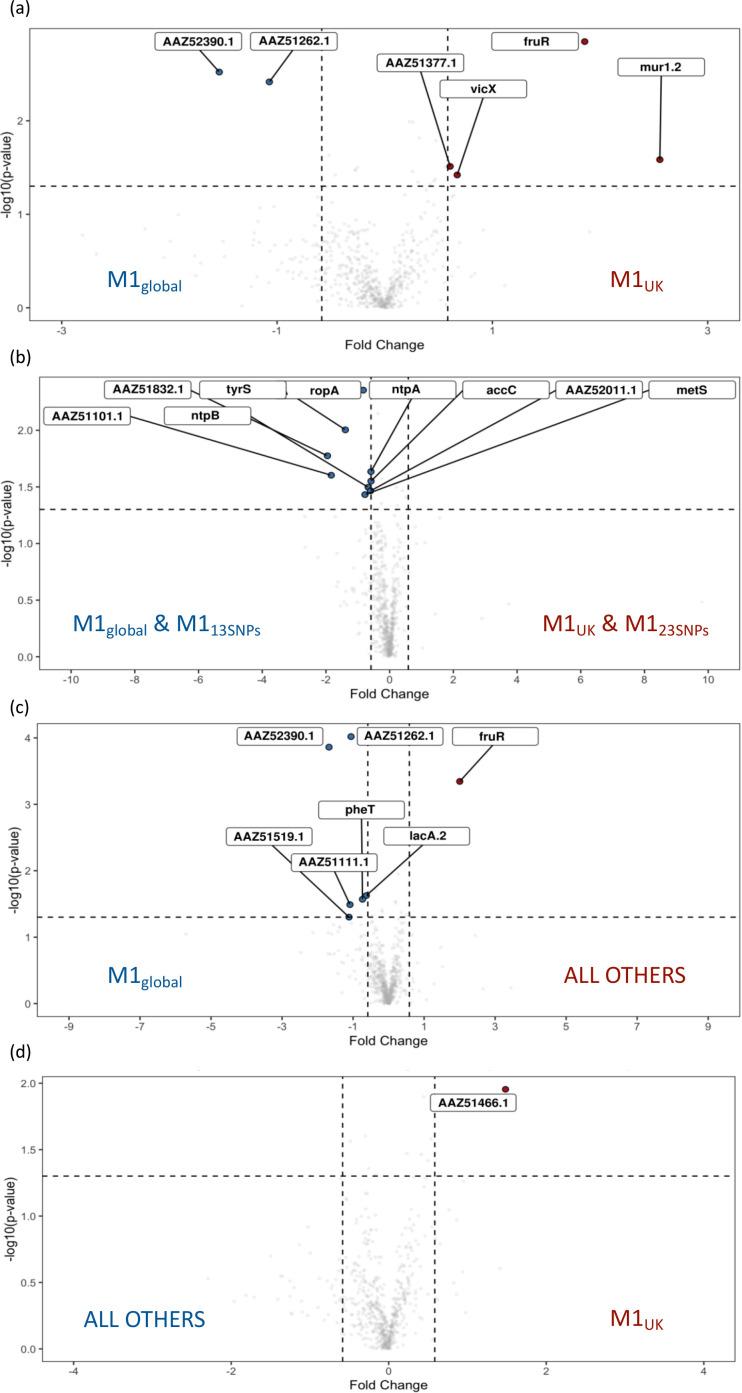
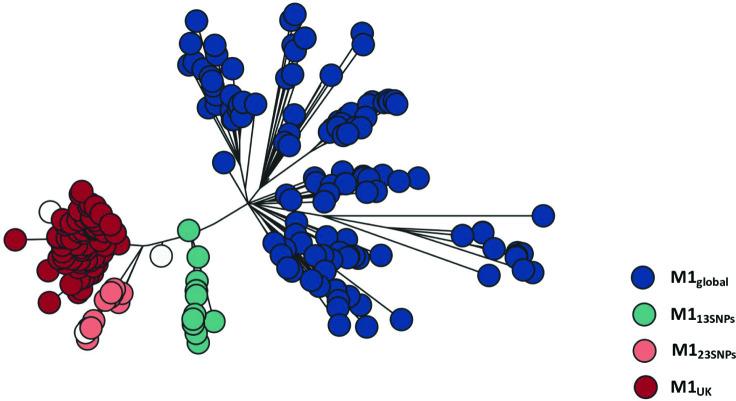
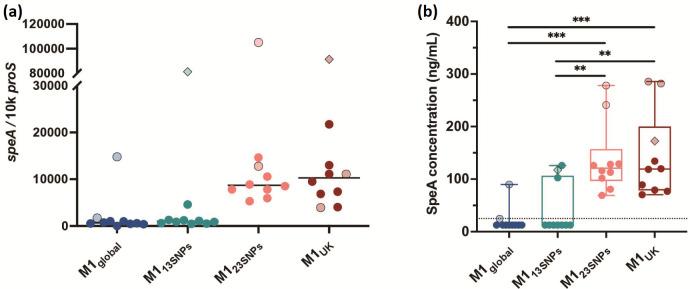
genotype 1 is a successful, globally distributed epidemic clone that is regarded as inherently virulent. An 1 sublineage, M1, that produces increased levels of SpeA toxin was associated with increased scarlet fever and invasive infections in England in 2015/2016. Defined by 27 SNPs in the core genome, M1 is now dominant in England. To more fully characterize M1, we undertook comparative transcriptomic and proteomic analyses of M1 and contemporary non-M1 1 strains (M1). Just seven genes were differentially expressed by M1 compared with contemporary M1 strains. In addition to , five genes in the operon that includes glycerol dehydrogenase were upregulated in M1 (, and phosphotransferase system IIC and IIB components), while aquaporin () was downregulated. M1 strains have a stop codon in . Deletion of in M1 abrogated glycerol dehydrogenase activity, and recapitulated upregulation of gene expression within the operon that includes , consistent with a feedback effect. Phylogenetic analysis identified two intermediate 1 sublineages in England comprising 13/27 (M1) and 23/27 SNPs (M1), respectively, that had failed to expand in the population. Proteomic analysis of invasive strains from the four phylogenetic 1 groups highlighted sublineage-specific changes in carbohydrate metabolism, protein synthesis and protein processing; upregulation of SpeA was not observed in chemically defined medium. In rich broth, however, expression of SpeA was upregulated ~10-fold in both M1 and M1 sublineages, compared with M1 and M1. We conclude that stepwise accumulation of SNPs led to the emergence of M1. While increased expression of SpeA is a key indicator of M1 and undoubtedly important, M1 strains have outcompeted M1 and other types that produce similar or more superantigen toxin. We speculate that an accumulation of adaptive SNPs has contributed to a wider fitness advantage in M1 on an inherently successful 1 streptococcal background.
基因型 1 是一种成功的、在全球范围内传播的流行克隆,被认为具有内在的毒力。一个亚谱系 M1,产生更高水平的 SpeA 毒素,与 2015/2016 年在英国猩红热和侵袭性感染的增加有关。M1 由核心基因组中的 27 个 SNP 定义,现在在英国占主导地位。为了更全面地描述 M1,我们对 M1 和当代非 M1 1 株(M1)进行了比较转录组学和蛋白质组学分析。与当代 M1 株相比,M1 仅有 7 个基因差异表达。除了,甘油脱氢酶操纵子中的 5 个基因上调(和磷酸转移酶系统 IIC 和 IIB 成分),而水通道蛋白()下调。M1 株在 中具有一个终止密码子。在 M1 中缺失 导致甘油脱氢酶活性丧失,并使操纵子内的基因表达重编程,包括 和磷酸转移酶系统 IIC 和 IIB 成分,这与反馈效应一致。系统发育分析鉴定出英国的两个中间 1 亚谱系,分别包含 13/27(M1)和 23/27 SNPs(M1),但在人群中未能扩增。来自四个系统发育 1 组的侵袭性菌株的蛋白质组分析突出了碳水化合物代谢、蛋白质合成和蛋白质加工的亚谱系特异性变化;在化学定义的培养基中未观察到 SpeA 的上调。然而,在丰富的肉汤中,M1 和 M1 亚谱系中 SpeA 的表达分别上调了约 10 倍,而 M1 和 M1 则没有。我们得出结论,SNP 的逐步积累导致了 M1 的出现。虽然 SpeA 的表达增加是 M1 的一个关键指标,无疑很重要,但 M1 株已经击败了 M1 和其他产生类似或更多超抗原毒素的 1 型菌株。我们推测,适应性 SNP 的积累有助于 M1 在具有内在成功的 1 链球菌背景下具有更广泛的适应性优势。



 Zotero 插件