
基于日本 2016-2017 年国家癌症登记处的皮肤癌流行病学。
Epidemiology of skin cancer based on Japan's National Cancer Registry 2016-2017.
机构信息
Department of Dermatologic Oncology, National Cancer Center Hospital, Tokyo, Japan.
Division of Supportive Care, Survivorship and Translational Research, National Cancer Center Institute for Cancer Control, Tokyo, Japan.
出版信息
Cancer Sci. 2023 Jul;114(7):2986-2992. doi: 10.1111/cas.15823. Epub 2023 Apr 24.
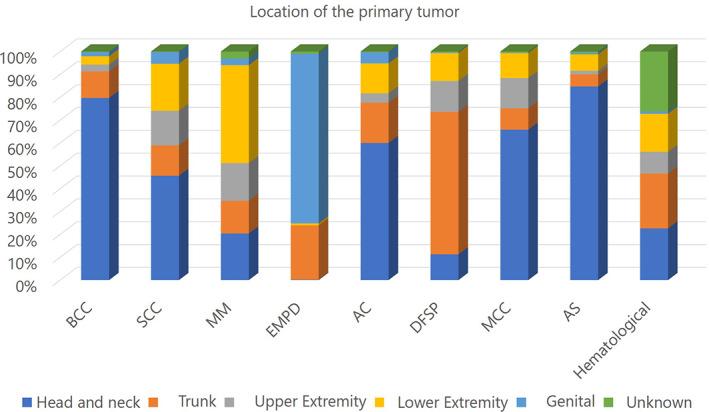
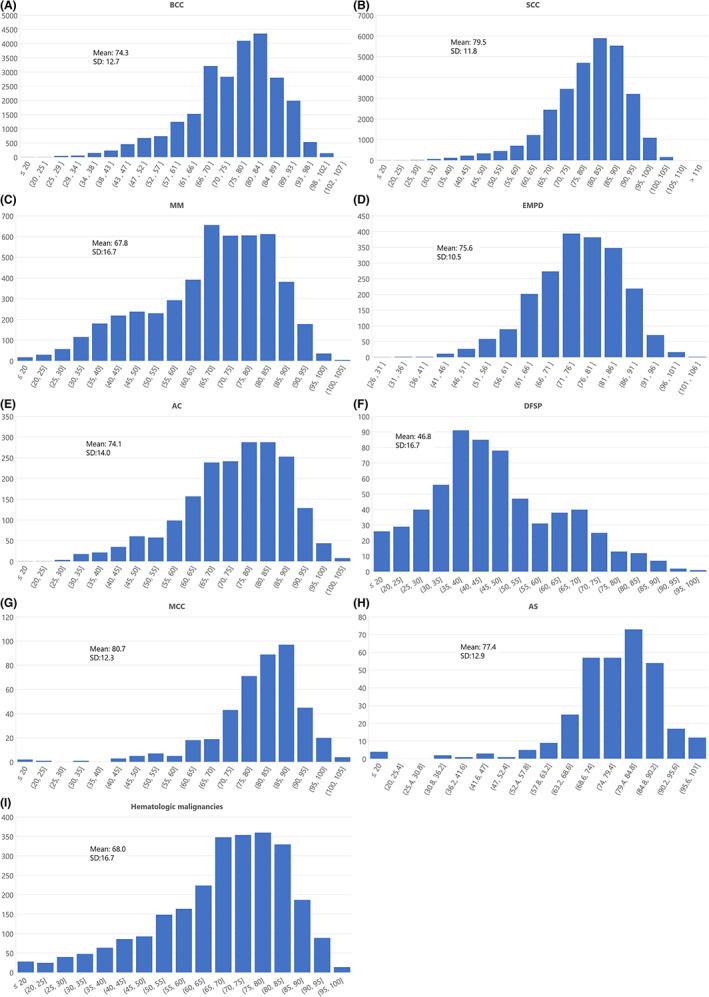
Skin cancer is most frequently diagnosed in the White population. However, its subtypes and epidemiology in Japan are understudied. We aimed to elucidate skin cancer incidence in Japan based on the National Cancer Registry, a new nationwide integrated population-based registry. Data from patients diagnosed with skin cancer in 2016 and 2017 were extracted and classified by cancer subtypes. Data were analyzed using the World Health Organization and General Rules tumor classifications. Tumor incidence was calculated as the number of new cases divided by the corresponding total person-years. Overall, 67,867 patients with skin cancer were included. The percentage of each subtype was as follows: basal cell carcinoma, 37.2%; squamous cell carcinoma, 43.9% (18.3% of which, in situ); malignant melanoma, 7.2% (22.1% of which, in situ); extramammary Paget's disease, 3.1% (24.9% of which, in situ); adnexal carcinoma, 2.9%; dermatofibrosarcoma protuberans, 0.9%; Merkel cell carcinoma, 0.6%; angiosarcoma, 0.5%; and hematologic malignancies, 3.8%. The overall age-adjusted incidence of skin cancer was 27.89 for the Japanese population model and 9.28 for the World Health Organization (WHO) model. The incidences of basal cell carcinoma and squamous cell carcinoma were the highest (3.63 and 3.40 per 100,000 persons, respectively, in the WHO model) among skin cancers, whereas the incidences of angiosarcoma and Merkel cell carcinoma were the lowest (0.026 and 0.038 per 100,000 persons, respectively, in the WHO model). This is the first report to provide comprehensive information on the epidemiological status of skin cancers in Japan using population-based NCR data.
皮肤癌最常被诊断为白人。然而,其亚型和日本的流行病学研究较少。我们旨在根据新的全国综合人群登记处国家癌症登记处,阐明日本的皮肤癌发病率。从 2016 年和 2017 年诊断为皮肤癌的患者中提取数据,并按癌症亚型进行分类。使用世界卫生组织和一般规则肿瘤分类分析数据。肿瘤发病率计算为新病例数除以相应的总人年数。共有 67867 例皮肤癌患者。各亚型的比例如下:基底细胞癌,37.2%;鳞状细胞癌,43.9%(其中原位癌为 18.3%);恶性黑色素瘤,7.2%(其中原位癌为 22.1%);乳房外 Pagets 病,3.1%(其中原位癌为 24.9%);附属器癌,2.9%;隆凸性皮肤纤维肉瘤,0.9%;Merkel 细胞癌,0.6%;血管肉瘤,0.5%;和血液恶性肿瘤,3.8%。按年龄调整的皮肤癌总体发病率为日本人群模型 27.89,世界卫生组织(WHO)模型 9.28。基底细胞癌和鳞状细胞癌的发病率最高(在 WHO 模型中分别为每 10 万人 3.63 和 3.40),而血管肉瘤和 Merkel 细胞癌的发病率最低(在 WHO 模型中分别为每 10 万人 0.026 和 0.038)。这是首次使用基于人群的 NCR 数据报告日本皮肤癌流行病学状况的综合信息。

 Zotero 插件