
利用接受和使用技术的统一理论(UTAUT)和电子健康素养(e-HL)来调查中国非吸烟大学生的控烟意愿和行为:一项横断面调查。
Using the Unified Theory of Acceptance and Use of Technology (UTAUT) and e-health literacy(e-HL) to investigate the tobacco control intentions and behaviors of non-smoking college students in China: a cross-sectional investigation.
机构信息
School of Public Health, Shandong University, Jinan, 250012, China.
School of Media and Communication, Shanghai Jiaotong University, Shanghai, 201100, China.
出版信息
BMC Public Health. 2023 Apr 25;23(1):765. doi: 10.1186/s12889-023-15644-5.
BACKGROUND
Non-smoking college students are starting to smoke in increasing numbers, which shows that their tobacco control situation seems not optimistic. The UTAUT and e-HL are commonly used models and theories to predict health behaviors, while there are few studies on tobacco control. This paper aims to study the influencing factors of tobacco control intention and behavior of non-smoking college students in China by combining the UTAUT and e-HL.
METHODS
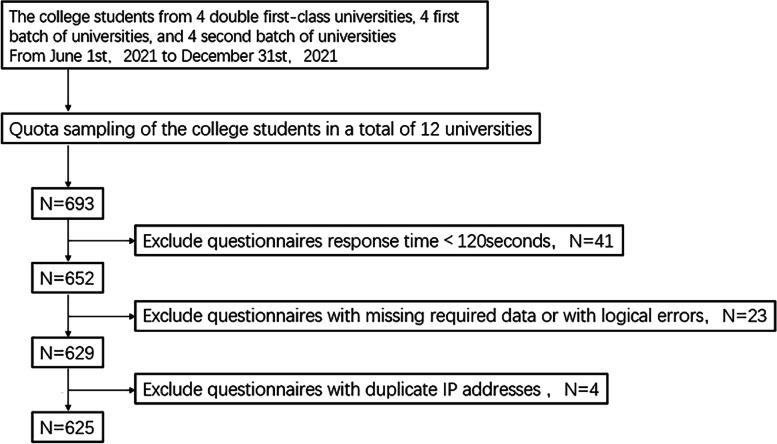
Based on the stratified sampling method, 625 college students from 12 universities were selected. Data were collected using a self-made questionnaire designed based on the UTAUT and e-health literacy scales. Data were analyzed by SPSS 22 and AMOS 26, including descriptive statistics, one-way variance analysis and structural equation model analysis.
RESULTS
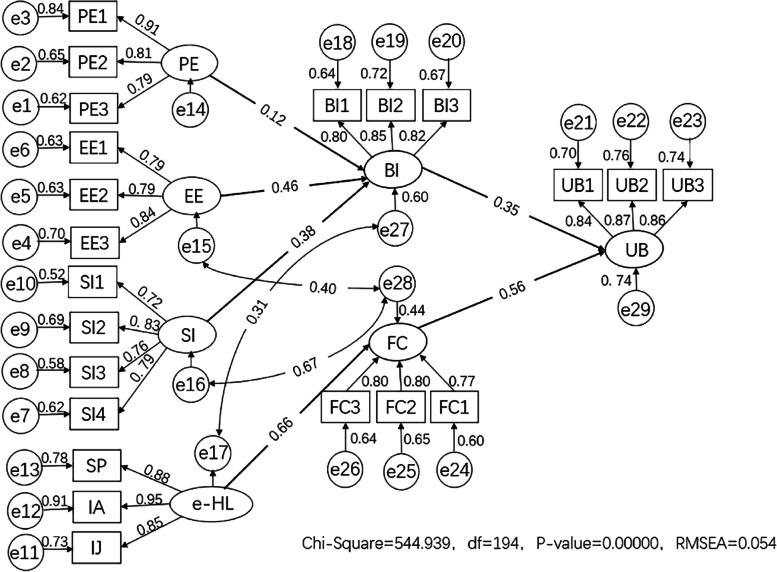
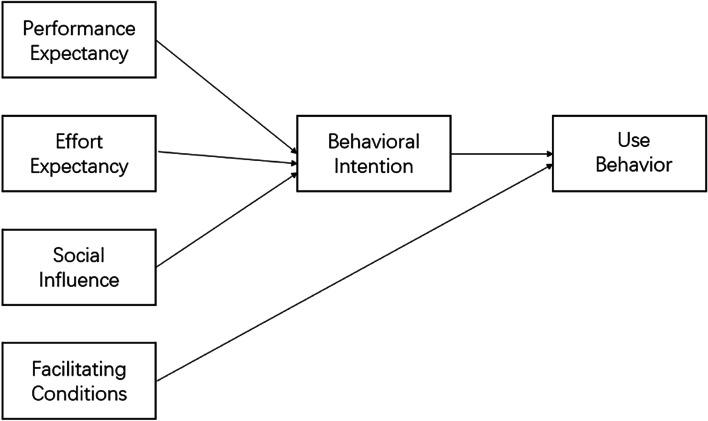
The results of one-way variance analysis showed that there were significant differences in the score of non-smoking college students' tobacco control intention or behavior by hometowns, monthly living expenses, and parents' smoking history. Performance expectancy, effort expectancy, social influence had direct positive effects on behavioral intention. Facilitating condition, behavioral intention had direct positive impacts on use behavior and e-HL had an indirect positive impact on use behavior.
CONCLUSIONS
The combination of the UTAUT and e-HL can be used as an appropriate framework to predict the influencing factors of non-smoking college students' intention and behavior of tobacco control. Improving performance expectancy, effort expectancy, and e-HL among non-smoking college students, creating positive social environments, and providing facilitating condition are key aspects of increasing their tobacco control intention and behavior. It is also beneficial to promote the implementation of smoke-free campus and smoke-free family projects.
背景
越来越多的不吸烟大学生开始吸烟,这表明他们的控烟情况似乎不容乐观。UTAUT 和 e-HL 是常用的预测健康行为的模型和理论,但针对控烟的研究较少。本研究旨在结合 UTAUT 和 e-HL 模型,探讨我国不吸烟大学生控烟意愿和行为的影响因素。
方法
采用分层抽样的方法,选取全国 12 所高校的 625 名大学生作为研究对象。基于 UTAUT 和 e 健康素养量表设计自填式问卷收集数据,采用 SPSS 22 和 AMOS 26 进行数据分析,包括描述性统计分析、单因素方差分析和结构方程模型分析。
结果
单因素方差分析结果显示,不吸烟大学生的控烟意愿或行为得分在生源地、月生活费和父母吸烟史方面存在显著差异。绩效期望、努力期望、社会影响对行为意愿有直接正向影响,促进条件、行为意愿对使用行为有直接正向影响,e-HL 对使用行为有间接正向影响。
结论
UTAUT 和 e-HL 的结合可以作为预测不吸烟大学生控烟意愿和行为的适当框架。提高不吸烟大学生的绩效期望、努力期望和 e-HL,营造积极的社会环境,提供促进条件,是增强其控烟意愿和行为的关键方面,有利于推动无烟校园和无烟家庭项目的实施。

 Zotero 插件