
小麦秆锈病隐性抗性基因 SrTm4 的高分辨率图谱定位
High-resolution mapping of SrTm4, a recessive resistance gene to wheat stem rust.
机构信息
National Key Laboratory of Wheat Improvement, Peking University Institute of Advanced Agricultural Sciences, Shandong Laboratory of Advanced Agriculture Sciences in Weifang, Weifang, 261325, Shandong, China.
Department of Plant Sciences, University of California, Davis, CA95616, USA.
出版信息
Theor Appl Genet. 2023 Apr 27;136(5):120. doi: 10.1007/s00122-023-04369-z.
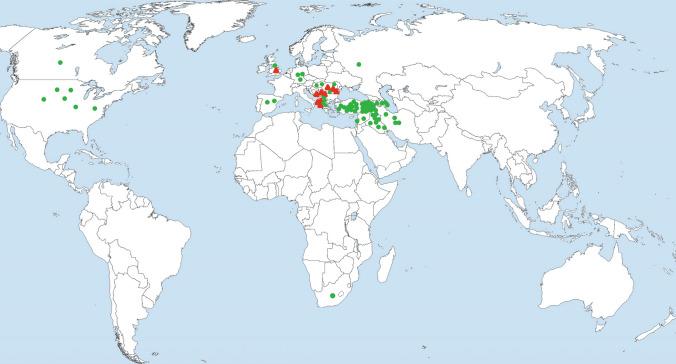
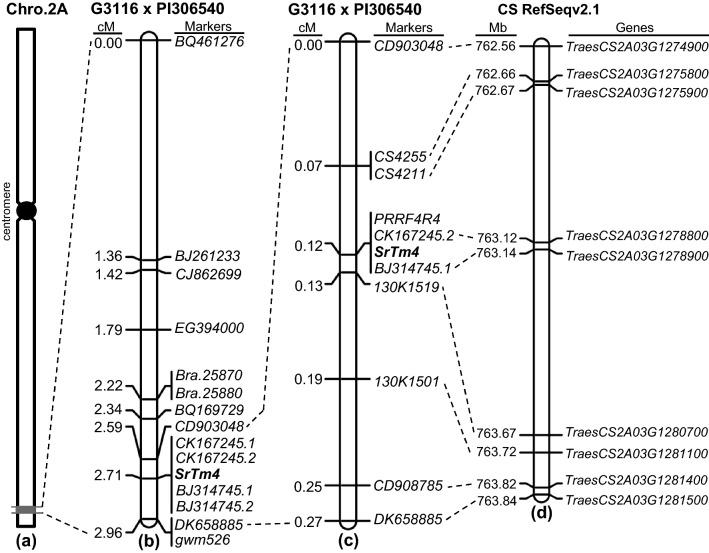
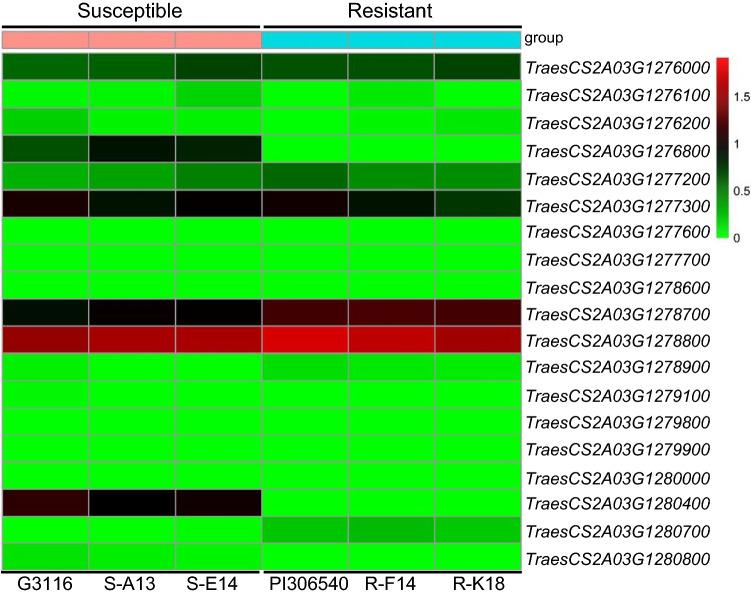
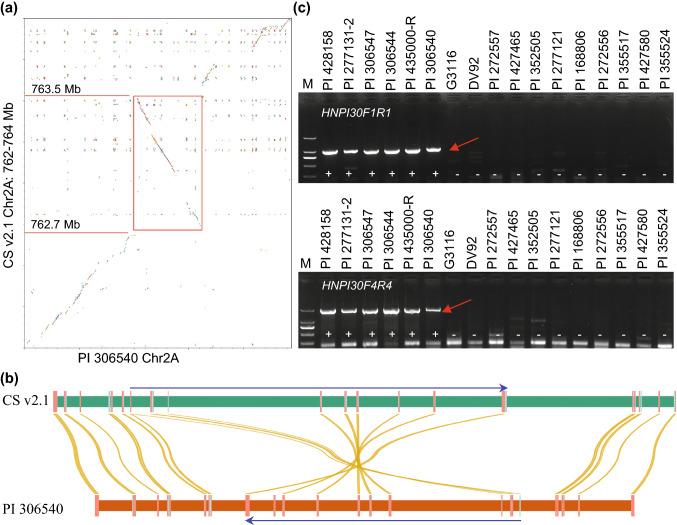
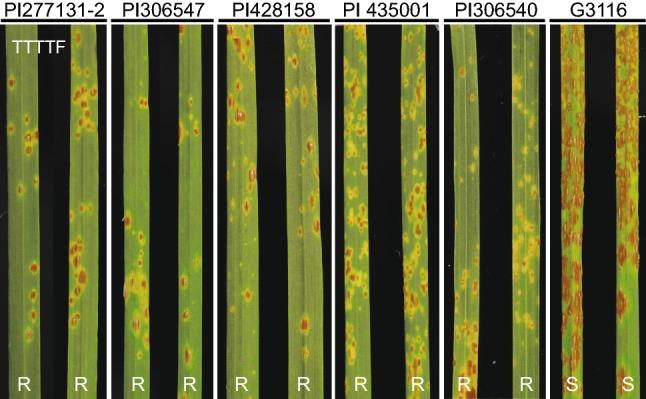
The diploid wheat recessive stem rust resistance gene SrTm4 was fine-mapped to a 754-kb region on chromosome arm 2AL and potential candidate genes were identified. Race Ug99 of Puccinia graminis f. sp. tritici (Pgt), the causal agent of wheat stem (or black) rust is one of the most serious threats to global wheat production. The identification, mapping, and deployment of effective stem rust resistance (Sr) genes are critical to reduce this threat. In this study, we generated SrTm4 monogenic lines and found that this gene confers resistance to North American and Chinese Pgt races. Using a large mapping population (9522 gametes), we mapped SrTm4 within a 0.06 cM interval flanked by marker loci CS4211 and 130K1519, which corresponds to a 1.0-Mb region in the Chinese Spring reference genome v2.1. A physical map of the SrTm4 region was constructed with 11 overlapping BACs from the resistant Triticum monococcum PI 306540. Comparison of the 754-kb physical map with the genomic sequence of Chinese Spring and a discontinuous BAC sequence of DV92 revealed a 593-kb chromosomal inversion in PI 306540. Within the candidate region, we identified an L-type lectin-domain containing receptor kinase (LLK1), which was disrupted by the proximal inversion breakpoint, as a potential candidate gene. Two diagnostic dominant markers were developed to detect the inversion breakpoints. In a survey of T. monococcum accessions, we identified 10 domesticated T. monococcum subsp. monococcum genotypes, mainly from the Balkans, carrying the inversion and showing similar mesothetic resistant infection types against Pgt races. The high-density map and tightly linked molecular markers developed in this study are useful tools to accelerate the deployment of SrTm4-mediated resistance in wheat breeding programs.
二倍体小麦隐性抗秆锈病基因 SrTm4 被精细定位到 2AL 染色体臂上的 754-kb 区域,并鉴定出潜在的候选基因。小麦秆锈病(或黑锈病)的致病菌 Puccinia graminis f. sp. tritici (Pgt)的 Ug99 是全球小麦生产的最严重威胁之一。鉴定、定位和部署有效的秆锈病抗性(Sr)基因对于降低这种威胁至关重要。在本研究中,我们生成了 SrTm4 单基因系,发现该基因赋予了对北美和中国 Pgt 菌株的抗性。利用一个大型的作图群体(9522 个配子),我们将 SrTm4 定位在标记 CS4211 和 130K1519 之间的 0.06cM 区间内,该区间对应于中国春参考基因组 v2.1 中的 1.0-Mb 区域。利用来自抗源 Triticum monococcum PI 306540 的 11 个重叠 BAC 构建了 SrTm4 区域的物理图谱。将 754-kb 物理图谱与中国春基因组序列和 DV92 的不连续 BAC 序列进行比较,发现 PI 306540 中存在一个 593-kb 的染色体倒位。在候选区域内,我们鉴定出一个 L 型 lectin-domain 受体激酶(LLK1),该基因被近端倒位断点破坏,是一个潜在的候选基因。开发了两个用于检测倒位断点的显性标记。在对 T. monococcum 材料的调查中,我们鉴定出 10 个来自巴尔干半岛的驯化 T. monococcum 亚种 monococcum 基因型携带该倒位,并对 Pgt 菌株表现出相似的中间抗病感染类型。本研究中开发的高密度图谱和紧密连锁的分子标记是加速小麦育种计划中 SrTm4 介导的抗性部署的有用工具。

 Zotero 插件