
血清肌联蛋白水平在患有代谢综合征的成年人中较低,并且与安卓型体脂肪量呈负相关。
Serum Levels of Myonectin Are Lower in Adults with Metabolic Syndrome and Are Negatively Correlated with Android Fat Mass.
机构信息
Physiology and Biochemistry Research Group-PHYSIS, Faculty of Medicine, University of Antioquia, Medellín 050010, Colombia.
Research Group in Physical Activity, Sports and Health Sciences-GICAFS, Universidad de Córdoba, Montería 230002, Colombia.
出版信息
Int J Mol Sci. 2023 Apr 7;24(8):6874. doi: 10.3390/ijms24086874.
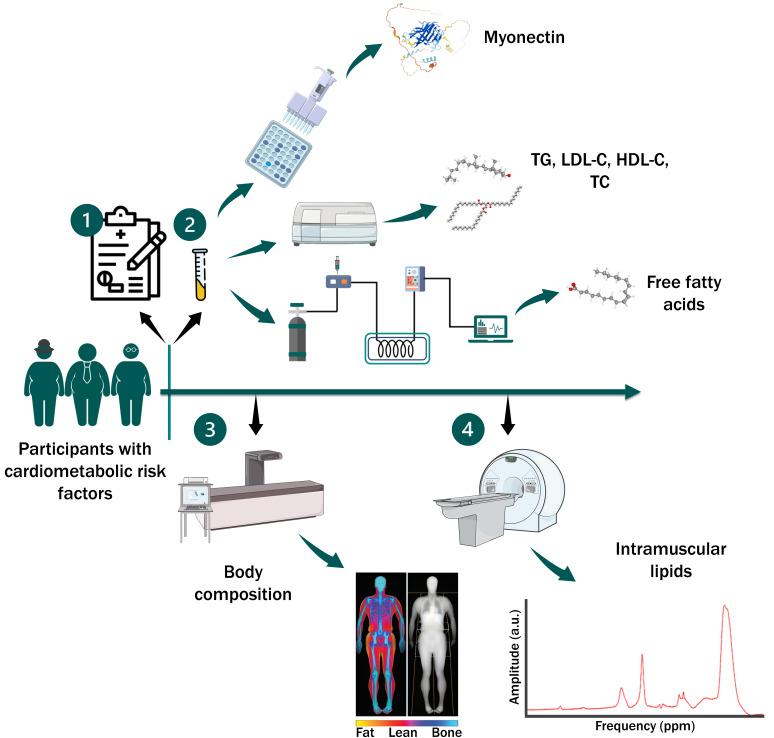
Myonectin has shown beneficial effects on lipid regulation in murine models; therefore, it may have implications in the pathophysiology of metabolic syndrome (MS). We evaluated the relationship between serum myonectin and serum lipids, global and regional fat mass, intramuscular lipid content, and insulin resistance (IR) in adults with metabolic risk factors. This was a cross-sectional study in sedentary adults who were diagnosed with MS or without MS (NMS). Serum myonectin was quantified by enzyme-linked immunosorbent assay, lipid profile by conventional techniques, and free fatty acids (FFA) by gas chromatography. Body composition was assessed by dual-energy X-ray absorptiometry and intramuscular lipid content through proton nuclear magnetic resonance spectroscopy in the right vastus lateralis muscle. IR was estimated with the homeostatic model assessment (HOMA-IR). The MS ( = 61) and NMS ( = 29) groups were comparable in age (median (interquartile range): 51.0 (46.0-56.0) vs. 53.0 (45.5-57.5) years, > 0.05) and sex (70.5% men vs. 72.4% women). MS subjects had lower serum levels of myonectin than NMS subjects (1.08 (0.87-1.35) vs. 1.09 (0.93-4.05) ng·mL, < 0.05). Multiple linear regression models adjusted for age, sex, fat mass index and lean mass index showed that serum myonectin was negatively correlated with the android/gynoid fat mass ratio (R = 0.48, < 0.01), but not with the lipid profile, FFA, intramuscular lipid content or HOMA-IR. In conclusion, serum myonectin is lower in subjects with MS. Myonectin negatively correlates with a component relevant to the pathophysiology of MS, such as the android/gynoid fat mass ratio, but not with other components such as FFA, intramuscular fat or IR.
肌联蛋白在调节血脂方面对鼠类模型有积极作用,因此可能对代谢综合征(MS)的病理生理学有影响。我们评估了具有代谢风险因素的成年人中血清肌联蛋白与血清脂质、全身和局部脂肪量、肌内脂质含量和胰岛素抵抗(IR)之间的关系。这是一项横断面研究,对象为久坐的成年人,他们被诊断为代谢综合征(MS)或非代谢综合征(NMS)。血清肌联蛋白通过酶联免疫吸附测定法定量,脂质谱通过常规技术,游离脂肪酸(FFA)通过气相色谱法。身体成分通过双能 X 射线吸收法评估,右股外侧肌的肌内脂质含量通过质子磁共振波谱法评估。IR 用稳态模型评估(HOMA-IR)来估计。MS(n = 61)和 NMS(n = 29)组在年龄(中位数(四分位数范围):51.0(46.0-56.0)与 53.0(45.5-57.5)岁,> 0.05)和性别(70.5%男性与 72.4%女性)方面无差异。MS 组的血清肌联蛋白水平低于 NMS 组(1.08(0.87-1.35)与 1.09(0.93-4.05)ng·mL,< 0.05)。调整年龄、性别、脂肪量指数和瘦体量指数的多元线性回归模型显示,血清肌联蛋白与安卓/女性脂肪量比呈负相关(R = 0.48,< 0.01),但与脂质谱、FFA、肌内脂肪量或 HOMA-IR 无关。综上所述,MS 患者的血清肌联蛋白水平较低。肌联蛋白与与 MS 病理生理学相关的成分呈负相关,如安卓/女性脂肪量比,但与其他成分如 FFA、肌内脂肪或 IR 无关。

 Zotero 插件