
钪-44:肿瘤相关血管生成中的诊断可行性。
Scandium-44: Diagnostic Feasibility in Tumor-Related Angiogenesis.
机构信息
Division of Nuclear Medicine and Translational Imaging, Department of Medical Imaging, Faculty of Medicine, University of Debrecen, Nagyerdei St. 98, H-4032 Debrecen, Hungary.
出版信息
Int J Mol Sci. 2023 Apr 17;24(8):7400. doi: 10.3390/ijms24087400.
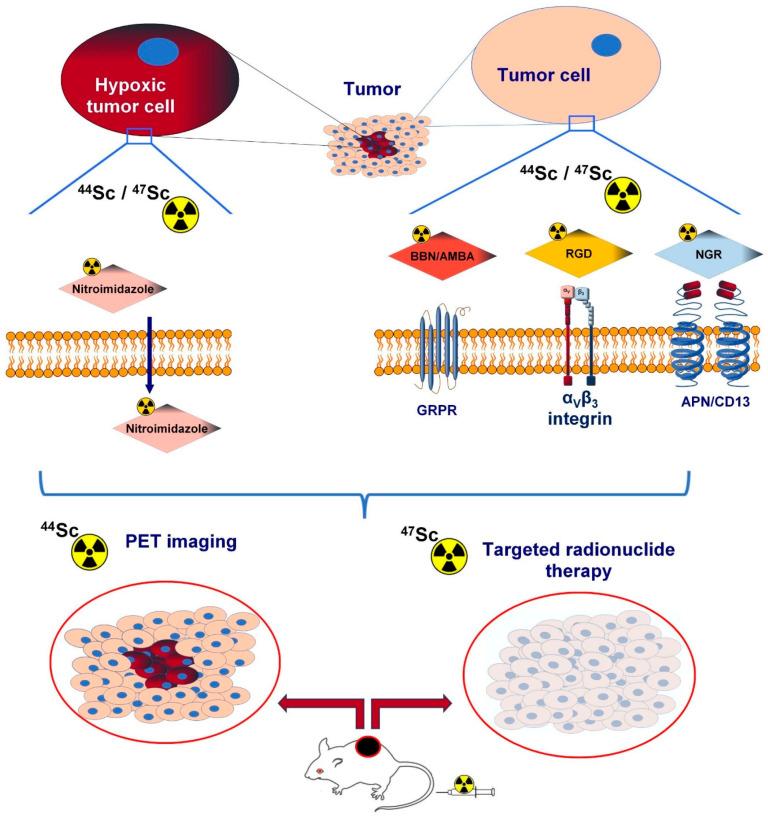
Angiogenesis-related cell-surface molecules, including integrins, aminopeptidase N, vascular endothelial growth factor, and gastrin-releasing peptide receptor (GRPR), play a crucial role in tumour formation. Radiolabelled imaging probes targeting angiogenic biomarkers serve as valuable vectors in tumour identification. Nowadays, there is a growing interest in novel radionuclides other than gallium-68 (Ga) or copper-64 (Cu) to establish selective radiotracers for the imaging of tumour-associated neo-angiogenesis. Given its ideal decay characteristics (E: 632 KeV) and a half-life (T = 3.97 h) that is well matched to the pharmacokinetic profile of small molecules targeting angiogenesis, scandium-44 (Sc) has gained meaningful attention as a promising radiometal for positron emission tomography (PET) imaging. More recently, intensive research has been centered around the investigation of Sc-labelled angiogenesis-directed radiopharmaceuticals. Previous studies dealt with the evaluation of Sc-appended ab integrin-affine Arg-Gly-Asp (RGD) tripeptides, GRPR-selective aminobenzoyl-bombesin analogue (AMBA), and hypoxia-associated nitroimidazole derivatives in the identification of various cancers using experimental tumour models. Given the tumour-related hypoxia- and angiogenesis-targeting capability of these PET probes, Sc seems to be a strong competitor of the currently used positron emitters in radiotracer development. In this review, we summarize the preliminary preclinical achievements with Sc-labelled angiogenesis-specific molecular probes.
血管生成相关的细胞表面分子,包括整合素、氨肽酶 N、血管内皮生长因子和胃泌素释放肽受体(GRPR),在肿瘤形成中发挥着关键作用。针对血管生成生物标志物的放射性标记成像探针是肿瘤识别的有价值载体。如今,人们对除镓-68(Ga)或铜-64(Cu)以外的新型放射性核素越来越感兴趣,以建立用于肿瘤相关新生血管成像的选择性放射性示踪剂。鉴于其理想的衰变特性(E:632keV)和半衰期(T=3.97h)与针对血管生成的小分子的药代动力学特征非常匹配,钪-44(Sc)作为正电子发射断层扫描(PET)成像的有前途的放射性金属已引起人们的关注。最近,研究的重点集中在研究 Sc 标记的血管生成靶向放射性药物上。以前的研究涉及评估 Sc 缀合的 ab 整合素亲和 Arg-Gly-Asp(RGD)三肽、GRPR 选择性氨苯甲酰-bombesin 类似物(AMBA)和缺氧相关硝基咪唑衍生物在使用实验肿瘤模型识别各种癌症中的应用。鉴于这些 PET 探针具有与肿瘤相关的缺氧和血管生成靶向能力,Sc 似乎是放射性示踪剂开发中目前使用的正电子发射体的有力竞争者。在这篇综述中,我们总结了 Sc 标记的血管生成特异性分子探针的初步临床前成就。
 Zotero 插件