
预测肝细胞癌患者免疫检查点抑制剂治疗反应的生物标志物。
Predictive Biomarkers for Immune-Checkpoint Inhibitor Treatment Response in Patients with Hepatocellular Carcinoma.
机构信息
Division of Hematology and Oncology, Department of Internal Medicine, Samsung Changwon Hospital, Sungkyunkwan University School of Medicine, Changwon 51353, Republic of Korea.
Karsh Division of Gastroenterology and Hepatology, Comprehensive Transplant Center, Samuel Oschin Comprehensive Cancer Institute, Cedars-Sinai Medical Center, Los Angeles, CA 90048, USA.
出版信息
Int J Mol Sci. 2023 Apr 21;24(8):7640. doi: 10.3390/ijms24087640.
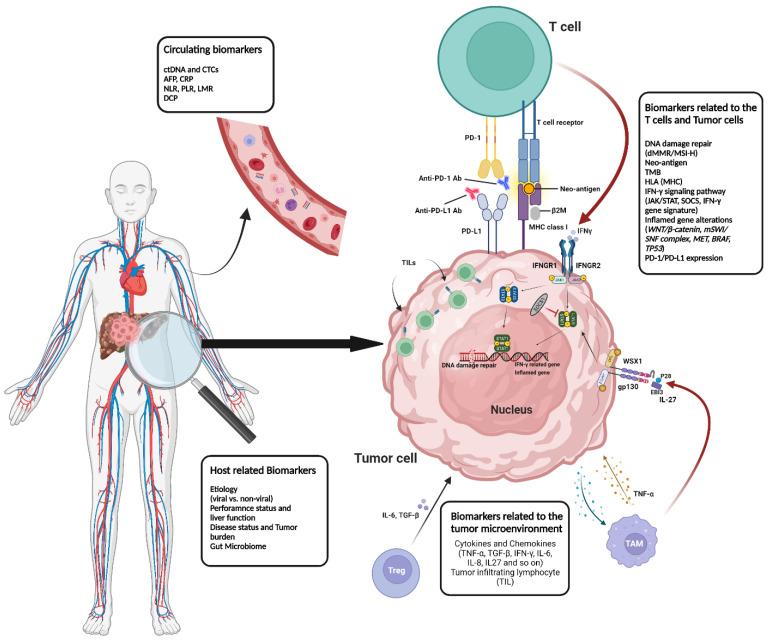
Hepatocellular carcinoma (HCC) has one of the highest mortality rates among solid cancers. Late diagnosis and a lack of efficacious treatment options contribute to the dismal prognosis of HCC. Immune checkpoint inhibitor (ICI)-based immunotherapy has presented a new milestone in the treatment of cancer. Immunotherapy has yielded remarkable treatment responses in a range of cancer types including HCC. Based on the therapeutic effect of ICI alone (programmed cell death (PD)-1/programmed death-ligand1 (PD-L)1 antibody), investigators have developed combined ICI therapies including ICI + ICI, ICI + tyrosine kinase inhibitor (TKI), and ICI + locoregional treatment or novel immunotherapy. Although these regimens have demonstrated increasing treatment efficacy with the addition of novel drugs, the development of biomarkers to predict toxicity and treatment response in patients receiving ICI is in urgent need. PD-L1 expression in tumor cells received the most attention in early studies among various predictive biomarkers. However, PD-L1 expression alone has limited utility as a predictive biomarker in HCC. Accordingly, subsequent studies have evaluated the utility of tumor mutational burden (TMB), gene signatures, and multiplex immunohistochemistry (IHC) as predictive biomarkers. In this review, we aim to discuss the current state of immunotherapy for HCC, the results of the predictive biomarker studies, and future direction.
肝细胞癌 (HCC) 是实体瘤中死亡率最高的癌症之一。晚期诊断和缺乏有效的治疗选择导致 HCC 的预后不佳。免疫检查点抑制剂 (ICI) 为癌症治疗带来了新的里程碑。免疫疗法在包括 HCC 在内的多种癌症类型中产生了显著的治疗反应。基于 ICI 单一疗法(程序性细胞死亡 (PD)-1/程序性死亡配体 1 (PD-L)1 抗体)的治疗效果,研究人员开发了联合 ICI 治疗方案,包括 ICI + ICI、ICI + 酪氨酸激酶抑制剂 (TKI)、ICI + 局部治疗或新型免疫疗法。尽管这些方案通过添加新药物显示出治疗效果的提高,但仍迫切需要开发生物标志物来预测接受 ICI 治疗的患者的毒性和治疗反应。在各种预测性生物标志物中,肿瘤细胞中 PD-L1 的表达在早期研究中受到最多关注。然而,PD-L1 表达本身作为 HCC 的预测性生物标志物的应用有限。因此,随后的研究评估了肿瘤突变负担 (TMB)、基因特征和多重免疫组化 (IHC) 作为预测性生物标志物的效用。在这篇综述中,我们旨在讨论 HCC 的免疫治疗现状、预测性生物标志物研究的结果以及未来的方向。
 Zotero 插件