
真菌色素血根素中超快激发态分子内质子转移途径的光测法研究。
Photogrammetry of Ultrafast Excited-State Intramolecular Proton Transfer Pathways in the Fungal Pigment Draconin Red.
机构信息
Department of Chemistry, Oregon State University, 153 Gilbert Hall, Corvallis, OR 97331, USA.
出版信息
Molecules. 2023 Apr 16;28(8):3506. doi: 10.3390/molecules28083506.
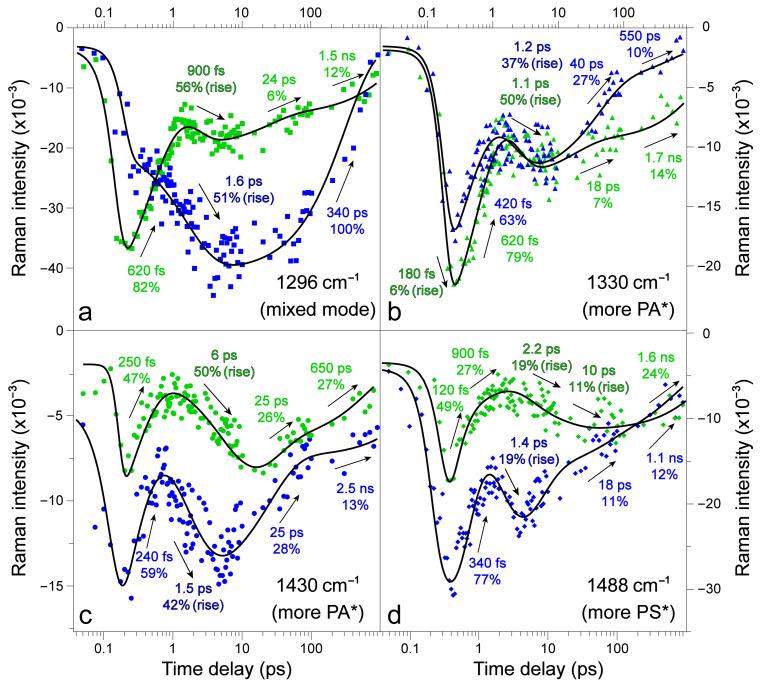
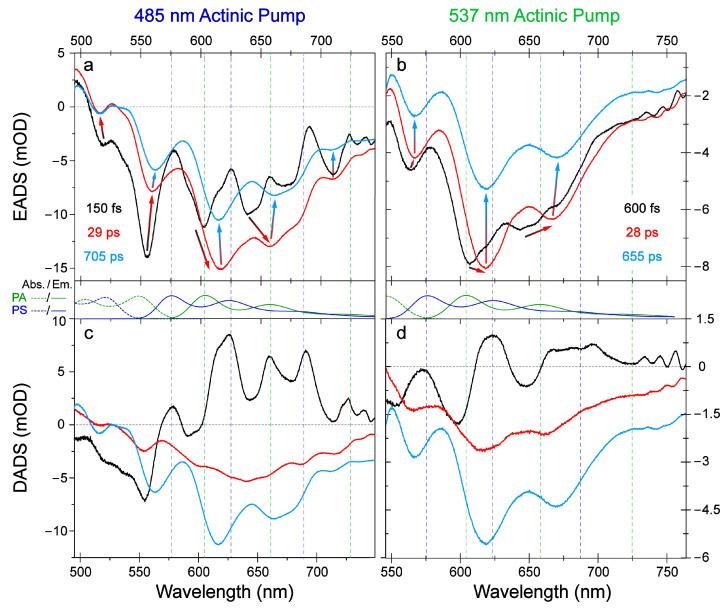
Proton transfer processes of organic molecules are key to charge transport and photoprotection in biological systems. Among them, excited-state intramolecular proton transfer (ESIPT) reactions are characterized by quick and efficient charge transfer within a molecule, resulting in ultrafast proton motions. The ESIPT-facilitated interconversion between two tautomers (PS and PA) comprising the tree fungal pigment Draconin Red in solution was investigated using a combination of targeted femtosecond transient absorption (fs-TA) and excited-state femtosecond stimulated Raman spectroscopy (ES-FSRS) measurements. Transient intensity (population and polarizability) and frequency (structural and cooling) dynamics of -COH rocking and -C=C, -C=O stretching modes following directed stimulation of each tautomer elucidate the excitation-dependent relaxation pathways, particularly the bidirectional ESIPT progression out of the Franck-Condon region to the lower-lying excited state, of the intrinsically heterogeneous chromophore in dichloromethane solvent. A characteristic overall excited-state PS-to-PA transition on the picosecond timescale leads to a unique "W"-shaped excited-state Raman intensity pattern due to dynamic resonance enhancement with the Raman pump-probe pulse pair. The ability to utilize quantum mechanics calculations in conjunction with steady-state electronic absorption and emission spectra to induce disparate excited-state populations in an inhomogeneous mixture of similar tautomers has broad implications for the modeling of potential energy surfaces and delineation of reaction mechanisms in naturally occurring chromophores. Such fundamental insights afforded by in-depth analysis of ultrafast spectroscopic datasets are also beneficial for future development of sustainable materials and optoelectronics.
有机分子的质子转移过程是生物系统中电荷传输和光保护的关键。其中,激发态分子内质子转移(ESIPT)反应的特点是分子内快速有效的电荷转移,导致超快质子运动。使用靶向飞秒瞬态吸收(fs-TA)和激发态飞秒受激拉曼光谱(ES-FSRS)测量相结合,研究了包含真菌色素 Draconin Red 的两种互变异构体(PS 和 PA)之间的 ESIPT 促进的转化。对每个互变异构体定向刺激后-COH 摇摆和-C=C、-C=O 伸缩模式的瞬态强度(种群和极化率)和频率(结构和冷却)动力学,阐明了依赖于激发的弛豫途径,特别是从 Franck-Condon 区域到较低激发态的双向 ESIPT 进展,对于二氯甲烷溶剂中固有不均匀发色团。在皮秒时间尺度上,特征性的整体 PS 到 PA 的超快激发态跃迁导致独特的“W”形激发态拉曼强度图案,这是由于与拉曼泵浦探测脉冲对的动态共振增强。在不均匀混合物中使用量子力学计算结合稳态电子吸收和发射光谱来诱导不同的激发态种群的能力,对潜在能量表面的建模和天然发色团反应机制的描绘具有广泛的意义。对超快光谱数据集的深入分析提供的这种基本见解,也有利于可持续材料和光电的未来发展。




 Zotero 插件