
接受疾病修正治疗的多发性硬化症患者对SARS-CoV-2疫苗接种的短期和长期体液免疫及细胞免疫反应
Short- and Long-Term Humoral and Cellular Immune Responses to SARS-CoV-2 Vaccination in Patients with Multiple Sclerosis Treated with Disease-Modifying Therapies.
作者信息
Sainz de la Maza Susana, Walo-Delgado Paulette Esperanza, Rodríguez-Domínguez Mario, Monreal Enric, Rodero-Romero Alexander, Chico-García Juan Luis, Pariente Roberto, Rodríguez-Jorge Fernando, Ballester-González Rubén, Villarrubia Noelia, Romero-Hernández Beatriz, Masjuan Jaime, Costa-Frossard Lucienne, Villar Luisa María
机构信息
Department of Neurology, Hospital Universitario Ramón y Cajal, Instituto Ramón y Cajal de Investigación Sanitaria (IRYCIS), Red Española de Esclerosis Múltiple (REEM), Universidad de Alcalá, 28034 Madrid, Spain.
Department of Immunology, Hospital Universitario Ramón y Cajal, Universidad de Alcalá, Instituto Ramón y Cajal de Investigación Sanitaria (IRYCIS), Red Española de Esclerosis Múltiple (REEM), 28034 Madrid, Spain.
出版信息
Vaccines (Basel). 2023 Apr 3;11(4):786. doi: 10.3390/vaccines11040786.
BACKGROUND
This study aimed to evaluate short- and long-term humoral and T-cell-specific immune responses to SARS-CoV-2 vaccines in patients with multiple sclerosis (MS) treated with different disease-modifying therapies (DMTs).
METHODS
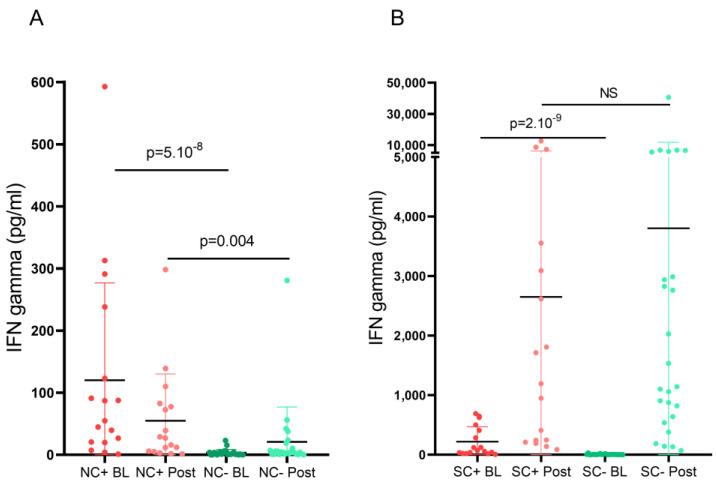
Single-center observational longitudinal study including 102 patients with MS who consecutively received vaccination against SARS-CoV-2. Serum samples were collected at baseline and after receiving the second dose of the vaccine. Specific Th1 responses following in vitro stimulation with spike and nucleocapsid peptides were analyzed by quantifying levels of IFN-γ. Serum IgG-type antibodies against the spike region of SARS-CoV-2 were studied by chemiluminescent microparticle immunoassay.
RESULTS
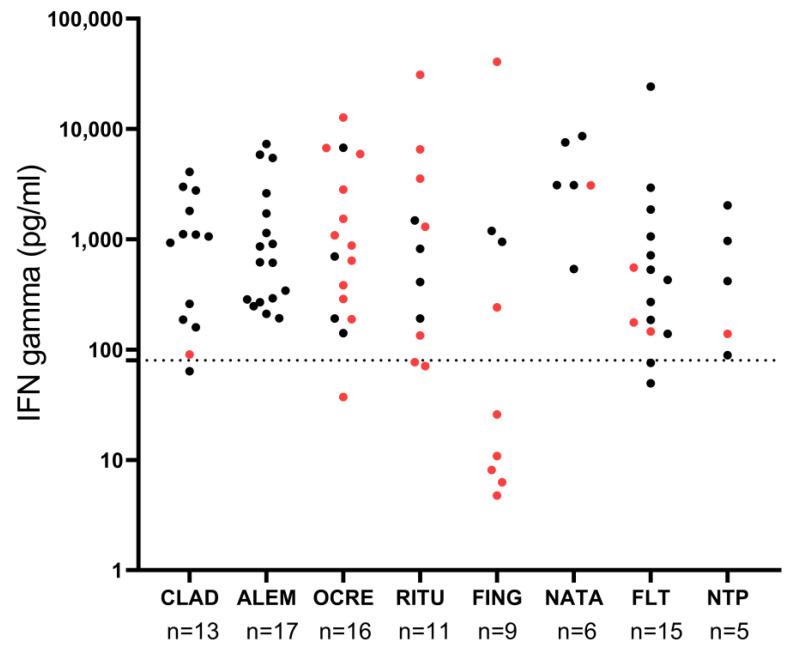
Patients undergoing fingolimod and anti-CD20 therapies had a markedly lower humoral response than those treated with other DMTs and untreated patients. Robust antigen-specific T-cell responses were detected in all patients except those treated with fingolimod, who had lower IFN-γ levels than those treated with other DMTs (25.8 pg/mL vs. 868.7 pg/mL, = 0.011). At mid-term follow-up, a decrease in vaccine-induced anti-SARS-CoV-2 IgG antibodies was observed in all subgroups of patients receiving DMTs, although most patients receiving induction DMTs or natalizumab and non-treated patients remained protected. Cellular immunity was maintained above protective levels in all DMT subgroups except the fingolimod subgroup.
CONCLUSIONS
SARS-CoV-2 vaccines induce robust and long-lasting humoral and cell-mediated specific immune responses in most patients with MS.
背景
本研究旨在评估接受不同疾病修正治疗(DMTs)的多发性硬化症(MS)患者对SARS-CoV-2疫苗的短期和长期体液及T细胞特异性免疫反应。
方法
单中心观察性纵向研究,纳入102例连续接受SARS-CoV-2疫苗接种的MS患者。在基线和接种第二剂疫苗后采集血清样本。通过定量IFN-γ水平分析用刺突蛋白和核衣壳肽体外刺激后的特异性Th1反应。采用化学发光微粒子免疫分析法研究针对SARS-CoV-2刺突区域的血清IgG型抗体。
结果
接受芬戈莫德和抗CD20治疗的患者的体液反应明显低于接受其他DMTs治疗的患者和未治疗患者。除接受芬戈莫德治疗的患者外,所有患者均检测到强烈的抗原特异性T细胞反应,接受芬戈莫德治疗的患者的IFN-γ水平低于接受其他DMTs治疗的患者(25.8 pg/mL对868.7 pg/mL,P = 0.011)。在中期随访中,接受DMTs治疗的所有患者亚组中均观察到疫苗诱导的抗SARS-CoV-2 IgG抗体减少,尽管大多数接受诱导DMTs或那他珠单抗治疗的患者以及未治疗患者仍受到保护。除芬戈莫德亚组外,所有DMT亚组的细胞免疫均维持在保护水平以上。
结论
SARS-CoV-2疫苗在大多数MS患者中诱导出强烈且持久的体液和细胞介导的特异性免疫反应。



 Zotero 插件