
高血糖所致卵巢癌疾病负担的系统分析与预测:1990年至2019年中国与世界的比较研究
Systematic analysis and prediction for disease burden of ovarian cancer attributable to hyperglycemia: a comparative study between China and the world from 1990 to 2019.
作者信息
Wu Peihong, Jiang Qingtao, Han Lei, Liu Xin
机构信息
Institute of Occupational Disease Prevention, Jiangsu Provincial Center for Disease Control and Prevention, Nanjing, China.
Jiangsu Preventive Medicine Association, Nanjing, China.
出版信息
Front Med (Lausanne). 2023 Apr 13;10:1145487. doi: 10.3389/fmed.2023.1145487. eCollection 2023.
BACKGROUND
Ovarian cancer is one of the most common female malignancies worldwide, and metabolic factors, such as hyperglycemia, are becoming potential risk factors. This study aimed to analyze the disease burden and its changing trend of ovarian cancer attributable to hyperglycemia in the Chinese population from 1990 to 2019.
METHODS
Using the data released by the Global Burden of Disease study 2019 (GBD 2019), we analyze the disease burden of ovarian cancer attributable to hyperglycemia in Chinese from 1990 to 2019 via morbidity, death, disability-adjusted life years (DALY); compare it with the global population; and predict the incidence and death trend in Chinese women for the next 10 years (2020-2029).
RESULTS
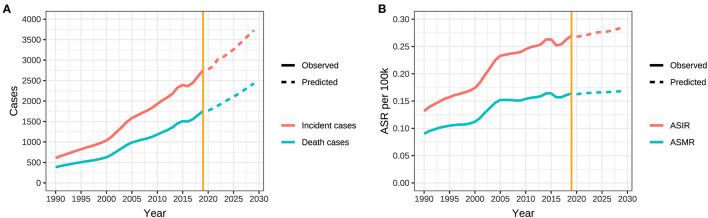
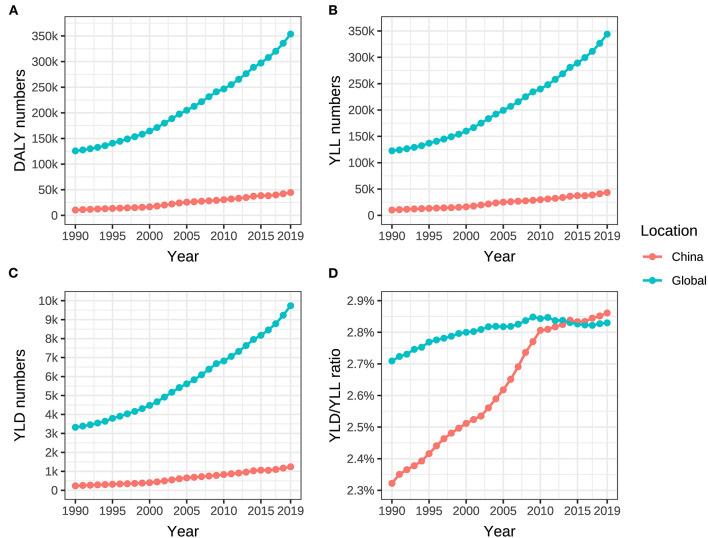
The incidence, death cases, and DALY numbers of ovarian cancer attributable to hyperglycemia in Chinese in 2019 were 2,751, 1,758, and 44,615 person-years, respectively, with an increase of 352.5%, 356.6%, and 329.0% compared with 1990, and the growth rate was higher than the global level. The age-standardized incidence rate (ASIR), age-standardized mortality rate (ASMR), and age-standardized DALY rate (ASDR) in 2019 were 0.270/100,000, 0.164/100,000, and 4.103/100,000, respectively. Moreover, the average annual percent changes (AAPCs) were 2.3%, 2.0%, and 2.0%, respectively, all higher than the global average. The disease burden of ovarian cancer attributable to hyperglycemia increased with age, reaching a peak in the 45-75 age group. The prediction of the neural network model showed that the incidence and death of the disease would remain high and rise in the next 10 years.
CONCLUSION
The disease burden caused by ovarian cancer attributable to hyperglycemia in Chinese accounts for a large proportion globally, and the ASIR, ASMR, and ASDR are increasing year by year. We should continue to pay attention to the role of metabolic factors, such as hyperglycemia, in the occurrence and development of ovarian cancer, perform a good job in tertiary prevention, and strive to reduce health losses.
背景
卵巢癌是全球最常见的女性恶性肿瘤之一,高血糖等代谢因素正成为潜在风险因素。本研究旨在分析1990年至2019年中国人群中高血糖所致卵巢癌的疾病负担及其变化趋势。
方法
利用全球疾病负担研究2019(GBD 2019)发布的数据,我们通过发病率、死亡率、伤残调整生命年(DALY)分析了1990年至2019年中国高血糖所致卵巢癌的疾病负担;与全球人群进行比较;并预测未来10年(2020 - 2029年)中国女性的发病率和死亡趋势。
结果
2019年中国高血糖所致卵巢癌的发病率、死亡病例和DALY数分别为2751例、1758例和44615人年,与1990年相比分别增长了352.5%、356.6%和329.0%,且增长率高于全球水平。2019年年龄标准化发病率(ASIR)、年龄标准化死亡率(ASMR)和年龄标准化DALY率(ASDR)分别为0.270/10万、0.164/10万和4.103/10万。此外,年均变化百分比(AAPC)分别为2.3%、2.0%和2.0%,均高于全球平均水平。高血糖所致卵巢癌的疾病负担随年龄增长而增加,在45 - 75岁年龄组达到峰值。神经网络模型预测显示,未来10年该疾病的发病率和死亡率将居高不下且呈上升趋势。
结论
中国高血糖所致卵巢癌的疾病负担在全球占比很大,且ASIR、ASMR和ASDR逐年上升。我们应继续关注高血糖等代谢因素在卵巢癌发生发展中的作用,做好三级预防工作,努力减少健康损失。




 Zotero 插件