
I13通过直接抑制BCR-ABL,克服了慢性髓性白血病中由T315I突变介导的耐药性。
I13 overrides resistance mediated by the T315I mutation in chronic myeloid leukemia by direct BCR-ABL inhibition.
作者信息
Gao Congying, Zhang Lei, Xu Yun, Ma Xiangyu, Chen Peilei, Chen Zhe-Sheng, Wei Liuya
机构信息
School of Pharmacy, Weifang Medical University, Weifang, China.
Department of Pharmaceutical Sciences, College of Pharmacy and Health Sciences, St. John's University, Queens, NY, United States.
出版信息
Front Pharmacol. 2023 Apr 12;14:1183052. doi: 10.3389/fphar.2023.1183052. eCollection 2023.
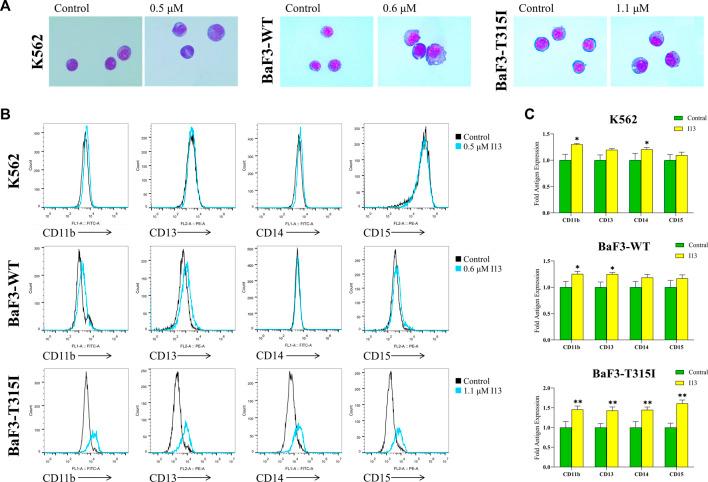
Chronic myeloid leukemia (CML) is a myeloproliferative neoplasm caused by a BCR-ABL fusion gene. Imatinib has significantly improved the treatment of CML as a first-generation tyrosine kinase inhibitor (TKIs). The T315I mutant form of BCR-ABL is the most common mutation that confers resistance to imatinib or the second-generation TKIs, resulting in poor clinical prognosis. In this work, we assessed the effect of a potent histone deacetylase (HDAC) inhibitor, I13, on the differentiation blockade in CML cells harboring T315I-mutated and wild-type BCR-ABL by MTT assay, flow cytometery, cell colony formation assay, mRNA Sequencing, Quantitative real-time PCR and Western blotting analysis. We found that I13 possessed highly potent activity against T315I-mutated BCR-ABL mutant-expressing cells and wild-type BCR-ABL-expressing cells. I13 induced cell differentiation and significantly suppressed the proliferation of these CML cells the cell cycle G0/G1-phase accumulation. Moreover, it was revealed that I13 triggered the differentiation of BaF3-T315I cells, which was attributed to the block of the chronic myeloid leukemia signaling pathway the depletion of BCR-ABL that was mediated by the inhibition of HDAC activity presented by the acetylation of histones H3 and H4. Taken together, I13 efficiently depleted BCR-ABL in CML cells expressing the BCR-ABL-T315I mutation, which blocked its function, serving as a scaffold protein that modulated the chronic myeloid leukemia signaling pathway mediating cell differentiation. The present findings demonstrate that I13 is a BCR-ABL modulator for the development of CML therapy that can override resistance caused by T315I-mutated BCR-ABL.
慢性粒细胞白血病(CML)是一种由BCR-ABL融合基因引起的骨髓增殖性肿瘤。伊马替尼作为第一代酪氨酸激酶抑制剂(TKIs),显著改善了CML的治疗。BCR-ABL的T315I突变形式是导致对伊马替尼或第二代TKIs耐药的最常见突变,临床预后较差。在本研究中,我们通过MTT法、流式细胞术、细胞集落形成试验、mRNA测序、定量实时PCR和蛋白质印迹分析,评估了一种有效的组蛋白去乙酰化酶(HDAC)抑制剂I13对携带T315I突变和野生型BCR-ABL的CML细胞分化阻滞的影响。我们发现I13对表达T315I突变的BCR-ABL突变细胞和表达野生型BCR-ABL的细胞具有高效活性。I13诱导细胞分化并显著抑制这些CML细胞的增殖,导致细胞周期G0/G1期积累。此外,研究表明I13触发了BaF3-T315I细胞的分化,这归因于慢性粒细胞白血病信号通路的阻断以及由组蛋白H3和H4乙酰化所呈现的HDAC活性抑制介导的BCR-ABL的消耗。综上所述,I13有效消耗了表达BCR-ABL-T315I突变的CML细胞中的BCR-ABL,阻断了其功能,作为一种支架蛋白调节介导细胞分化的慢性粒细胞白血病信号通路。本研究结果表明,I13是一种用于CML治疗开发的BCR-ABL调节剂,可克服由T315I突变的BCR-ABL引起的耐药性。


 Zotero 插件