
光合作用放氧的电子-质子瓶颈。
The electron-proton bottleneck of photosynthetic oxygen evolution.
机构信息
Department of Physics, Freie Universität, Berlin, Germany.
Department of Information Engineering, Computer Science and Mathematics, University of L'Aquila, L'Aquila, Italy.
出版信息
Nature. 2023 May;617(7961):623-628. doi: 10.1038/s41586-023-06008-5. Epub 2023 May 3.
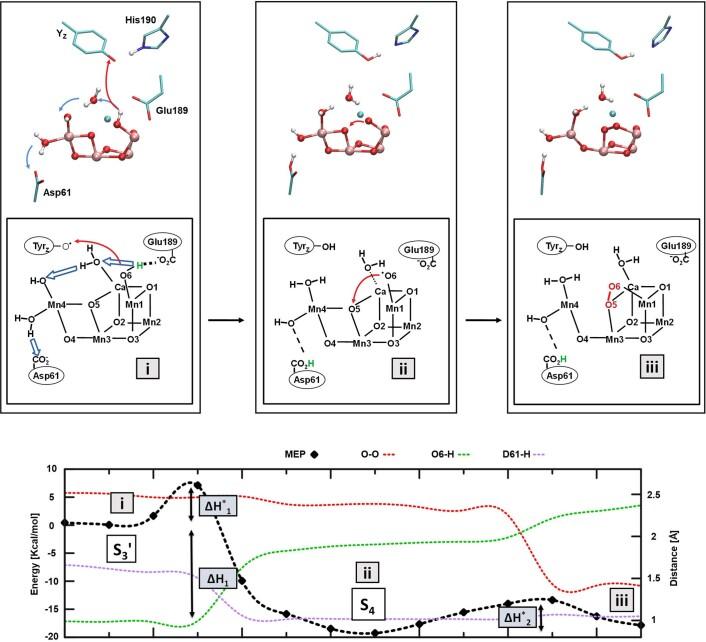
Photosynthesis fuels life on Earth by storing solar energy in chemical form. Today's oxygen-rich atmosphere has resulted from the splitting of water at the protein-bound manganese cluster of photosystem II during photosynthesis. Formation of molecular oxygen starts from a state with four accumulated electron holes, the S state-which was postulated half a century ago and remains largely uncharacterized. Here we resolve this key stage of photosynthetic O formation and its crucial mechanistic role. We tracked 230,000 excitation cycles of dark-adapted photosystems with microsecond infrared spectroscopy. Combining these results with computational chemistry reveals that a crucial proton vacancy is initally created through gated sidechain deprotonation. Subsequently, a reactive oxygen radical is formed in a single-electron, multi-proton transfer event. This is the slowest step in photosynthetic O formation, with a moderate energetic barrier and marked entropic slowdown. We identify the S state as the oxygen-radical state; its formation is followed by fast O-O bonding and O release. In conjunction with previous breakthroughs in experimental and computational investigations, a compelling atomistic picture of photosynthetic O formation emerges. Our results provide insights into a biological process that is likely to have occurred unchanged for the past three billion years, which we expect to support the knowledge-based design of artificial water-splitting systems.
光合作用通过将太阳能以化学形式储存来为地球上的生命提供能量。今天富含氧气的大气是由于光合作用中在蛋白结合的锰簇的光系统 II 中分解水而产生的。氧气分子的形成始于一个具有四个累积电子空穴的状态,即 S 态,这一状态在半个世纪前被假设出来,但至今仍未被充分描述。在这里,我们解决了光合作用 O 形成的这一关键阶段及其关键的机制作用。我们使用微秒红外光谱跟踪了暗适应光系统的 230000 个激发循环。将这些结果与计算化学相结合,揭示了一个关键的质子空位最初是通过门控侧链去质子化而产生的。随后,在单电子多质子转移事件中形成了一个反应性氧自由基。这是光合作用 O 形成中最慢的步骤,具有中等的能量势垒和明显的熵减速。我们将 S 态识别为氧自由基态;其形成后,快速形成 O-O 键并释放 O。与实验和计算研究的先前突破相结合,出现了一个令人信服的光合作用 O 形成的原子图像。我们的结果为过去三十亿年可能没有改变的生物过程提供了深入的了解,我们预计这将支持基于知识的人工水分解系统的设计。



 Zotero 插件