
接触自然与应激网络内功能连接性降低有关:一项静息态脑电图研究。
Exposure to nature is associated with decreased functional connectivity within the distress network: A resting state EEG study.
作者信息
Imperatori Claudio, Massullo Chiara, De Rossi Elena, Carbone Giuseppe Alessio, Theodorou Annalisa, Scopelliti Massimiliano, Romano Luciano, Del Gatto Claudia, Allegrini Giorgia, Carrus Giuseppe, Panno Angelo
机构信息
Cognitive and Clinical Psychology Laboratory, Department of Human Sciences, European University of Rome, Rome, Italy.
Experimental Psychology Laboratory, Department of Education, Roma Tre University, Rome, Italy.
出版信息
Front Psychol. 2023 Apr 20;14:1171215. doi: 10.3389/fpsyg.2023.1171215. eCollection 2023.
INTRODUCTION
Despite the well-established evidence supporting the restorative potential of nature exposure, the neurophysiological underpinnings of the restorative cognitive/emotional effect of nature are not yet fully understood. The main purpose of the current study was to investigate the association between exposure to nature and electroencephalography (EEG) functional connectivity in the distress network.
METHODS
Fifty-three individuals (11 men and 42 women; mean age 21.38 ± 1.54 years) were randomly assigned to two groups: (i) a green group and (ii) a gray group. A slideshow consisting of images depicting natural and urban scenarios were, respectively, presented to the green and the gray group. Before and after the slideshow, 5 min resting state (RS) EEG recordings were performed. The exact low-resolution electromagnetic tomography (eLORETA) software was used to execute all EEG analyses.
RESULTS
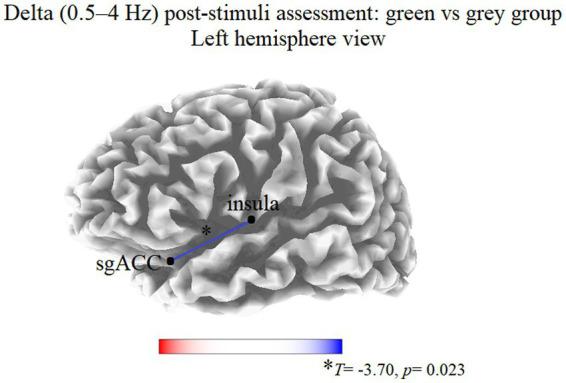
Compared to the gray group, the green group showed a significant increase in positive emotions ( = 9.50 = 0.003) and in the subjective experience of being full of energy and alive ( = 4.72 = 0.035). Furthermore, as compared to urban pictures, the exposure to natural images was associated with a decrease of delta functional connectivity in the distress network, specifically between the left insula and left subgenual anterior cingulate cortex ( = -3.70, = 0.023).
DISCUSSION
Our results would seem to be in accordance with previous neurophysiological studies suggesting that experiencing natural environments is associated with brain functional dynamics linked to emotional restorative processes.
引言
尽管有充分的证据支持接触自然具有恢复潜能,但自然对认知/情绪的恢复作用的神经生理学基础尚未完全明确。本研究的主要目的是探讨接触自然与痛苦网络中脑电图(EEG)功能连接之间的关联。
方法
53名个体(11名男性和42名女性;平均年龄21.38±1.54岁)被随机分为两组:(i)绿色组和(ii)灰色组。分别向绿色组和灰色组展示由描绘自然和城市场景的图像组成的幻灯片。在幻灯片展示前后,进行5分钟的静息状态(RS)脑电图记录。使用精确低分辨率电磁断层扫描(eLORETA)软件进行所有脑电图分析。
结果
与灰色组相比,绿色组的积极情绪显著增加(=9.50,=0.003),且在充满活力和生机的主观体验方面也显著增加(=4.72,=0.035)。此外,与城市图片相比,接触自然图像与痛苦网络中δ波功能连接的减少有关,特别是在左脑岛和左膝下前扣带回皮质之间(=-3.70,=0.023)。
讨论
我们的结果似乎与先前的神经生理学研究一致,表明体验自然环境与与情绪恢复过程相关的脑功能动态有关。
 Zotero 插件