
用植物促生细菌(PGPB)进行种子引发可改善[具体植物名称未给出]的生长和水分胁迫耐受性。
Seed priming with plant growth-promoting bacteria (PGPB) improves growth and water stress tolerance of .
作者信息
Rahnama Shiva, Ghehsareh Ardestani Elham, Ebrahimi Ataollah, Nikookhah Farzaneh
机构信息
Department of Rangeland and Watershed Management, Faculty of Natural Resources and Earth Sciences, Shahrekord University, Shahrekord, 8818634141, Iran.
Central Laboratory, Shahrekord University, Shahrekord, Iran.
出版信息
Heliyon. 2023 Apr 14;9(4):e15498. doi: 10.1016/j.heliyon.2023.e15498. eCollection 2023 Apr.
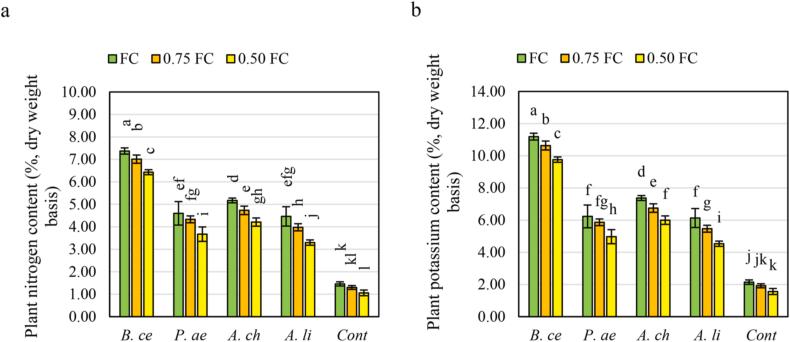
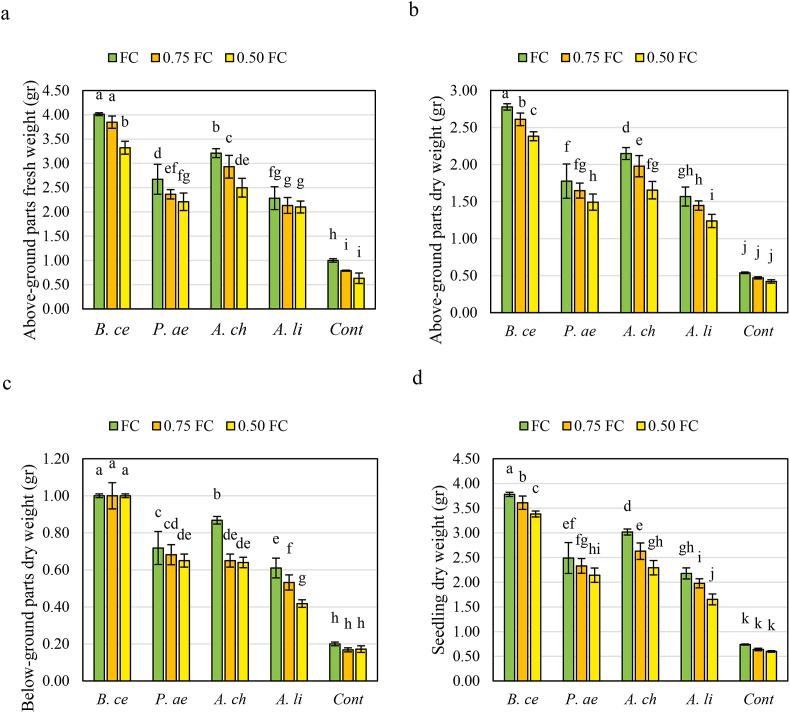
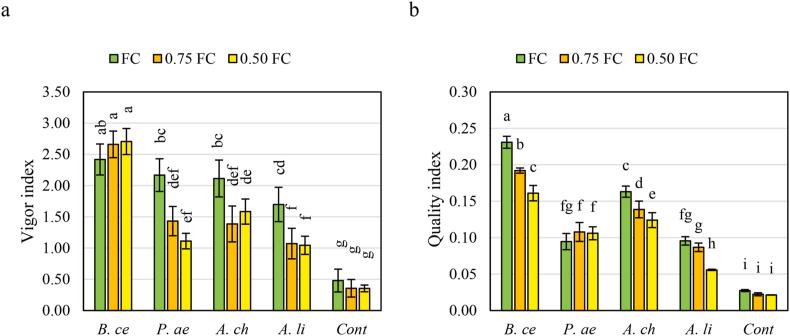
Abiotic and biotic stresses are major global threats to food security in the 21st century. Application of plant growth-promoting bacteria (PGPB) in rangeland plants is the only possible alternative that supports plant growth and development to combat environmental stress and successfully restoring rangelands. PGPBs were also found to be a potential substitute for chemical fertilizers and pesticides. The challenge is to determine which biofertilizers can be used for in normal and under water stress conditions. We sought to determine the benefits of PGPB for under water stress conditions in terms of seedling growth traits, growth indicators, and nutrient uptake in the research greenhouse Therefore, a completely randomized factorial design was conducted with two treatments of PGPB inoculation, including the control (no PGPB inoculation), PGPBs , , , and , and water stress in the research greenhouse. Overall, the results of the current study showed that water stress greatly reduced the above-ground fresh weight of above-ground plant parts and the nitrogen and potassium content of The present study confirms the positive effects of PGPB on fresh and dry weights of above- and below-ground parts and seedling, vigor index, quality index, and nitrogen and potassium content of , except for below-ground parts length, compared with the controls, which shows that PGPB usually improves some indicators of plant growth and development. We suggest that restoration of seed inoculation with PGPB should be supported in degraded rangelands and marginal drylands in low rainfall years, which may cause water scarcity and consequently water stress in arid and semi-arid regions.
非生物和生物胁迫是21世纪全球粮食安全面临的主要威胁。在牧场植物中应用促植物生长细菌(PGPB)是支持植物生长发育以应对环境胁迫并成功恢复牧场的唯一可行选择。人们还发现PGPB可作为化肥和农药的潜在替代品。挑战在于确定哪些生物肥料可用于正常和水分胁迫条件下。我们试图在研究温室中,从幼苗生长性状、生长指标和养分吸收方面确定PGPB在水分胁迫条件下对[植物名称未明确]的益处。因此,在研究温室中进行了完全随机析因设计,有两种PGPB接种处理,包括对照(不接种PGPB)、PGPB[菌株名称未明确]、[菌株名称未明确]、[菌株名称未明确]和[菌株名称未明确],以及水分胁迫。总体而言,当前研究结果表明,水分胁迫极大地降低了地上植物部分的地上鲜重以及[植物名称未明确]的氮和钾含量。本研究证实,与对照相比,PGPB对地上和地下部分的鲜重和干重、幼苗、活力指数、质量指数以及[植物名称未明确]的氮和钾含量有积极影响,但地下部分长度除外,这表明PGPB通常会改善植物生长发育的一些指标。我们建议,在低降雨年份可能导致缺水从而造成干旱和半干旱地区水分胁迫的退化牧场和边缘旱地,应支持用PGPB进行[植物名称未明确]种子接种来恢复。

 Zotero 插件