
老年新冠患者独立合并症组的概况显示,与标准治疗及低剂量羟氯喹相比,抗病毒药物的致死率较低。
Profiles of Independent-Comorbidity Groups in Senior COVID-19 Patients Reveal Low Fatality Associated with Standard Care and Low-Dose Hydroxychloroquine over Antivirals.
作者信息
Said Kamaleldin B, Alsolami Ahmed, Alreshidi Fayez Saud, Fathuddin Anas, Alshammari Fawwaz, Alrashid Fauwaz, Aljadani Ahmed, Aboras Rana, Alreshidi Fatmah, Alghozwi Mohammed H, Alshammari Suliman F, Alharbi Nawaf F
机构信息
Department of Pathology and Microbiology, College of Medicine, University of Ha'il, Ha'il, 55476, Saudi Arabia.
Genomics, Bioinformatics and Systems Biology, Carleton University, Ottawa, ON K1S 5B6, Canada.
出版信息
J Multidiscip Healthc. 2023 May 1;16:1215-1229. doi: 10.2147/JMDH.S403700. eCollection 2023.
INTRODUCTION
The lack of feasible therapies and comorbidities aggravate the COVID-19 case-fatality rate (CFR). However, reports examining CFR associations with diabetes, concomitant cardiovascular diseases, chronic kidney disease, and chronic liver disease (CLD) are limited. More studies assessing hydroxychloroquine (Hcq) and antivirals are needed.
PURPOSE
To examine associations of COVID-19 CFR in comorbid patient groups each with single comorbidities and after treatment with Hcq, favipiravir, and dexamethasone (Dex), either alone or in combination versus standard care.
METHODS
Using statistical analysis, we descriptively determined these associations among 750 COVID-19 patient groups during the last quarter of 2021.
RESULTS
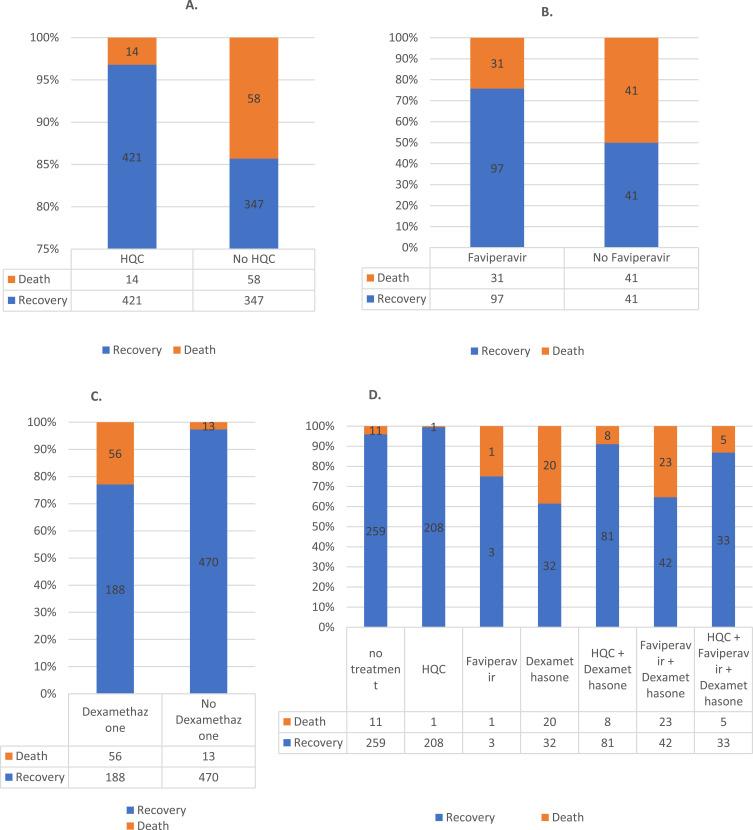
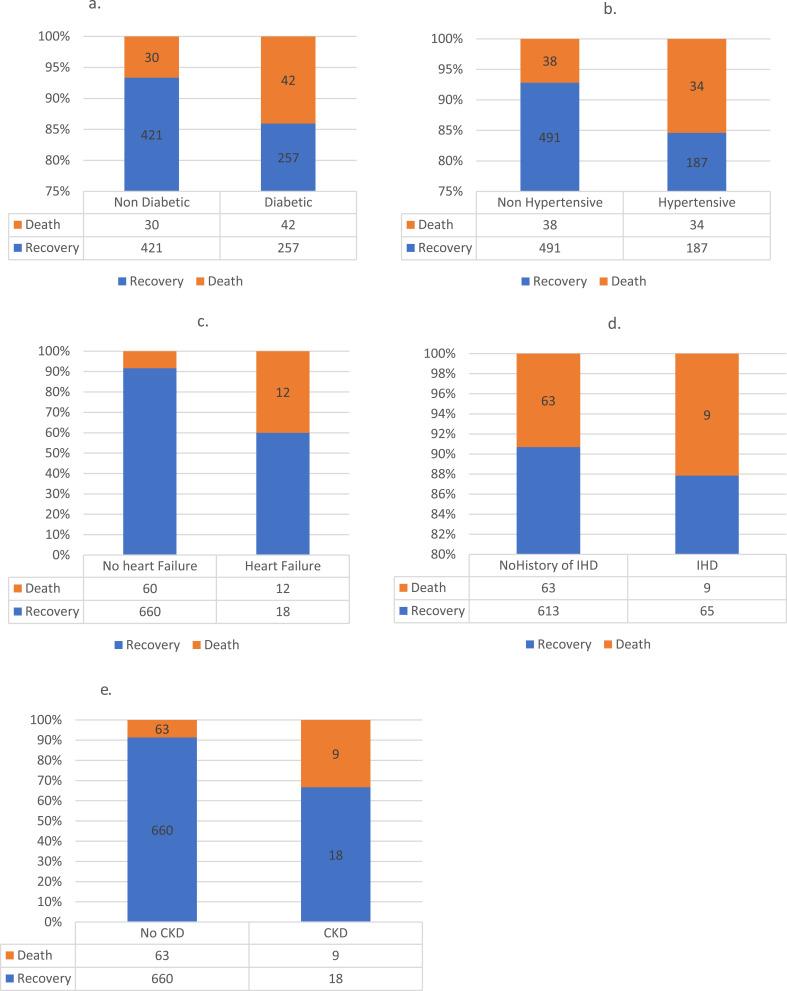
A diabetes comorbidity (40%, n=299) showed twice the fatality (CFR 14%) of the others (CFR 7%; =0.001). Hypertension (Htn) was the second-commonest comorbidity (29.5%, n=221), with similar CFR to diabetes (15% and 7% for Htn and non-Htn, respectively), but with higher significance (=0.0006167). Although only 4% (n=30) heart failure (HF) was reported, the CFR (40%) was much higher than in those without it (8%). A similar rate (4%) for chronic kidney disease was reported, with CFRs of 33% and 9% among those with and without it, respectively (=0.00048). Ischemic heart disease was 11% (n=74), followed by chronic liver disease (0.4%) and history of smoking (1%); however, these were not significant due to the sample sizes. Treatment indicated standard care and Hcq alone or in combination were superior (CFR of 4% and 0.5%, respectively) compared to favipiravir (25%) or Dex (38.5%) independently or in combination (35.4%). Furthermore, Hcq performed well (CFR 9%) when combined with Dex (9%; =4.28-).
CONCLUSION
The dominance of diabetes and other comorbidities with significant association with CFR implied existence of a common virulence mechanism. The superiority of low-dose Hcq and standard care over antivirals warrants further studies.
引言
缺乏可行的治疗方法和合并症会加重新型冠状病毒肺炎(COVID-19)的病死率(CFR)。然而,关于CFR与糖尿病、合并心血管疾病、慢性肾病和慢性肝病(CLD)之间关联的报告有限。需要更多评估羟氯喹(Hcq)和抗病毒药物的研究。
目的
研究COVID-19合并症患者群体中单一合并症以及接受Hcq、法匹拉韦和地塞米松(Dex)单独或联合治疗与标准治疗相比时CFR的关联。
方法
通过统计分析,我们描述性地确定了2021年最后一个季度750个COVID-19患者群体之间的这些关联。
结果
糖尿病合并症(40%,n = 299)的病死率(CFR为14%)是其他合并症(CFR为7%)的两倍(P = 0.001)。高血压(Htn)是第二常见的合并症(29.5%,n = 221),其CFR与糖尿病相似(Htn和非Htn分别为15%和7%),但具有更高的显著性(P = 0.0006167)。虽然仅报告了4%(n = 30)的心力衰竭(HF),但其CFR(40%)远高于无心力衰竭者(8%)。报告的慢性肾病发生率相似(4%),有和无慢性肾病者的CFR分别为33%和9%(P = 0.00048)。缺血性心脏病为11%(n = 74),其次是慢性肝病(0.4%)和吸烟史(1%);然而,由于样本量的原因,这些均无显著性差异。治疗显示,与单独使用法匹拉韦(25%)或Dex(38.5%)或联合使用(35.4%)相比,标准治疗以及单独或联合使用Hcq更具优势(CFR分别为4%和0.5%)。此外,Hcq与Dex联合使用时效果良好(CFR为9%)(P = 4.28-)。
结论
糖尿病和其他与CFR显著相关的合并症占主导地位,这意味着存在共同的致病机制。低剂量Hcq和标准治疗相对于抗病毒药物的优势值得进一步研究。
 Zotero 插件