
在瑞典双胞胎样本中,检测 15q11.2(BP1-BP2)拷贝数变异携带者在 9/12 和 18 岁时的神经发育问题。
Examining neurodevelopmental problems in 15q11.2 (BP1-BP2) copy number variation carriers at ages 9/12 and 18 in a Swedish twin sample.
机构信息
Department of Psychiatry and Neurochemistry, Institute of Neuroscience and Physiology at the Sahlgrenska Academy, University of Gothenburg, Gothenburg, Sweden.
Department of Medical Epidemiology and Biostatistics, Karolinska Institutet, Stockholm, Sweden.
出版信息
Mol Genet Genomic Med. 2023 Aug;11(8):e2191. doi: 10.1002/mgg3.2191. Epub 2023 May 8.
BACKGROUND
Several copy number variations (CNVs) are associated with increased risk for neurodevelopmental and psychiatric disorders. The CNV 15q11.2 (BP1-BP2) deletion has been associated with learning difficulties, attention deficit hyperactivity disorder (ADHD), epilepsy, and brain morphology; however, many carriers present mild or no symptoms. Carrying the reciprocal duplication does not seem to confer risk for these disorders or traits. Our aim was to examine the impact of carrying either 15q11.2 deletion and reciprocal duplication on neurodevelopmental problems in a population-based sample of children.
METHODS
Twins with genotype and phenotype information in the Child and Adolescent Twin Study in Sweden (CATSS) were included (N = 12,040). We included measures of neurodevelopmental problems (NDPs), including learning problems, from the questionnaire Autism-Tics, ADHD, and other Comorbidities inventory (A-TAC) at age 9/12, ADHD and autism spectrum disorder (ASD) questionnaires at age 18, as well as information about lifetime psychiatric diagnoses and epileptic seizures. We tested the association between these phenotypic measurements and carrying the 15q11.2 deletion, the reciprocal duplication, and other CNVs with previously reported strong associations with neurodevelopmental and psychiatric disorders (i.e., psychiatric CNVs).
RESULTS
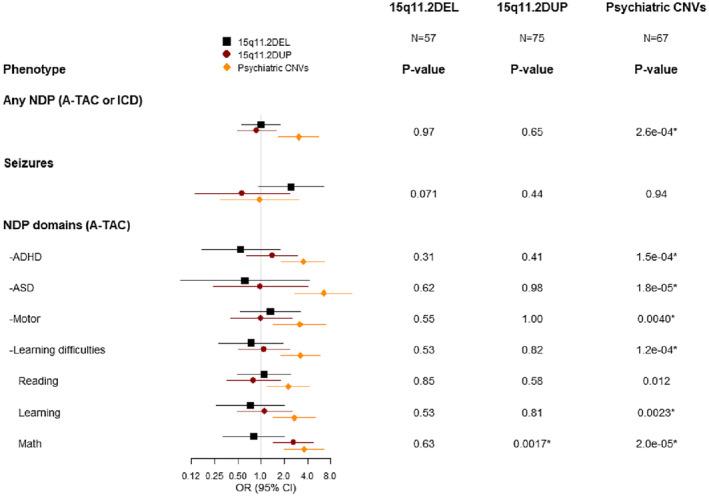
We identified 57 carriers of the 15q11.2 deletion, 75 carriers of the reciprocal duplication, and 67 carriers of other psychiatric CNVs. We did not find an increased risk for NDPs or psychiatric diagnoses in the 15q11.2 deletion carriers. For 15q11.2 duplication carriers, we found an increased risk for math learning problems and fewer self-reported ADHD symptoms at age 18 but not for other NDPs. In line with previous studies, we found an increased risk of NDPs and other evaluated phenotypes in carriers of psychiatric CNVs.
CONCLUSIONS
Our results support previous findings that carrying 15q11.2 deletion does not have a large effect on NDPs in children.
背景
一些拷贝数变异(CNVs)与神经发育和精神疾病的风险增加有关。15q11.2(BP1-BP2)缺失与学习困难、注意力缺陷多动障碍(ADHD)、癫痫和大脑形态有关;然而,许多携带者表现出轻微或没有症状。携带相反的重复似乎不会增加这些疾病或特征的风险。我们的目的是在瑞典儿童青少年双胞胎研究(CATSS)的基于人群的样本中,检查携带 15q11.2 缺失和相反重复对神经发育问题的影响。
方法
纳入了在瑞典儿童青少年双胞胎研究(CATSS)中具有基因型和表型信息的双胞胎(N=12040)。我们包括了从问卷自闭症-抽搐,ADHD 和其他合并症清单(A-TAC)中测量的神经发育问题(NDPs),包括 9/12 岁时的学习问题,18 岁时的 ADHD 和自闭症谱系障碍(ASD)问卷,以及关于终身精神科诊断和癫痫发作的信息。我们测试了这些表型测量值与携带 15q11.2 缺失、相反重复和其他先前报道与神经发育和精神疾病有强烈关联的 CNVs(即精神科 CNVs)之间的关联。
结果
我们确定了 57 名 15q11.2 缺失携带者、75 名相反重复携带者和 67 名其他精神科 CNVs 携带者。我们没有发现 15q11.2 缺失携带者患 NDPs 或精神科诊断的风险增加。对于 15q11.2 重复携带者,我们发现 18 岁时数学学习问题和自我报告的 ADHD 症状较少的风险增加,但其他 NDPs 没有增加。与之前的研究一致,我们发现携带精神科 CNVs 的携带者患 NDPs 和其他评估表型的风险增加。
结论
我们的结果支持之前的发现,即携带 15q11.2 缺失不会对儿童的 NDPs 产生重大影响。
 Zotero 插件