
皮质类固醇治疗对弥漫性大B细胞淋巴瘤中CXCR4表达的影响。
Influence of corticosteroid treatment on CXCR4 expression in DLBCL.
作者信息
Martin Sebastian, Viertl David, Janz Anna, Habringer Stefan, Keller Ulrich, Schottelius Margret
机构信息
Translational Radiopharmaceutical Sciences, Department of Nuclear Medicine and Department of Oncology, Centre Hospitalier Universitaire Vaudois (CHUV), University of Lausanne, Rue du Bugnon 25A, Agora, CH-1011, Lausanne, Switzerland.
AGORA, Pôle de Recherche Sur Le Cancer, 1011, Lausanne, Switzerland.
出版信息
EJNMMI Res. 2023 May 10;13(1):40. doi: 10.1186/s13550-023-00993-4.
BACKGROUND
CXCR4-targeted radioligand therapy (RLT) with [Lu]Lu/[Y]Y-PentixaTher has recently evolved as a promising therapeutic option for patients with advanced hematological cancers. Given their advanced disease stage, most patients scheduled for PentixaTher RLT require concomitant or bridging chemotherapy to prevent intermittent tumor progression. These (mostly combination) therapies may cause significant downregulation of tumoral CXCR4 expression, challenging the applicability of PentixaTher RLT. This study therefore aimed at investigating the influence of corticosteroids, a central component of these chemotherapies, on CXCR4 regulation in diffuse large B cell lymphoma (DLBCL).
METHODS
Different DLBCL cell lines (Daudi, OCI-LY1, SUDHL-4, -5-, -6 and -8) as well as the human T-cell lymphoma cell line Jurkat were incubated with Dexamethasone (Dex; 0.5 and 5 µM, respectively) and Prednisolone (Pred; 5 and 50 µM, respectively) for different time points (2 h, 24 h). Treatment-induced modulation of cellular CXCR4 surface expression was assessed via flow cytometry (FC) and compared to untreated cells. A radioligand binding assay with [I]CPCR4.3 was performed in parallel using the same cells. To quantify potential corticosteroid treatment effects on tumoral CXCR4 expression in vivo, OCI-LY1 bearing NSG mice were injected 50 µg Dex/mouse i.p. (daily for 6 days). Then, a biodistribution study (1 h p.i.) using [Ga]PentixaTher was performed, and tracer biodistribution in treated (n = 5) vs untreated mice (n = 5) was compared.
RESULTS
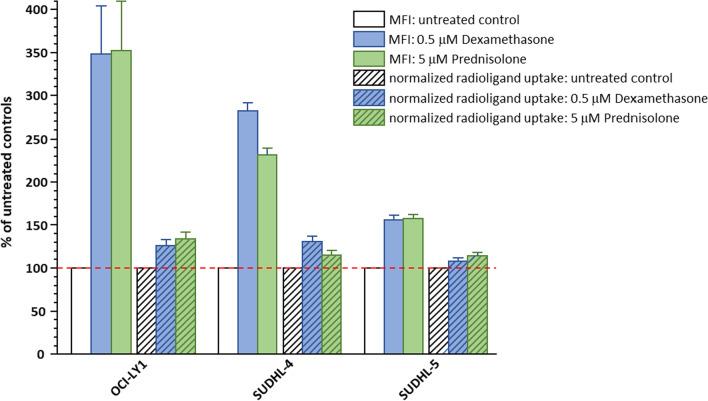
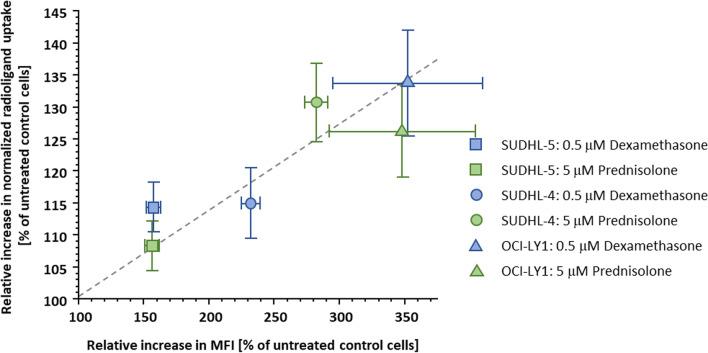
In the in vitro experiments, a strongly cell line-dependent upregulation of CXCR4 was observed for both Dex and Pred treatment, with negligible differences between the high and low dose. While in Jurkat, Daudi and SUDHL-8 cells, CXCR4 expression remained unchanged, a 1.5- to 3.5-fold increase in CXCR4 cell surface expression was observed for SUDHL-5 < SUDHL-4 /-6 < OCI-LY1 via FC compared to untreated cells. This increase in CXCR4 expression was also reflected in correspondingly enhanced [I]CPCR4.3 accumulation in treated cells, with a linear correlation between FC and radioligand binding data. In vivo, Dex treatment led to a general increase of [Ga]PentixaTher uptake in all organs compared to untreated animals, as a result of a higher tracer concentration in blood. However, we observed an overproportionally enhanced [Ga]PentixaTher uptake in the OCI-LY1 tumors in treated (21.0 ± 5.5%iD/g) vs untreated (9.2 ± 2.8%iD/g) mice, resulting in higher tumor-to-background ratios in the treatment group.
CONCLUSION
Overall, corticosteroid treatment (Dex/Pred) consistently induced an upregulation of CXCR4 expression DBLCL cells in vitro, albeit in a very cell line-dependent manner. For the cell line with the most pronounced Dex-induced CXCR4 upregulation, OCI-LY1, the in vitro findings were corroborated by an in vivo biodistribution study. This confirms that at least the corticosteroid component of stabilizing chemotherapy regimens in DLBCL patients prior to [Lu]Lu-PentixaTher RLT does not lead to downregulation of the molecular target CXCR4 and may even have a beneficiary effect. However, further studies are needed to investigate if and to what extent the other commonly used chemotherapeutic agents affect CXCR4 expression on DLBCL to ensure the choice of an appropriate treatment regimen prior to [Lu]Lu/[Y]Y-PentixaTher RLT.
背景
[镥]镥/[钇]钇-喷替沙肽靶向CXCR4的放射性配体疗法(RLT)最近已发展成为晚期血液系统癌症患者一种有前景的治疗选择。鉴于大多数计划接受喷替沙肽RLT的患者疾病分期较晚,需要同时或过渡性化疗以防止肿瘤间歇性进展。这些(大多为联合)疗法可能导致肿瘤CXCR4表达显著下调,对喷替沙肽RLT的适用性构成挑战。因此,本研究旨在调查这些化疗的核心成分皮质类固醇对弥漫性大B细胞淋巴瘤(DLBCL)中CXCR4调节的影响。
方法
将不同的DLBCL细胞系(Daudi、OCI-LY1、SUDHL-4、-5、-6和-8)以及人T细胞淋巴瘤细胞系Jurkat分别用不同浓度的地塞米松(Dex;分别为0.5和5 μM)和泼尼松龙(Pred;分别为5和50 μM)孵育不同时间点(2小时、24小时)。通过流式细胞术(FC)评估治疗诱导的细胞CXCR4表面表达的调节,并与未处理的细胞进行比较。使用相同的细胞并行进行[碘]CPCR4.3放射性配体结合试验。为了量化皮质类固醇治疗对体内肿瘤CXCR4表达的潜在影响,给携带OCI-LY1的NSG小鼠腹腔注射50 μg Dex/小鼠(每天一次,共6天)。然后,进行使用[镓]喷替沙肽的生物分布研究(注射后1小时),并比较治疗组(n = 5)和未治疗小鼠(n = 5)中示踪剂的生物分布。
结果
在体外实验中,观察到Dex和Pred处理均导致CXCR4强烈的细胞系依赖性上调,高剂量和低剂量之间差异可忽略不计。在Jurkat、Daudi和SUDHL-8细胞中,CXCR4表达保持不变,而通过FC观察到,与未处理细胞相比,SUDHL-5 < SUDHL-4 / -6 < OCI-LY1细胞的CXCR4细胞表面表达增加了1.5至3.5倍。CXCR4表达的增加也反映在处理细胞中[碘]CPCR4.3积累相应增强,FC和放射性配体结合数据之间存在线性相关性。在体内,与未处理动物相比,Dex处理导致所有器官中[镓]喷替沙肽摄取普遍增加,这是由于血液中示踪剂浓度较高。然而,我们观察到,与未治疗小鼠(9.2±2.8%ID/g)相比,治疗组(21.0±5.5%ID/g)的OCI-LY1肿瘤中[镓]喷替沙肽摄取过度增强,导致治疗组肿瘤与背景比值更高。
结论
总体而言,皮质类固醇治疗(Dex/Pred)在体外一致诱导DLBCL细胞中CXCR4表达上调,尽管具有很强的细胞系依赖性。对于Dex诱导CXCR4上调最明显的细胞系OCI-LY1,体内生物分布研究证实了体外研究结果。这证实,在[镥]镥-喷替沙肽RLT之前,DLBCL患者稳定化疗方案中至少皮质类固醇成分不会导致分子靶点CXCR4下调,甚至可能具有有益作用。然而,需要进一步研究其他常用化疗药物是否以及在何种程度上影响DLBCL上的CXCR4表达,以确保在[镥]镥/[钇]钇-喷替沙肽RLT之前选择合适的治疗方案。


 Zotero 插件