
人类剪接中催化激活的结构基础。
Structural basis of catalytic activation in human splicing.
机构信息
Macromolecular Crystallography, Max Planck Institute for Multidisciplinary Sciences, Göttingen, Germany.
Molecular Biology, Max Planck Institute for Multidisciplinary Sciences, Göttingen, Germany.
出版信息
Nature. 2023 May;617(7962):842-850. doi: 10.1038/s41586-023-06049-w. Epub 2023 May 10.
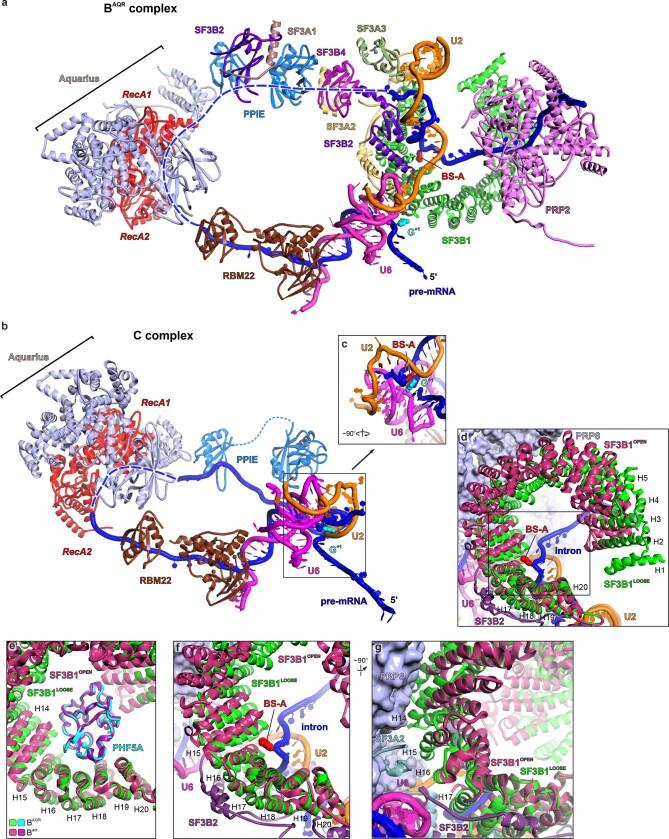
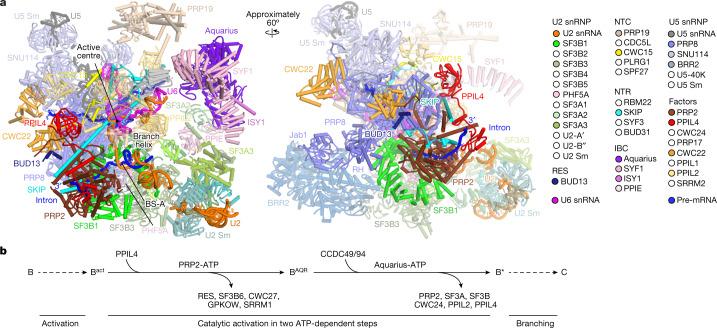
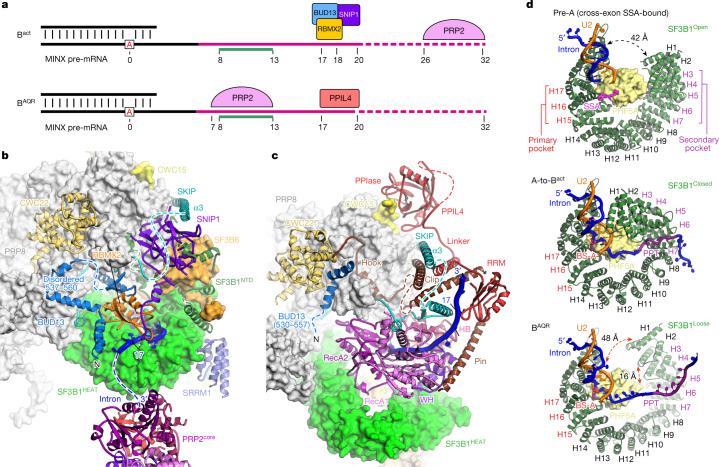
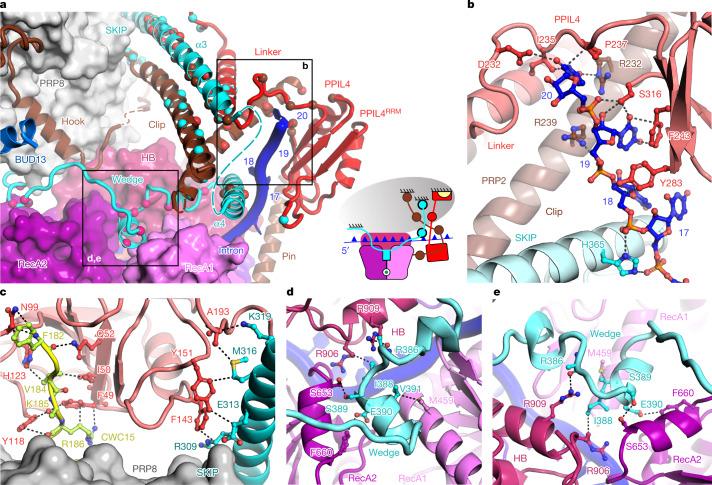
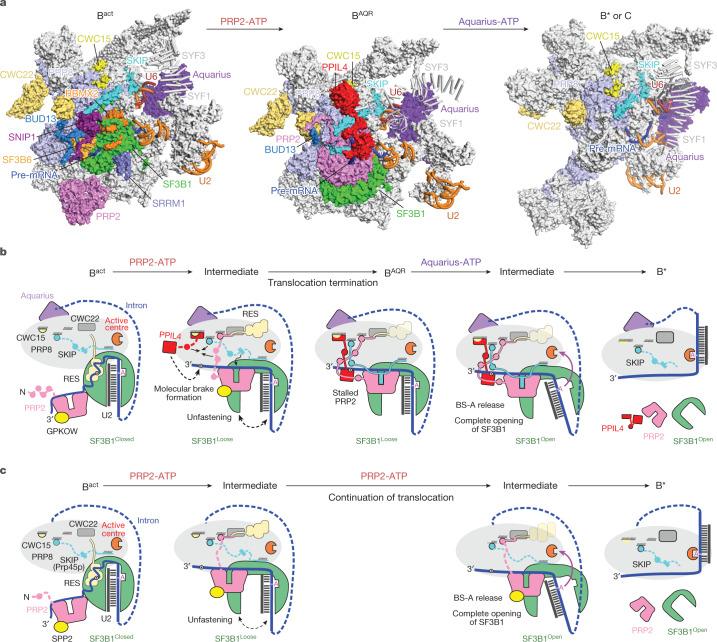
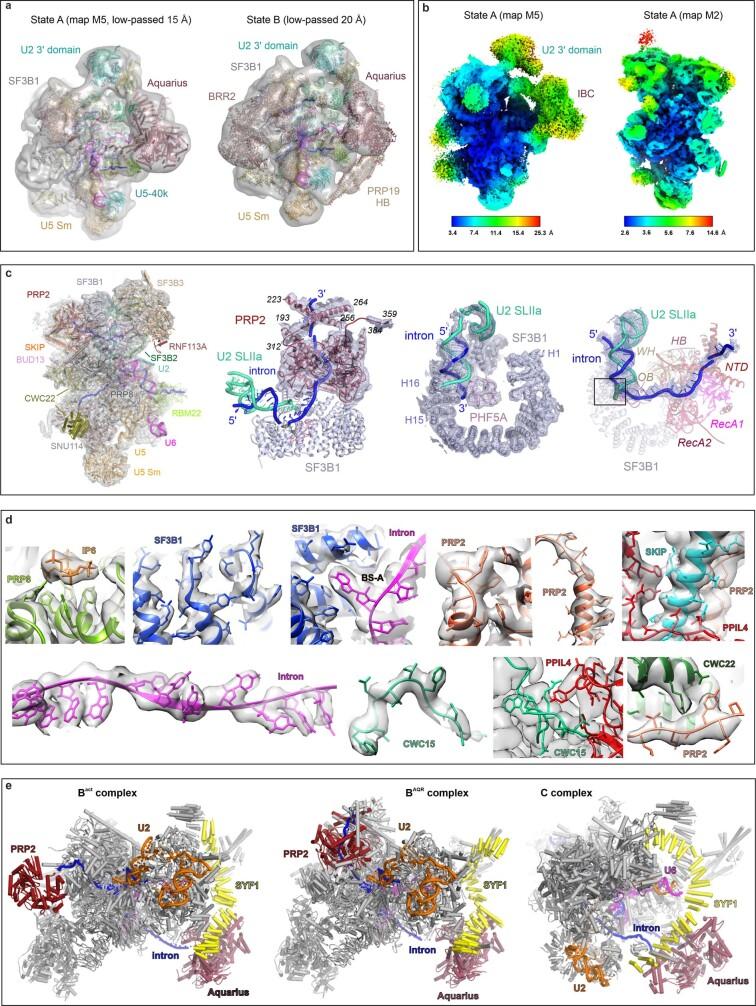
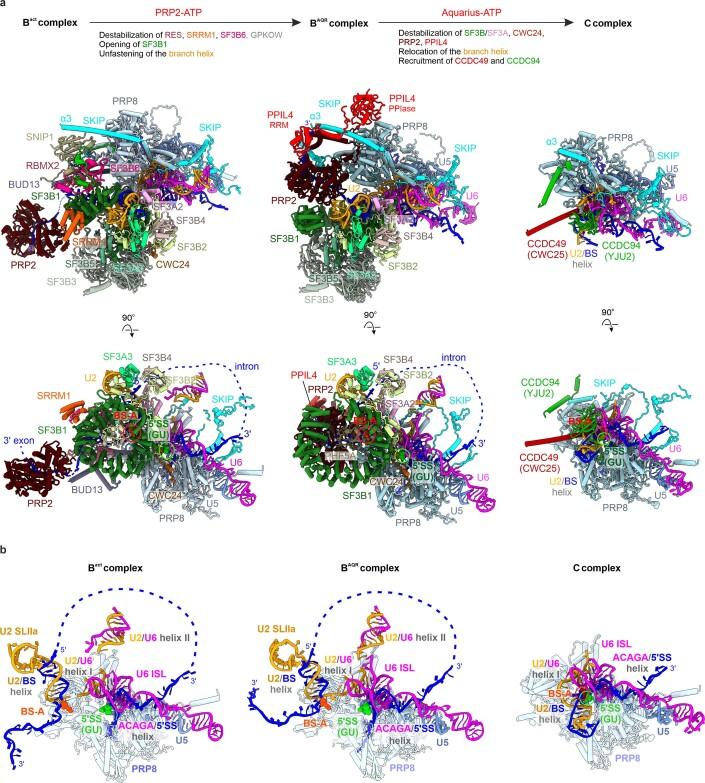
Pre-mRNA splicing follows a pathway driven by ATP-dependent RNA helicases. A crucial event of the splicing pathway is the catalytic activation, which takes place at the transition between the activated B and the branching-competent B spliceosomes. Catalytic activation occurs through an ATP-dependent remodelling mediated by the helicase PRP2 (also known as DHX16). However, because PRP2 is observed only at the periphery of spliceosomes, its function has remained elusive. Here we show that catalytic activation occurs in two ATP-dependent stages driven by two helicases: PRP2 and Aquarius. The role of Aquarius in splicing has been enigmatic. Here the inactivation of Aquarius leads to the stalling of a spliceosome intermediate-the B complex-found halfway through the catalytic activation process. The cryogenic electron microscopy structure of B reveals how PRP2 and Aquarius remodel B and B, respectively. Notably, PRP2 translocates along the intron while it strips away the RES complex, opens the SF3B1 clamp and unfastens the branch helix. Translocation terminates six nucleotides downstream of the branch site through an assembly of PPIL4, SKIP and the amino-terminal domain of PRP2. Finally, Aquarius enables the dissociation of PRP2, plus the SF3A and SF3B complexes, which promotes the relocation of the branch duplex for catalysis. This work elucidates catalytic activation in human splicing, reveals how a DEAH helicase operates and provides a paradigm for how helicases can coordinate their activities.
前体 mRNA 剪接遵循由 ATP 依赖性 RNA 解旋酶驱动的途径。剪接途径的一个关键事件是催化激活,它发生在激活的 B 剪接体和分支竞争的 B 剪接体之间的转变过程中。催化激活通过 PRP2(也称为 DHX16)介导的 ATP 依赖性重排发生。然而,由于仅在剪接体的外围观察到 PRP2,其功能仍然难以捉摸。在这里,我们表明催化激活通过两种解旋酶 PRP2 和 Aquarius 驱动的两个 ATP 依赖性阶段发生。Aquarius 在剪接中的作用一直是个谜。在这里,Aquarius 的失活导致剪接体中间体 B 复合物的停滞,该中间体发现在催化激活过程的中途。B 的低温电子显微镜结构揭示了 PRP2 和 Aquarius 分别如何重塑 B 和 B。值得注意的是,PRP2 在沿内含子移位的同时去除 RES 复合物,打开 SF3B1 夹并松开分支螺旋。通过 PPIL4、SKIP 和 PRP2 的氨基末端结构域的组装,转位在分支位点下游六个核苷酸处终止。最后,Aquarius 使 PRP2 加上 SF3A 和 SF3B 复合物解离,这促进了分支双链体的重新定位以进行催化。这项工作阐明了人类剪接中的催化激活,揭示了 DEAH 解旋酶如何运作,并为解旋酶如何协调其活性提供了范例。





 Zotero 插件