
COVID-19 患者机械取栓治疗缺血性脑卒中的死亡率。
Mortality following mechanical thrombectomy for ischemic stroke in patients with COVID-19.
机构信息
Department of Neurological Surgery, Keck School of Medicine of the University of Southern California, Los Angeles, CA, USA.
Keck School of Medicine of the University of Southern California, Los Angeles, CA, USA.
出版信息
J Stroke Cerebrovasc Dis. 2023 Aug;32(8):107171. doi: 10.1016/j.jstrokecerebrovasdis.2023.107171. Epub 2023 May 4.
OBJECTIVES
Multiple prior studies have shown a relationship between COVID-19 and strokes; further, COVID-19 has been shown to influence both time-to-thrombectomy and overall thrombectomy rates. Using large-scale, recently released national data, we assessed the association between COVID-19 diagnosis and patient outcomes following mechanical thrombectomy.
MATERIALS AND METHODS
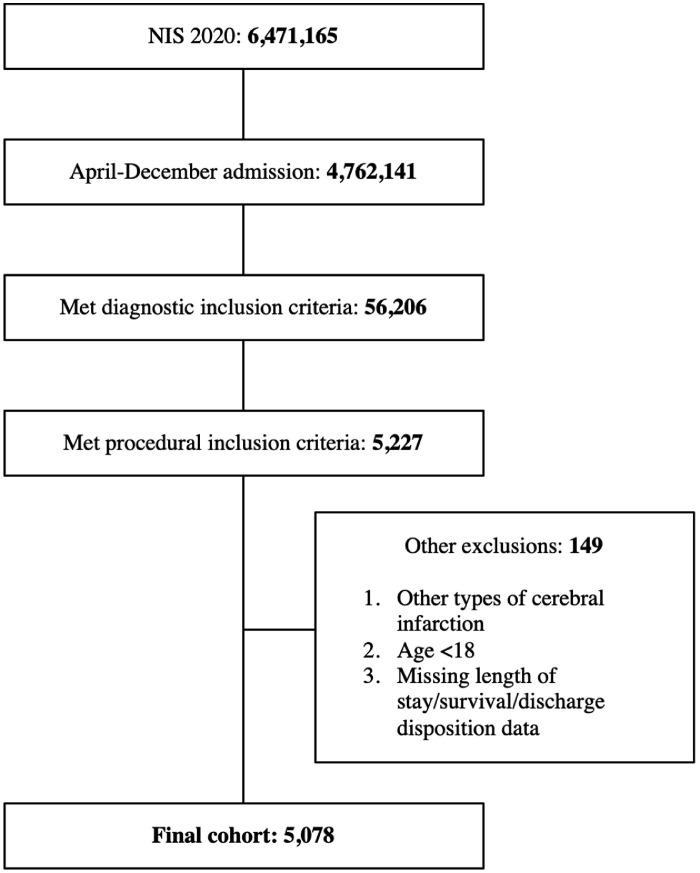
Patients in this study were identified from the 2020 National Inpatient Sample. All patients with arterial strokes undergoing mechanical thrombectomy were identified using ICD-10 coding criteria. Patients were further stratified by COVID diagnosis (positive vs. negative). Other covariates, including patient/hospital demographics, disease severity, and comorbidities were collected. Multivariable analysis was used to determine the independent effect of COVID-19 on in-hospital mortality and unfavorable discharge.
RESULTS
5078 patients were identified in this study; 166 (3.3%) were COVID-19 positive. COVID-19 patients had a significantly higher mortality rate (30.1% vs. 12.4%, p < 0.001). When controlling for patient/hospital characteristics, APR-DRG disease severity, and Elixhauser Comorbidity Index, COVID-19 was an independent predictor of increased mortality (OR 1.13, p = 0.002). COVID-19 was not significantly related to discharge disposition (p = 0.480). Older age and increased APR-DRG disease severity were also correlated with increase morality.
CONCLUSIONS
Overall, this study indicates that COVID-19 is a predictor of mortality among mechanical thrombectomy. This finding is likely multifactorial but may be related to multisystem inflammation, hypercoagulability, and re-occlusion seen in COVID-19 patients. Further research would be needed to clarify these relationships.
目的
多项先前的研究表明 COVID-19 与中风之间存在关联;此外,COVID-19 已被证明会影响溶栓治疗的时间和总体溶栓率。本研究利用大规模、最近发布的全国性数据,评估 COVID-19 诊断与机械取栓患者预后之间的关系。
材料与方法
本研究中的患者数据来自 2020 年全国住院患者样本。使用 ICD-10 编码标准确定所有接受机械取栓治疗的动脉性中风患者。根据 COVID 诊断(阳性与阴性)进一步对患者进行分层。收集其他协变量,包括患者/医院人口统计学特征、疾病严重程度和合并症。采用多变量分析确定 COVID-19 对住院死亡率和不良出院的独立影响。
结果
本研究共纳入 5078 例患者,其中 166 例(3.3%)COVID-19 阳性。COVID-19 患者死亡率明显更高(30.1%比 12.4%,p < 0.001)。在校正患者/医院特征、APR-DRG 疾病严重程度和 Elixhauser 合并症指数后,COVID-19 是死亡率增加的独立预测因素(OR 1.13,p = 0.002)。COVID-19 与出院转归无显著相关性(p = 0.480)。年龄较大和 APR-DRG 疾病严重程度增加也与死亡率增加相关。
结论
总体而言,本研究表明 COVID-19 是机械取栓患者死亡率的预测因素。这一发现可能是多因素的,但可能与 COVID-19 患者中出现的多系统炎症、高凝状态和再闭塞有关。需要进一步研究来阐明这些关系。
 Zotero 插件