
影响公众重复接种新冠疫苗意愿的因素:对疫苗宣传的启示
Factors Affecting the Public Intention to Repeat the COVID-19 Vaccination: Implications for Vaccine Communication.
作者信息
Lee Yubin, Park Kunhee, Shin Jeonghoon, Oh Jeonghyeon, Jang Yeongeun, You Myoungsoon
机构信息
Department of Public Health, Graduate School of Public Health, Seoul National University, Seoul 08826, Republic of Korea.
Gyeonggi Infectious Disease Control Center, Suwon 16508, Republic of Korea.
出版信息
Healthcare (Basel). 2023 Apr 26;11(9):1235. doi: 10.3390/healthcare11091235.
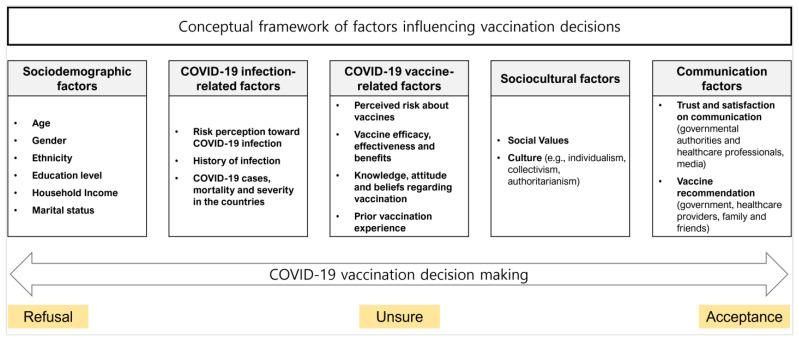
Although most of the pandemic-related mandatory restrictions have been lifted or eased, vaccination is still recommended as an effective measure to minimize the damage from COVID-19 infection. Since COVID-19 eradication is unlikely, it is necessary to understand the factors affecting the public's vaccination intention when COVID-19 vaccination is continuously recommended. This study aims to explore the factors that affect the intention to repeat the COVID-19 vaccination in South Korea. An online survey was conducted in January 2022 with adults living in Gyeonggi-do, South Korea. In a hierarchical logistic regression analysis, sociodemographic factors, COVID-19 infection-related factors, COVID-19 vaccination-related factors, sociocultural factors, and communication factors were taken into account. In this study, more than three-quarters (78.1%) of Koreans were willing to repeat the COVID-19 vaccination. People who had high-risk perceptions, had been vaccinated against COVID-19 at least once, had more authoritarian attitudes, regarded the vaccination as a social responsibility, and had positive attitudes toward health authorities' regular briefings were more likely to repeat the vaccination. In contrast, those who directly or indirectly experienced COVID-19 vaccine side effects and who showed psychological reactance against the government's vaccination recommendation were less likely to repeat the vaccination. Our research indicates that empathetic communication, promotion of the prosocial aspect of vaccination, and regular and transparent provision of vaccine information are essential for promoting the intention to repeat the COVID-19 vaccination.
尽管与疫情相关的大多数强制性限制已被解除或放宽,但仍建议接种疫苗,作为将新冠病毒感染造成的损害降至最低的有效措施。由于根除新冠病毒不太可能实现,在持续建议接种新冠疫苗的情况下,有必要了解影响公众接种意愿的因素。本研究旨在探讨影响韩国人重复接种新冠疫苗意愿的因素。2022年1月,对居住在韩国京畿道的成年人进行了一项在线调查。在分层逻辑回归分析中,考虑了社会人口因素、新冠病毒感染相关因素、新冠疫苗接种相关因素、社会文化因素和沟通因素。在本研究中,超过四分之三(78.1%)的韩国人愿意重复接种新冠疫苗。有高风险认知、至少接种过一次新冠疫苗、态度更专制、将接种视为社会责任以及对卫生当局定期简报持积极态度的人更有可能重复接种。相比之下,直接或间接经历过新冠疫苗副作用以及对政府的接种建议表现出心理抗拒的人重复接种的可能性较小。我们的研究表明,共情沟通、宣传接种疫苗的亲社会方面以及定期、透明地提供疫苗信息对于提高重复接种新冠疫苗的意愿至关重要。
 Zotero 插件