
肺移植后第一个月游离 DNA 定量和定性的临床意义。
Clinical relevance of cell-free DNA quantification and qualification during the first month after lung transplantation.
机构信息
Immunogenetics Laboratory, Etablissement Français du Sang, Marseille, France.
ADES UMR, Aix Marseille Univ, Marseille, France.
出版信息
Front Immunol. 2023 Apr 27;14:1183949. doi: 10.3389/fimmu.2023.1183949. eCollection 2023.
BACKGROUND
Many studies have reported the relevance of donor-derived cfDNA (dd-cfDNA) after lung transplantation (LTx) to diagnose and monitor acute rejection (AR) or chronic rejection or infection (INF). However, the analysis of cfDNA fragment size has not been studied. The aim of this study was to determine the clinical relevance of dd-cfDNA and cfDNA size profiles in events (AR and INF) during the first month after LTx.
METHODS
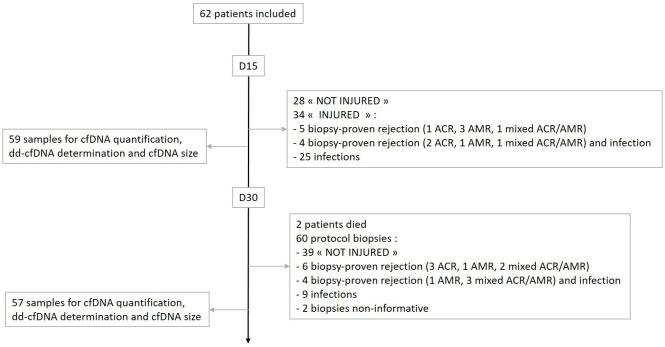
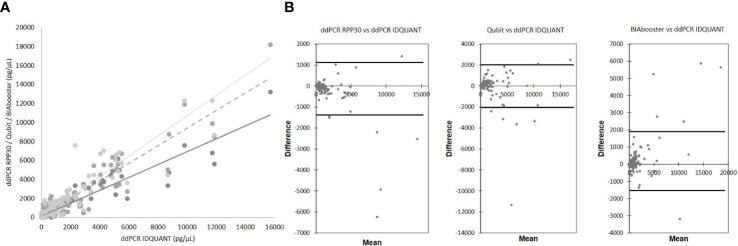
This prospective, single-center study includes 62 LTx recipients at the Marseille Nord Hospital, France. Total cfDNA quantification was performed by fluorimetry and digital PCR, dd-cfDNA by NGS (AlloSeq cfDNA-CareDX), and the size profile by BIABooster (Adelis). A bronchoalveolar lavage and transbronchial biopsies at D30 established the following groups: not-injured and injured graft (AR, INF, or AR+INF).
RESULTS
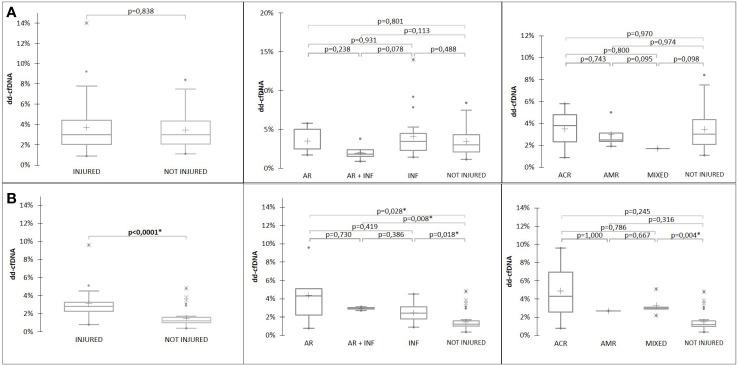
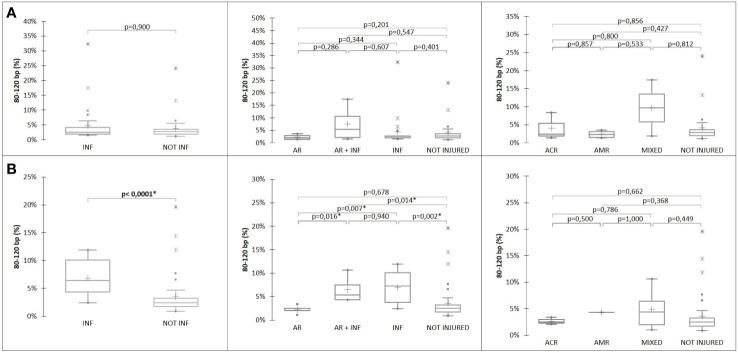
Quantification of total cfDNA was not correlated with the patient's status at D30. The percentage of dd-cfDNA was significantly higher for injured graft patients at D30 (p=0.0004). A threshold of 1.72% of dd-cfDNA correctly classified the not-injured graft patients (negative predictive value of 91.4%). Among recipients with dd-cfDNA >1.72%, the quantification of small sizes (80-120bp) >3.70% identified the INF with high performance (specificity and positive predictive value of 100%).
CONCLUSION
With the aim of considering cfDNA as a polyvalent non-invasive biomarker in transplantation, an algorithm combining the quantification of dd-cfDNA and small sizes of DNA may significantly classify the different types of allograft injuries.
背景
许多研究报告称,肺移植(LTx)后供体来源的 cfDNA(dd-cfDNA)与诊断和监测急性排斥(AR)或慢性排斥或感染(INF)有关。然而,cfDNA 片段大小的分析尚未得到研究。本研究旨在确定 dd-cfDNA 和 cfDNA 大小谱在 LTx 后第一个月的事件(AR 和 INF)中的临床相关性。
方法
这是一项前瞻性、单中心研究,包括法国马赛 Nord 医院的 62 名 LTx 受者。通过荧光法和数字 PCR 进行总 cfDNA 定量,通过 NGS(AlloSeq cfDNA-CareDX)进行 dd-cfDNA 定量,通过 BIABooster(Adelis)进行 cfDNA 大小谱分析。在 D30 时进行支气管肺泡灌洗和经支气管活检,建立以下分组:未受损和受损移植物(AR、INF 或 AR+INF)。
结果
总 cfDNA 的定量与 D30 时患者的状态无关。在 D30 时,受损移植物患者的 dd-cfDNA 百分比显著更高(p=0.0004)。dd-cfDNA 为 1.72%的阈值可正确分类未受损移植物患者(阴性预测值为 91.4%)。在 dd-cfDNA>1.72%的受者中,小尺寸(80-120bp)的定量>3.70%可高度识别 INF(特异性和阳性预测值为 100%)。
结论
为了将 cfDNA 视为移植中的一种多用途非侵入性生物标志物,结合 dd-cfDNA 和小尺寸 DNA 的定量的算法可能会显著分类不同类型的同种异体损伤。


 Zotero 插件