School of Biomedical Engineering, University of Technology Sydney, Sydney, Australia.
Garvan Institute of Medical Research, Sydney, Australia.
Elife. 2023 May 16;12:e83888. doi: 10.7554/eLife.83888.
Fragility fracture is associated with an increased risk of mortality, but mortality is not part of doctor-patient communication. Here, we introduce a new concept called 'Skeletal Age' as the age of an individual's skeleton resulting from a fragility fracture to convey the combined risk of fracture and fracture-associated mortality for an individual.
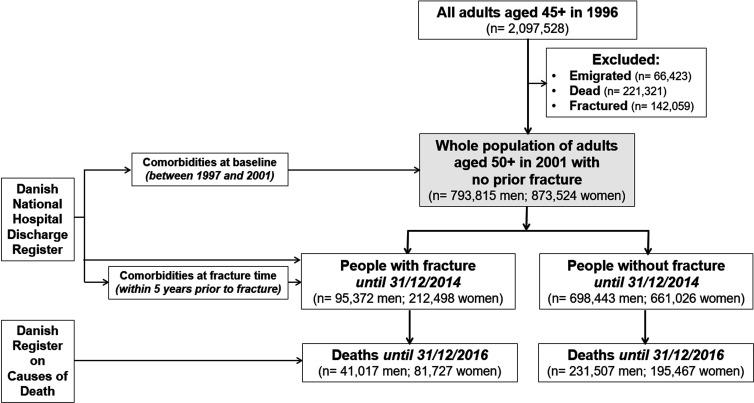
We used the Danish National Hospital Discharge Register which includes the whole-country data of 1,667,339 adults in Denmark born on or before January 1, 1950, who were followed up to December 31, 2016 for incident low-trauma fracture and mortality. Skeletal age is defined as the sum of chronological age and the number of years of life lost (YLL) associated with a fracture. Cox's proportional hazards model was employed to determine the hazard of mortality associated with a specific fracture for a given risk profile, and the hazard was then transformed into YLL using the Gompertz law of mortality.
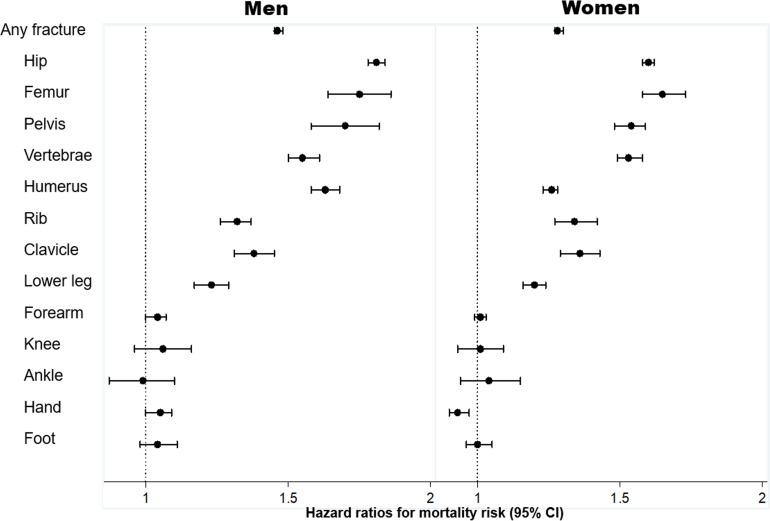
During the median follow-up period of 16 years, there had been 307,870 fractures and 122,744 post-fracture deaths. A fracture was associated with between 1 and 7 years of life lost, with the loss being greater in men than women. Hip fractures incurred the greatest loss of life years. For instance, a 60-year-old individual with a hip fracture is estimated to have a skeletal age of 66 for men and 65 for women. Skeletal Age was estimated for each age and fracture site stratified by gender.
We propose 'Skeletal Age' as a new metric to assess the impact of a fragility fracture on an individual's life expectancy. This approach will enhance doctor-patient risk communication about the risks associated with osteoporosis.
National Health and Medical Research Council in Australia and Amgen Competitive Grant Program 2019.
脆性骨折与死亡率增加相关,但死亡率并非医患沟通的一部分。在这里,我们引入了一个新概念,即“骨骼年龄”,代表个体因脆性骨折而导致的骨骼年龄,用于传达个体骨折和骨折相关死亡的综合风险。
我们使用丹麦全国住院登记系统,该系统包含了 1950 年 1 月 1 日或之前出生的丹麦 1667339 名成年人的全国数据,这些人在 2016 年 12 月 31 日之前接受了低创伤性骨折和死亡率的随访。骨骼年龄定义为年龄和因骨折而失去的年数(YLL)之和。采用 Cox 比例风险模型确定特定骨折与特定风险特征相关的死亡风险,然后使用死亡率的 Gompertz 定律将风险转化为 YLL。
在中位数为 16 年的随访期间,共发生了 307870 例骨折和 122744 例骨折后死亡。骨折会导致 1 至 7 年的生命损失,男性的损失大于女性。髋部骨折导致的生命损失最大。例如,一名 60 岁的男性髋部骨折患者估计骨骼年龄为 66 岁,女性为 65 岁。按性别和骨折部位对每个年龄进行了骨骼年龄分层估计。
我们提出“骨骼年龄”作为一种新的指标,用于评估脆性骨折对个体预期寿命的影响。这种方法将增强医患之间关于骨质疏松症相关风险的沟通。
澳大利亚国家卫生和医学研究委员会和安进竞争资助计划 2019 年。

 Zotero 插件