
转录因子POU2F1的高表达可改善肺腺癌吸烟者的生存率:两项队列的回顾性研究
High expression of transcription factor POU2F1 confers improved survival on smokers with lung adenocarcinoma: a retrospective study of two cohorts.
作者信息
Schulze Arik Bernard, Wenge Daniela Vanessa, Evers Georg, Heitkötter Birthe, Bleckmann Annalen, Schmidt Lars Henning, Mohr Michael, Hartmann Wolfgang, Arteaga Maria Francisca, Mikesch Jan-Henrik
机构信息
Department of Medicine A, Hematology, Oncology and Pulmonary Medicine, University Hospital Muenster, Muenster, Germany.
West German Cancer Center, University Hospital Muenster, Muenster, Germany.
出版信息
Transl Lung Cancer Res. 2023 Apr 28;12(4):727-741. doi: 10.21037/tlcr-22-714. Epub 2023 Mar 23.
BACKGROUND
Non-small cell lung cancer (NSCLC) is the leading cause of cancer-related mortality worldwide and its most important risk factor is tobacco smoking. While smoking is associated with inferior outcome in NSCLC patients, smoking also correlates with a higher tumor mutational burden. In contrast to adenocarcinomas (ADC) of non-smokers, that frequently harbor targetable gain-of-function mutations, NSCLC smokers largely present with non-targetable loss-of-function mutations of genes associated with DNA-damage repair. The transcription factor Pit-1, Oct1/2, Unc-86 (POU) domain class 2 transcription factor 1 (POU2F1) is a widely expressed bipotential stabilizer of repressed and inducible transcriptional states and frequently deregulated in cancer.
METHODS
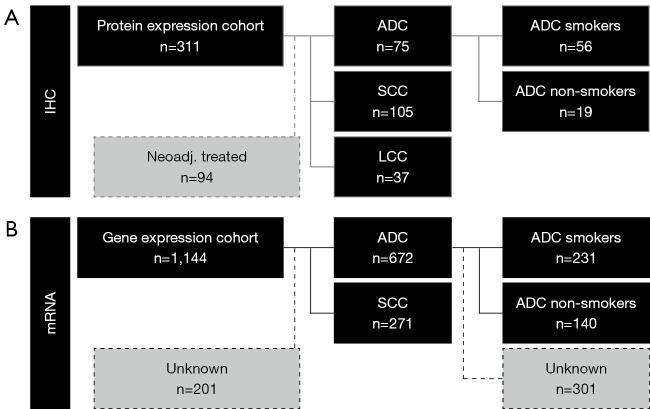
Via immunohistochemistry, we evaluated POU2F1 protein expression on a tissue micro array of 217 operable stage I-III NSCLC patients. Findings were reproduced in a gene expression database of 1144 NSCLC patients, filtered for POU2F1 mRNA expression. After retroviral overexpression of POU2F1 in A549 cells, we evaluated for clonogenic growth and proliferation. Additionally, CRISPR-Cas9 mediated POU2F1 knockdown in A549 cells was likewise analyzed.
RESULTS
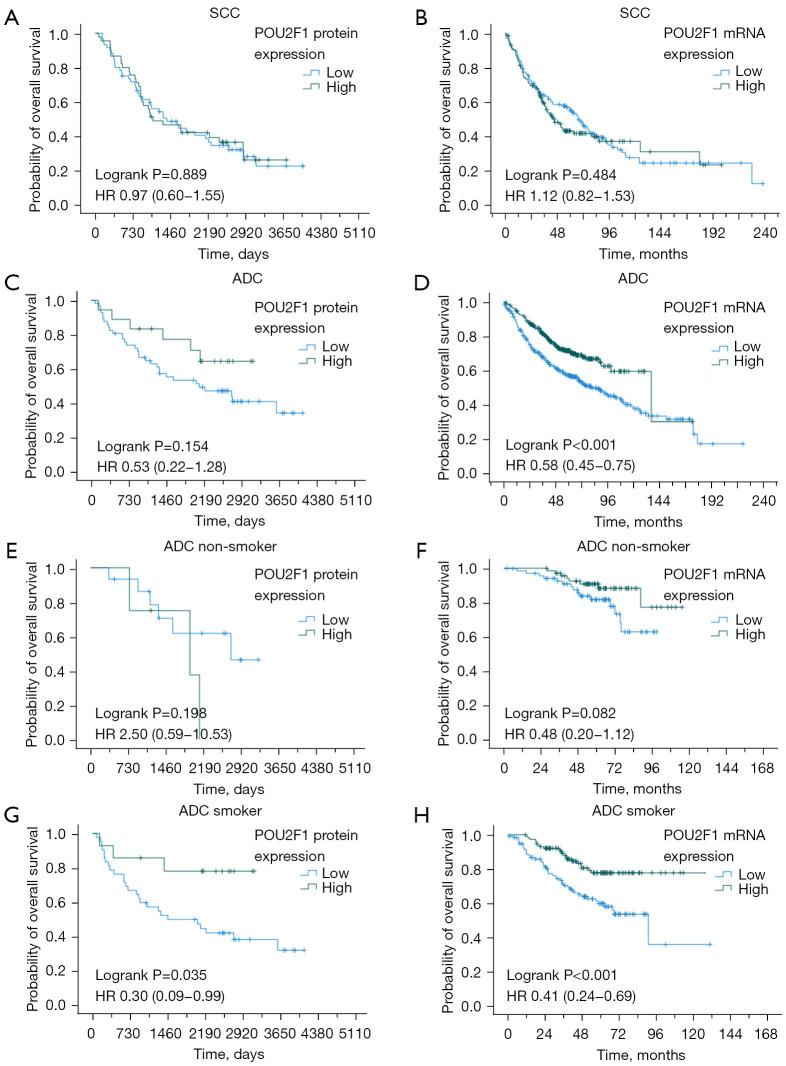
High protein expression of POU2F1 in 217 NSCLC patients resulted in improved outcome of smokers with ADC [hazard ratio (HR) 0.30 (0.09-0.99), P=0.035]. Moreover, gene expression analysis confirmed favorable outcome of high POU2F1 mRNA expression in smokers with ADC [HR 0.41 (0.24-0.69), P<0.001]. Other than that, retrovirally induced overexpression of POU2F1 in A549 cells significantly reduced both, clonogenic growth as well as proliferation of NSCLC cells, whereas CRISPR-Cas9 mediated knockdown of the protein did not have any impact.
CONCLUSIONS
Our data suggest that high expression of POU2F1 mediates a less aggressive cancer phenotype in smokers with ADC NSCLC. Pharmacological induction of genes and signaling pathways controlled by POU2F1 may provide novel avenues for future targeted NSCLC therapies in smokers.
背景
非小细胞肺癌(NSCLC)是全球癌症相关死亡的主要原因,其最重要的风险因素是吸烟。虽然吸烟与NSCLC患者较差的预后相关,但吸烟也与较高的肿瘤突变负担相关。与非吸烟者的腺癌(ADC)不同,后者经常携带可靶向的功能获得性突变,NSCLC吸烟者大多表现为与DNA损伤修复相关基因的不可靶向的功能丧失性突变。转录因子Pit-1、Oct1/2、Unc-86(POU)结构域2类转录因子1(POU2F1)是一种广泛表达的双潜能稳定剂,可稳定抑制性和诱导性转录状态,在癌症中经常失调。
方法
通过免疫组织化学,我们评估了217例可手术的I-III期NSCLC患者组织微阵列上POU2F1蛋白的表达。在一个1144例NSCLC患者的基因表达数据库中重现了研究结果,该数据库根据POU2F1 mRNA表达进行了筛选。在A549细胞中逆转录病毒过表达POU2F1后,我们评估了克隆形成生长和增殖情况。此外,同样分析了CRISPR-Cas9介导的A549细胞中POU2F1的敲低情况。
结果
217例NSCLC患者中POU2F1的高蛋白表达导致ADC吸烟者的预后改善[风险比(HR)0.30(0.09-0.99),P=0.035]。此外,基因表达分析证实,ADC吸烟者中POU2F1 mRNA高表达的预后良好[HR 0.41(0.24-0.69),P<0.001]。除此之外,逆转录病毒诱导的A549细胞中POU2F1的过表达显著降低了NSCLC细胞的克隆形成生长和增殖,而CRISPR-Cas9介导的该蛋白敲低没有任何影响。
结论
我们的数据表明,POU2F1的高表达介导了ADC NSCLC吸烟者中侵袭性较低的癌症表型。对受POU2F1控制的基因和信号通路进行药理学诱导可能为未来吸烟者NSCLC的靶向治疗提供新途径。



 Zotero 插件