
2022年埃塞俄比亚南部盖德奥地区成年人中与食源性和水源性疾病相关的健康素养及健康信息来源:一项基于社区的横断面研究
Health literacy and health information sources in relation to foodborne and waterborne diseases among adults in Gedeo zone, southern Ethiopia, 2022: A community-based cross-sectional study.
作者信息
Seboka Binyam Tariku, Negashe Misrak, Yehualashet Delelegn Emwodew, Kassawe Chalachew, Namaro Mulugeta, Yigeremu Mahlet
机构信息
School of Public Health, Dilla University, Dilla, Ethiopia.
Department of Psychiatry, Dilla University, Dilla, Ethiopia.
出版信息
Heliyon. 2023 Apr 29;9(5):e15856. doi: 10.1016/j.heliyon.2023.e15856. eCollection 2023 May.
INTRODUCTION
Foodborne and waterborne illnesses affect billions of people each year and impose a significant burden on public health globally. To reduce the prevalence of foodborne and waterborne illness in resource-constrained settings like Ethiopia, it is essential to recognize and address the factors that influence health literacy and the sources of health information. We explored health literacy and health information sources regarding foodborne and waterborne illnesses among adults in the Gedeo zone.
METHODS
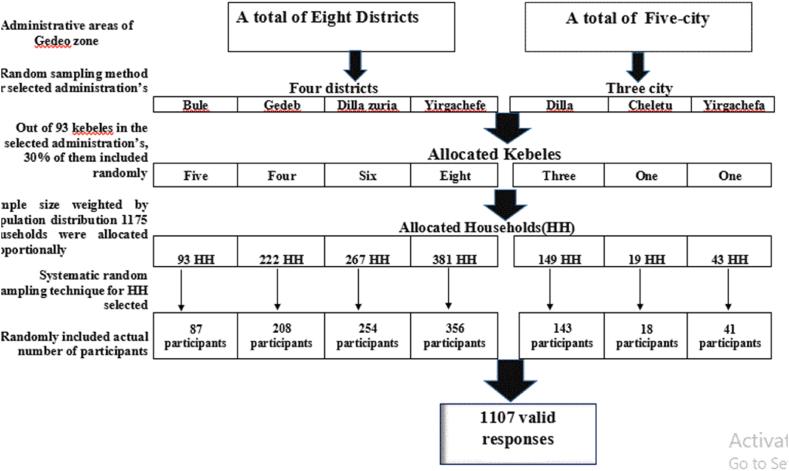
A community-based quantitative study was undertaken between March and April 2022 in the Gedeo zone in southern Ethiopia. A semi-structured, pretested, and interviewer-administered questionnaire was used to collect data from 1,175 study participants selected through a systematic sampling technique. Data were entered in Epidata version 4.6 and analyzed in STATA version 14.2. Data were analyzed using descriptive statistics and the Chi-square test, and multivariate logistic regression analysis was used to assess the associations between variables at a significance level of 0.05. Further, a structural equation model or path analysis was also used in the data analysis.
RESULT
1,107 (about 51% men) study participants were included in the analysis. About 25.5% of the participants had a foodborne or waterborne illness in the last six months before the survey. Family members and/or close friends were the most-used channel of health information (43.3%), and the internet or online sources were the least-used (14.5%). The result of path analysis shows that seeking health information, having adequate health literacy, and foodborne and waterborne literacy were significantly associated with lower incidences of foodborne or waterborne illness.
CONCLUSION
Our findings showed that individuals with a higher level of health literacy and foodborne and waterborne illness literacy had a lower incidence of foodborne and waterborne illness. Similarly, obtaining health information is positively associated with lowering the incidence of foodborne and waterborne illnesses. Importantly, our findings show mass media has the potential to reach a large audience when educating adults about foodborne and waterborne illnesses.
引言
食源性和水源性疾病每年影响数十亿人,给全球公共卫生带来沉重负担。为了在埃塞俄比亚等资源有限的地区降低食源性和水源性疾病的流行率,必须认识并解决影响健康素养和健康信息来源的因素。我们在盖德奥地区探讨了成年人关于食源性和水源性疾病的健康素养及健康信息来源。
方法
2022年3月至4月在埃塞俄比亚南部的盖德奥地区开展了一项基于社区的定量研究。采用一份经过预测试的半结构化访谈式问卷,通过系统抽样技术从1175名研究参与者中收集数据。数据录入Epidata 4.6版本,并在STATA 14.2版本中进行分析。使用描述性统计和卡方检验进行数据分析,并采用多因素逻辑回归分析在0.05的显著性水平下评估变量之间的关联。此外,数据分析中还使用了结构方程模型或路径分析。
结果
1107名(约51%为男性)研究参与者纳入分析。在调查前的最后六个月里,约25.5%的参与者患有食源性或水源性疾病。家庭成员和/或亲密朋友是最常使用的健康信息渠道(43.3%),而互联网或在线资源是最少使用的(14.5%)。路径分析结果表明,寻求健康信息、具备足够的健康素养以及食源性和水源性疾病素养与食源性或水源性疾病的较低发病率显著相关。
结论
我们的研究结果表明,健康素养以及食源性和水源性疾病素养较高的个体,食源性和水源性疾病的发病率较低。同样,获取健康信息与降低食源性和水源性疾病的发病率呈正相关。重要的是,我们的研究结果表明,在对成年人进行食源性和水源性疾病教育时,大众媒体有潜力覆盖大量受众。


 Zotero 插件