
运动对年轻成年人脑血流和执行功能的影响:一项双盲随机对照试验。
The effect of exercise on cerebral blood flow and executive function among young adults: a double-blinded randomized controlled trial.
机构信息
Vanke School of Public Health, Tsinghua University, Beijing, 100084, China.
Division of Sports Science and Physical Education, Tsinghua University, Beijing, 100084, China.
出版信息
Sci Rep. 2023 May 22;13(1):8269. doi: 10.1038/s41598-023-33063-9.
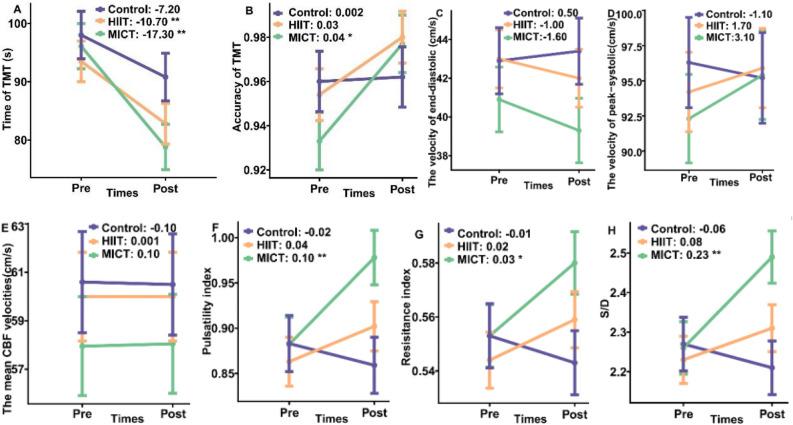
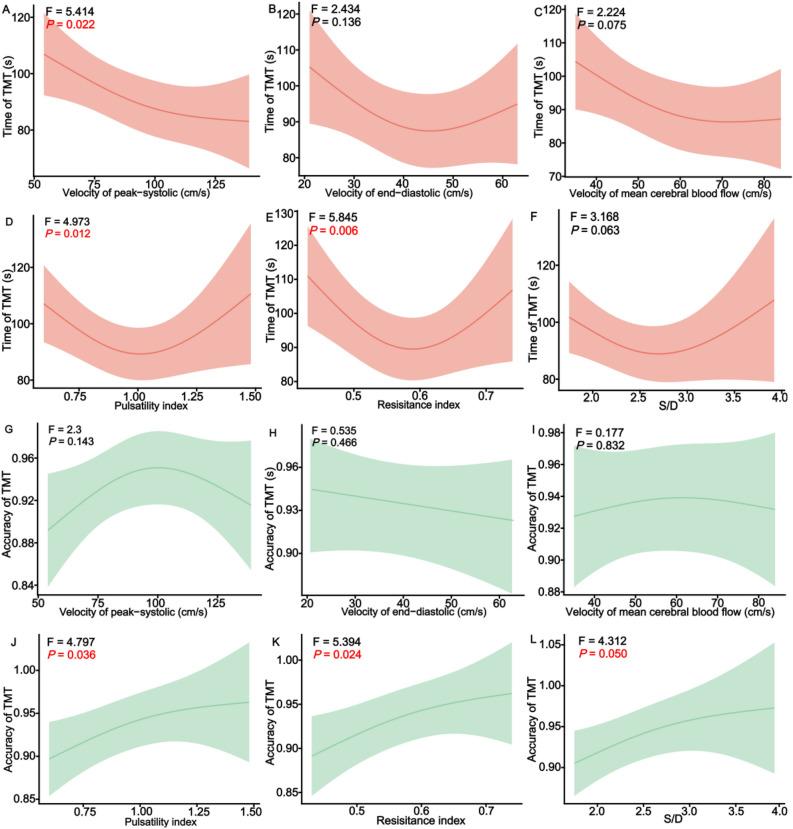
Studies have demonstrated that exercise benefits executive function. However, it remains unclear which type of exercise is optimal for preserving executive function among young adults and the cerebral blood flow (CBF) mechanisms that underlie exercise-induced cognitive benefits. Therefore, this study aims to compare the intervention effects of high-intensity interval training (HIIT) and moderate-intensity continuous training (MICT) on executive function and the CBF mechanism. This was a double-blinded, randomized, controlled trial study conducted between October 2020 and January 2021 (ClinicalTrials.gov identifier: NCT04830059). Ninety-three healthy young adults (25.23 ± 2.18 years old; 49.82% male) were randomized into the HIIT (N = 33), MICT (N = 32), and control (N = 28) groups. Participants in exercise groups were guided to perform 40 min of HIIT and MICT three times a week for 12 weeks, while the control group received health education for the same period. The primary outcomes, changes in executive function assessed by the trail-making test (TMT), and CBF measured by transcranial Doppler flow analyzer (EMS-9WA), were evaluated before and after the interventions. The time taken to complete the TMT task improved significantly in the MICT group compared to the control group [β = -10.175, 95%, confidence interval (CI) = -20.320, -0.031]. Additionally, the MICT group showed significant improvements in the pulsatility index (PI) (β = 0.120, 95% CI = 0.018, 0.222), resistance index (RI) (β = 0.043, 95% CI = 0.005, 0.082), and peak-systolic/end-diastolic velocity (S/D) (β = 0.277, 95% CI = 0.048, 0.507) of CBF compared to the control group. The time taken to complete the TMT was associated with the velocity of peak-systolic (F = 5.414, P = 0.022), PI (F = 4.973, P = 0.012), and RI (F = 5.845, P = 0.006). Furthermore, the accuracy of TMT was associated with PI (F = 4.797, P = 0.036), RI (F = 5.394, P = 0.024), and S/D (F = 4.312, P = 0.05) of CBF. A 12-week MICT intervention improved CBF and executive function more effectively than HIIT among young adults. Furthermore, the findings suggest that CBF was one of the potential mechanisms underlying the cognitive benefits of exercise in young people. These results provide practical evidence supporting the promotion of regular exercise to maintain executive function and improve brain health.
研究表明,运动有益于执行功能。然而,对于在年轻成年人中哪种类型的运动最适合保持执行功能,以及运动引起认知益处的脑血流(CBF)机制仍不清楚。因此,本研究旨在比较高强度间歇训练(HIIT)和中等强度持续训练(MICT)对执行功能和 CBF 机制的干预效果。这是一项 2020 年 10 月至 2021 年 1 月进行的双盲、随机、对照试验研究(ClinicalTrials.gov 标识符:NCT04830059)。93 名健康的年轻成年人(25.23±2.18 岁;49.82%为男性)被随机分为 HIIT 组(N=33)、MICT 组(N=32)和对照组(N=28)。运动组的参与者被指导每周进行 3 次,每次 40 分钟的 HIIT 和 MICT,而对照组在同一时期接受健康教育。主要结局是由走迷宫测试(TMT)评估的执行功能变化和经颅多普勒血流分析仪(EMS-9WA)测量的 CBF。在干预前后进行评估。与对照组相比,MICT 组完成 TMT 任务的时间明显缩短[β=-10.175,95%置信区间(CI)=-20.320,-0.031]。此外,与对照组相比,MICT 组的搏动指数(PI)(β=0.120,95%CI=0.018,0.222)、阻力指数(RI)(β=0.043,95%CI=0.005,0.082)和收缩期峰值/舒张末期速度(S/D)(β=0.277,95%CI=0.048,0.507)的 CBF 均有显著改善。完成 TMT 的时间与收缩期峰值速度(F=5.414,P=0.022)、PI(F=4.973,P=0.012)和 RI(F=5.845,P=0.006)相关。此外,TMT 的准确性与 PI(F=4.797,P=0.036)、RI(F=5.394,P=0.024)和 S/D(F=4.312,P=0.05)相关。12 周的 MICT 干预比 HIIT 更有效地改善了年轻人的 CBF 和执行功能。此外,研究结果表明,CBF 是运动对年轻人认知益处的潜在机制之一。这些结果为促进定期运动以维持执行功能和改善大脑健康提供了实际证据。

 Zotero 插件