
2022 年埃塞俄比亚西北部阿姆哈拉地区综合专科医院创伤性脑损伤患者的死亡率及其预测因素。
Incidence and predictors of mortality among traumatic brain injury patients admitted to Amhara region Comprehensive Specialized Hospitals, northwest Ethiopia, 2022.
机构信息
Department of Surgical Nursing, School of Nursing, College of Medicine and Health Sciences, University of Gondar, Gondar, Ethiopia.
Department of Nursing, College of Medicine and Health Sciences, Debre Markos University, Debre Markos, Ethiopia.
出版信息
BMC Emerg Med. 2023 May 24;23(1):55. doi: 10.1186/s12873-023-00823-9.
INTRODUCTION
Traumatic brain injury is a substantial cause of mortality and morbidity with a higher burden in low and middle-income countries due to healthcare systems that are unable to deliver effectively the acute and long-term care the patients require. Besides its burden, there is little information on traumatic brain injury-related mortality in Ethiopia, especially in the region. Therefore, this study aimed to assess the incidence and predictors of mortality among traumatic brain injury patients admitted to comprehensive specialized hospitals in the Amhara region, northwest Ethiopia, 2022.
METHODS
An institution-based retrospective follow-up study was conducted among 544 traumatic brain injury patients admitted from January 1, 2021, to December 31, 2021. A simple random sampling method was used. Data were extracted using a pre-tested and structured data abstraction sheet. Data were entered, coded, and cleaned into EPi-info version 7.2.0.1 software and exported to STATA version 14.1 for analysis. The Weibull regression model was fitted to determine the association between time to death and covariates. Variables with a P-value < 0.05 were declared statistically significant.
RESULTS
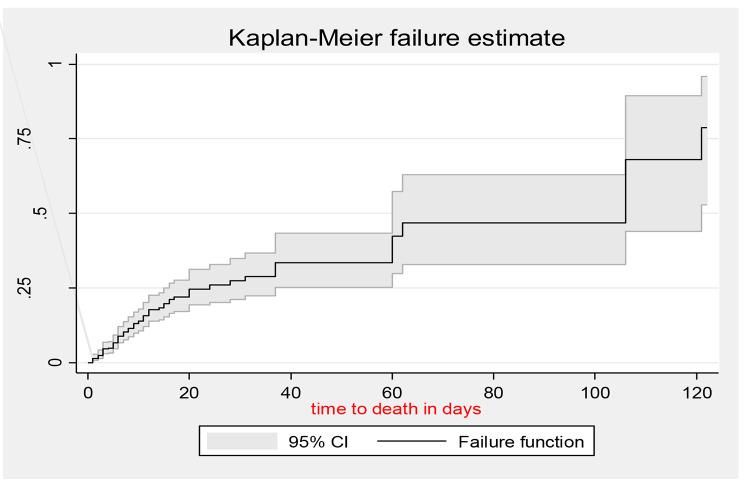
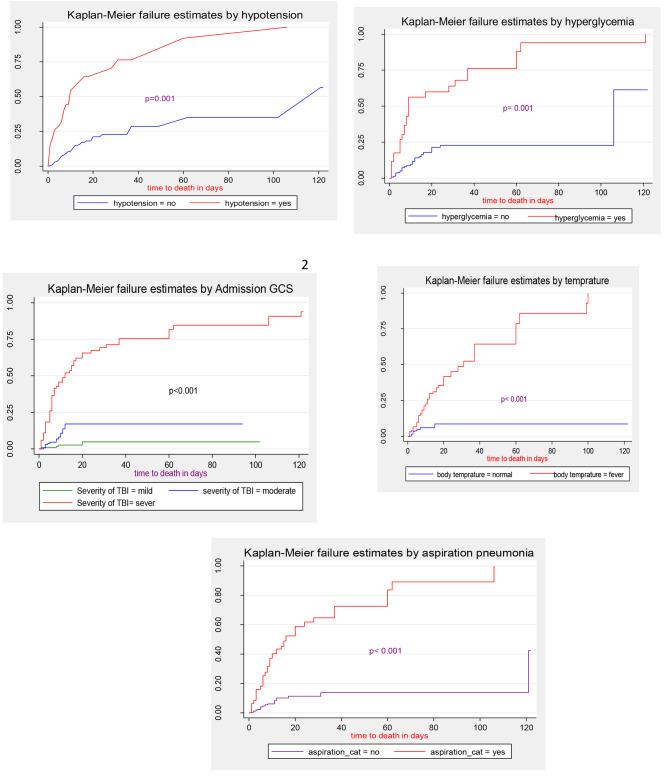
The overall incidence of mortality among traumatic brain injury patients was 1.23 per 100 person-day observation [95% (CI: 1.0, 1.5)] with a median survival time of 106 (95% CI: 60, 121) days. Age [AHR: 1.08 (95% CI; 1.06, 1.1)], severe traumatic brain injury [AHR: 10 (95% CI; 3.55, 28.2)], moderate traumatic brain injury [AHR: 9.2 (95% CI 2.97, 29)], hypotension [AHR: 6.9 (95% CI; 2.8, 17.1)], coagulopathy [AHR: 2.55 (95% CI: 1.27, 5.1)], hyperthermia [AHR: 2.79 (95% CI; 1.4, 5.5)], and hyperglycemia [AHR: 2.28 (95% CI; 1.13, 4.6)] were positively associated with mortality while undergoing neurosurgery were negatively associated with mortality [AHR: 0.47 (95% CI; 0.27-0 0.82)].
CONCLUSION
The overall incidence of mortality was found to be high. Age, severe and moderate traumatic brain injury, hypotension at admission, coagulopathy, presence of associated aspiration pneumonia, undergoing a neurosurgical procedure, episode of hyperthermia, and hyperglycemia during hospitalization were the independent predictors of time to death. Therefore, interventions to reduce mortality should focus on the prevention of primary injury and secondary brain injury.
简介
创伤性脑损伤是一个主要的死亡和发病原因,在中低收入国家,由于医疗体系无法有效提供患者所需的急性和长期护理,其负担更高。除了其负担之外,关于埃塞俄比亚创伤性脑损伤相关死亡率的信息很少,特别是在该地区。因此,本研究旨在评估 2022 年在埃塞俄比亚阿姆哈拉地区综合专科医院接受治疗的创伤性脑损伤患者的发病率和死亡率预测因素。
方法
这是一项基于机构的回顾性随访研究,纳入了 2021 年 1 月 1 日至 12 月 31 日期间入院的 544 例创伤性脑损伤患者。采用简单随机抽样方法。使用经过预测试和结构化数据提取表来提取数据。将数据输入、编码并清理到 EPi-info 版本 7.2.0.1 软件中,并导出到 STATA 版本 14.1 进行分析。威布尔回归模型用于确定死亡时间与协变量之间的关联。P 值<0.05 的变量被宣布为具有统计学意义。
结果
创伤性脑损伤患者的总死亡率为 1.23/100 人日观察[95%置信区间(CI):1.0,1.5],中位生存时间为 106(95%CI:60,121)天。年龄[AHR:1.08(95%CI;1.06,1.1)]、严重创伤性脑损伤[AHR:10(95%CI;3.55,28.2)]、中度创伤性脑损伤[AHR:9.2(95%CI 2.97,29)]、低血压[AHR:6.9(95%CI;2.8,17.1)]、凝血障碍[AHR:2.55(95%CI:1.27,5.1)]、发热[AHR:2.79(95%CI;1.4,5.5)]和高血糖[AHR:2.28(95%CI;1.13,4.6)]与死亡率呈正相关,而接受神经外科手术与死亡率呈负相关[AHR:0.47(95%CI;0.27-0.82)]。
结论
研究发现,总体死亡率较高。年龄、严重和中度创伤性脑损伤、入院时低血压、凝血障碍、合并吸入性肺炎、接受神经外科手术、发热和高血糖是死亡时间的独立预测因素。因此,降低死亡率的干预措施应侧重于预防原发性损伤和继发性脑损伤。
 Zotero 插件