
眼科疾病中的 Rho 激酶抑制剂:一段转化研究历程
Rho-kinase Inhibitors in Ocular Diseases: A Translational Research Journey.
作者信息
Singh Kirti, Singh Arshi
机构信息
Guru Nanak Eye Centre, Maulana Azad Medical College, New Delhi, India.
出版信息
J Curr Glaucoma Pract. 2023 Jan-Mar;17(1):44-48. doi: 10.5005/jp-journals-10078-1396.
AIM
This review summarizes current data on Rho-kinase (ROCK) inhibitors use in ocular diseases, primarily glaucoma.
BACKGROUND
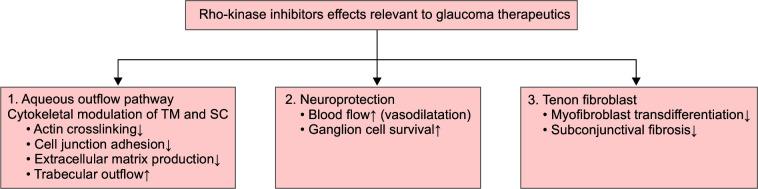
Translational research over the last decade culminating in the development of ROCK inhibitors has provided a much-needed shot in the arm to glaucoma pharmacopeia. ROCK pathway is intricately involved in cytoskeletal modulation with action on cell morphology, cell motility, cell adhesion, cell apoptosis, and smooth muscle contraction. This cytoskeletal modulation property has been utilized to modify trabecular meshwork (TM) resistance, resulting in the discovery of ROCK inhibitors to increase trabecular outflow.
REVIEW RESULTS
Multicentric trials on ROCK inhibitors for antiglaucoma medications are summarized. The focus is on linking pharmacological action to the clinical utility of these drugs. While the Rho Kinase Elevated intraocular Pressure (IOP) Treatment (ROCKET) trials compared monotherapy with ROCK inhibitor netarsudil vs timolol, MERCURY trials compared a fixed dose combination of latanoprost and ROCK inhibitor netarsudil [fixed combination netarsudil-latanoprost (FCNL)] vs monotherapy with either and bimatoprost-timolol combination. While ROCKET trials showed ROCK inhibitors to be non-inferior to timolol, MERCURY trials showed FCNL achieving a much greater IOP reduction than monotherapy with either. Conjunctival hyperemia was the most common side effect reported with ROCK inhibitor use.
CONCLUSION
Moderate efficacy of ROCK inhibitors with a common side effect of conjunctival hyperemia, makes it an adjunctive antiglaucoma drug of choice and not a first-line therapy.
CLINICAL SIGNIFICANCE
ROCK inhibitors' action on diseased TM is more physiological compared to available antiglaucoma medications that either reduce aqueous secretion or enhance uveoscleral outflow. The property of ROCK inhibition to stabilize the endothelium of both retinal vasculature and cornea has opened a new chapter in the treatment of diabetic retinopathy and corneal decompensation.
HOW TO CITE THIS ARTICLE
Singh K, Singh A. Rho-kinase Inhibitors in Ocular Diseases: A Translational Research Journey. J Curr Glaucoma Pract 2023;17(1):44-48.
目的
本综述总结了目前Rho激酶(ROCK)抑制剂在眼部疾病,主要是青光眼中的应用数据。
背景
过去十年的转化研究最终促成了ROCK抑制剂的开发,为青光眼药物学提供了急需的助力。ROCK通路与细胞骨架调节密切相关,对细胞形态、细胞运动、细胞黏附、细胞凋亡和平滑肌收缩均有作用。这种细胞骨架调节特性已被用于改变小梁网(TM)阻力,从而发现了ROCK抑制剂可增加小梁网房水流出量。
综述结果
总结了关于ROCK抑制剂作为抗青光眼药物的多中心试验。重点是将这些药物的药理作用与临床应用联系起来。虽然Rho激酶升高眼压(IOP)治疗(ROCKET)试验比较了ROCK抑制剂奈他洛尔单药治疗与噻吗洛尔的疗效,但汞试验比较了拉坦前列素与ROCK抑制剂奈他洛尔的固定剂量组合[固定组合奈他洛尔-拉坦前列素(FCNL)]与单药治疗以及比马前列素-噻吗洛尔组合的疗效。虽然ROCKET试验表明ROCK抑制剂不劣于噻吗洛尔,但汞试验表明FCNL降低眼压的效果比单药治疗要好得多。结膜充血是使用ROCK抑制剂报告的最常见副作用。
结论
ROCK抑制剂疗效中等,常见副作用为结膜充血,使其成为辅助抗青光眼药物的首选,而非一线治疗药物。
临床意义
与现有的减少房水分泌或增加葡萄膜巩膜流出量的抗青光眼药物相比,ROCK抑制剂对病变小梁网的作用更具生理性。ROCK抑制稳定视网膜血管内皮和角膜内皮的特性为糖尿病视网膜病变和角膜失代偿的治疗开辟了新篇章。
如何引用本文
Singh K, Singh A. Rho激酶抑制剂在眼部疾病中的应用:一段转化研究历程。《当代青光眼实践杂志》2023年;17(1):44-48。
 Zotero 插件