
一个 ParDE 毒素-抗毒素系统负责维持毒性质粒,但与 III 型分泌系统相关的生长抑制无关。
A ParDE toxin-antitoxin system is responsible for the maintenance of the virulence plasmid but not for type III secretion-associated growth inhibition.
机构信息
Department of Ecophysiology, Max Planck Institute for Terrestrial Microbiology, Marburg, Germany.
Department of Microbiology and Molecular Biology, Justus Liebig University Gießen, Gießen, Germany.
出版信息
Front Cell Infect Microbiol. 2023 May 9;13:1166077. doi: 10.3389/fcimb.2023.1166077. eCollection 2023.
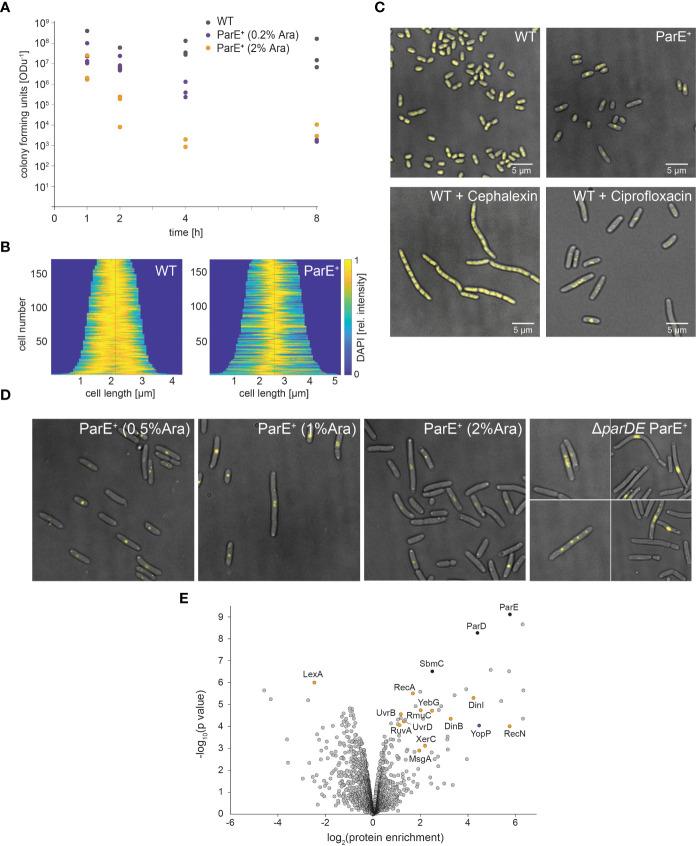
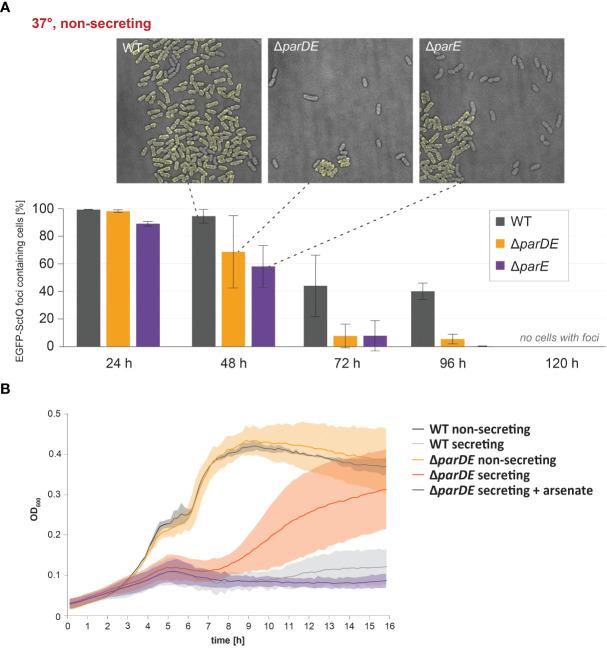
Many Gram-negative pathogens utilize the type III secretion system (T3SS) to translocate virulence-promoting effector proteins into eukaryotic host cells. The activity of this system results in a severe reduction of bacterial growth and division, summarized as secretion-associated growth inhibition (SAGI). In , the T3SS and related proteins are encoded on a virulence plasmid. We identified a ParDE-like toxin-antitoxin system on this virulence plasmid in genetic proximity to , encoding a T3SS effector. Effectors are strongly upregulated upon activation of the T3SS, indicating a potential role of the ParDE system in the SAGI or maintenance of the virulence plasmid. Expression of the toxin ParE resulted in reduced growth and elongated bacteria, highly reminiscent of the SAGI. Nevertheless, the activity of ParDE is not causal for the SAGI. T3SS activation did not influence ParDE activity; conversely, ParDE had no impact on T3SS assembly or activity itself. However, we found that ParDE ensures the presence of the T3SS across bacterial populations by reducing the loss of the virulence plasmid, especially under conditions relevant to infection. Despite this effect, a subset of bacteria lost the virulence plasmid and regained the ability to divide under secreting conditions, facilitating the possible emergence of T3SS-negative bacteria in late acute and persistent infections.
许多革兰氏阴性病原体利用 III 型分泌系统(T3SS)将促进毒力的效应蛋白易位到真核宿主细胞中。该系统的活性导致细菌生长和分裂的严重减少,概括为分泌相关生长抑制(SAGI)。在 中,T3SS 及其相关蛋白编码在毒力质粒上。我们在遗传上接近 ,在这个毒力质粒上鉴定出一种 ParDE 样毒素-抗毒素系统,编码 T3SS 效应蛋白。效应蛋白在 T3SS 激活时强烈上调,表明 ParDE 系统在 SAGI 或维持毒力质粒中具有潜在作用。毒素 ParE 的表达导致生长减少和细菌伸长,高度类似于 SAGI。然而,ParDE 的活性并不是 SAGI 的原因。T3SS 激活不会影响 ParDE 活性;相反,ParDE 对 T3SS 组装或自身活性没有影响。然而,我们发现 ParDE 通过减少毒力质粒的丢失来确保 T3SS 在细菌群体中的存在,尤其是在与感染相关的条件下。尽管有这种作用,但一部分细菌失去了毒力质粒,并在分泌条件下恢复了分裂能力,从而促进了 T3SS 阴性细菌在晚期急性和持续性感染中的可能出现。


 Zotero 插件