
随机对照试验研究全身麻醉对微创肾切除术后恢复的影响。
Randomized controlled trial of the effect of general anesthetics on postoperative recovery after minimally invasive nephrectomy.
机构信息
Department of Anesthesiology and Pain Medicine, Seoul National University Hospital, Seoul, Korea.
Department of Anesthesiology and Pain Medicine, Seoul National University College of Medicine, Seoul, Korea.
出版信息
Korean J Anesthesiol. 2024 Feb;77(1):95-105. doi: 10.4097/kja.23083. Epub 2023 May 26.
BACKGROUND
General anesthetic techniques can affect postoperative recovery. We compared the effect of propofol-based total intravenous anesthesia (TIVA) and desflurane anesthesia on postoperative recovery.
METHODS
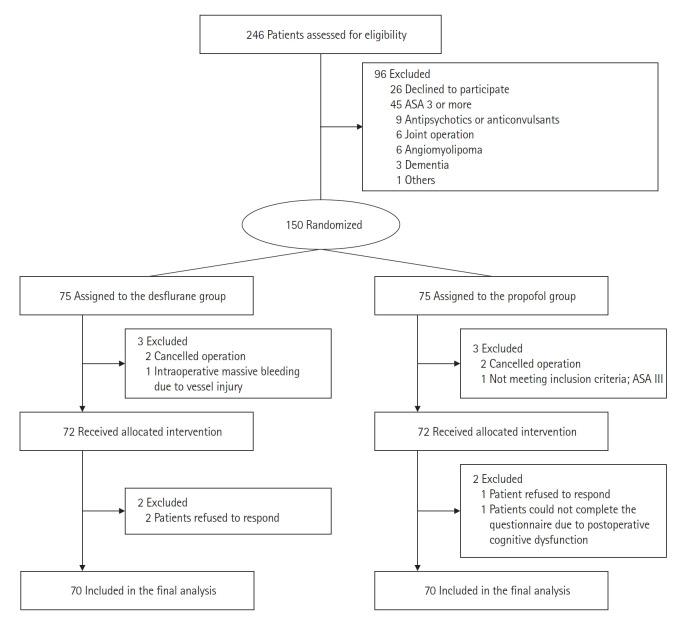
In this randomized trial, 150 patients undergoing robot-assisted or laparoscopic nephrectomy for renal cancer were randomly allocated to either the TIVA or desflurane anesthesia (DES) group. Postoperative recovery was evaluated using the Korean version of the Quality of Recovery-15 questionnaire (QoR-15K) at 24 h, 48 h, and 72 h postoperatively. A generalized estimating equation (GEE) was performed to analyze longitudinal QoR-15K data. Fentanyl consumption, pain severity, postoperative nausea and vomiting, and quality of life three weeks after discharge were also compared.
RESULTS
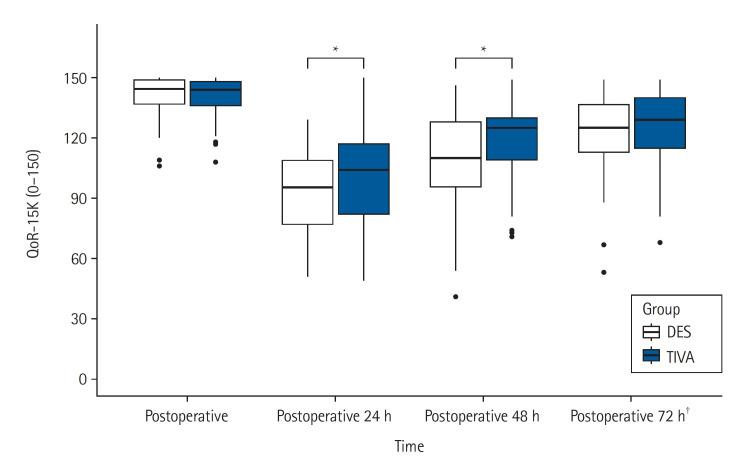
Data were analyzed for 70 patients in each group. The TIVA group showed significantly higher QoR-15K scores at 24 and 48 h postoperatively (24 h: DES, 96 [77, 109] vs. TIVA, 104 [82, 117], median difference 8 [95% CI: 1, 15], P = 0.029; 48 h: 110 [95, 128] vs. 125 [109, 130], median difference 8 [95% CI: 1, 15], P = 0.022), however not at 72 h (P = 0.400). The GEE revealed significant effects of group (adjusted mean difference 6.2, 95% CI: 0.39, 12.1, P = 0.037) and time (P < 0.001) on postoperative QoR-15K scores without group-time interaction (P = 0.051). However, there were no significant differences in other outcomes, except for fentanyl consumption, within the first 24 h postoperatively.
CONCLUSIONS
Propofol-based TIVA showed only a transient improvement in postoperative recovery than desflurane anesthesia, without significant differences in other outcomes.
背景
全身麻醉技术会影响术后恢复。我们比较了依托咪酯全凭静脉麻醉(TIVA)和地氟烷麻醉对术后恢复的影响。
方法
在这项随机试验中,150 例行机器人辅助或腹腔镜肾切除术的肾癌患者被随机分配到 TIVA 或地氟烷麻醉(DES)组。术后 24 小时、48 小时和 72 小时使用韩国版恢复质量问卷(QoR-15K)评估术后恢复情况。使用广义估计方程(GEE)分析纵向 QoR-15K 数据。还比较了芬太尼消耗量、疼痛严重程度、术后恶心呕吐和出院后 3 周的生活质量。
结果
每组均对 70 例患者的数据进行了分析。TIVA 组术后 24 小时和 48 小时 QoR-15K 评分显著升高(24 小时:DES,96[77,109] vs. TIVA,104[82,117],中位数差异 8[95%CI:1,15],P=0.029;48 小时:110[95,128] vs. 125[109,130],中位数差异 8[95%CI:1,15],P=0.022),但在 72 小时时无差异(P=0.400)。GEE 显示,组间(调整后的平均差异 6.2,95%CI:0.39,12.1,P=0.037)和时间(P<0.001)对术后 QoR-15K 评分有显著影响,无组间-时间交互作用(P=0.051)。然而,除了术后前 24 小时的芬太尼消耗量外,其他结果没有显著差异。
结论
依托咪酯 TIVA 仅在术后恢复方面短暂优于地氟烷麻醉,其他结果无显著差异。
 Zotero 插件