
中国社区居住的老年人衰弱与不良结局风险:四种不同衰弱量表的比较。
Frailty and risk of adverse outcomes among community-dwelling older adults in China: a comparison of four different frailty scales.
机构信息
School of Public Health, Fudan University, Shanghai, China.
Division of Chronic Non-communicable Disease and Injury, Shanghai Municipal Center for Disease Control and Prevention, Shanghai, China.
出版信息
Front Public Health. 2023 May 10;11:1154809. doi: 10.3389/fpubh.2023.1154809. eCollection 2023.
BACKGROUND
Data on which frailty scales are most suitable for estimating risk in Chinese community populations remain limited. Herein we examined and compared four commonly used frailty scales in predicting adverse outcomes in a large population-based cohort of Chinese older adults.
METHODS
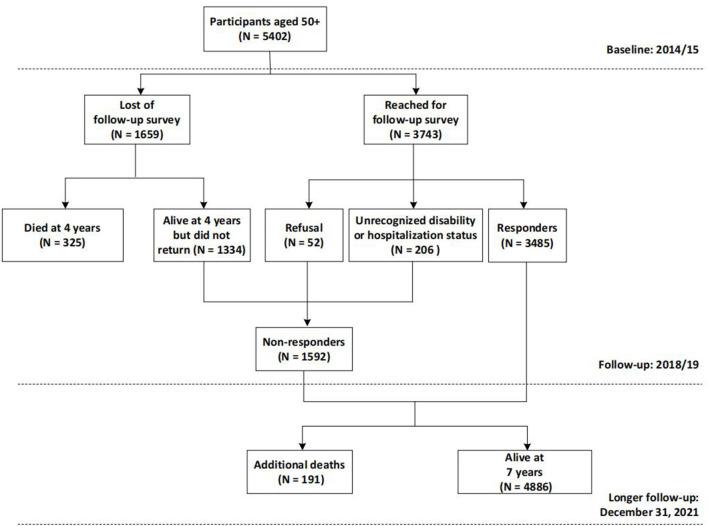
A total of 5402 subjects (mean age 66.3 ± 9.6 years, 46.6% male) from the WHO Study on global AGEing and adult health (SAGE) in Shanghai were studied. Frailty was measured using a 35-item frailty index (FI), the frailty phenotype (FP), FRAIL, and Tilburg Frailty Indicator (TFI). Multivariate logistic regression models were performed to evaluate the independent association between frailty and outcomes including 4-year disability, hospitalization, and 4- and 7-year all-cause mortality. The accuracy for predicting these outcomes was determined by evaluating the area under the curve (AUC). The prevalence of frailty, sensitivity, and specificity were calculated using our proposed cut-off points and other different values.
RESULTS
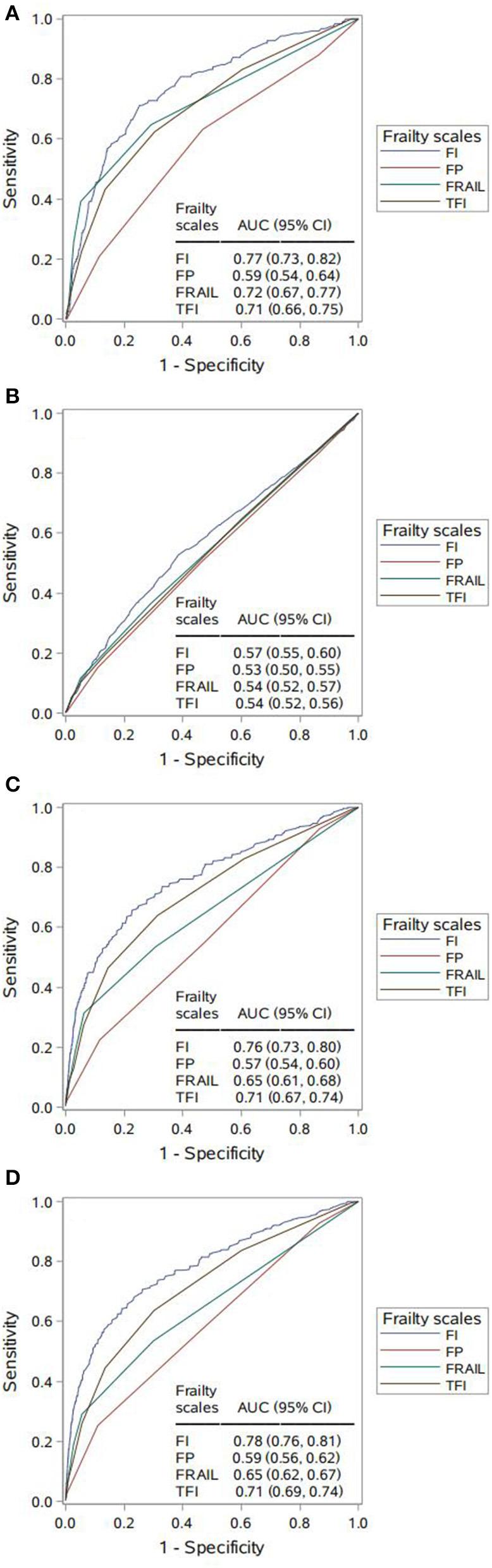
Prevalence of frailty ranged from 4.2% (FRAIL) to 16.9% (FI). FI, FRAIL and TFI were comparably associated with 4-year hospitalization, and 4- and 7-year mortality (adjusted odds ratios [aORs] 1.44-1.69, 1.91-2.22 and 1.85-2.88, respectively). FRAIL conferred the greatest risk of 4-year disability, followed by FI and TFI (aOR 5.55, 3.50, and 1.91, respectively). FP only independently predicted 4- and 7-year mortality (aOR 1.57 and 2.21, respectively). AUC comparisons showed that FI, followed by TFI and FRAIL, exhibited acceptable predictive accuracy for 4-year disability, 4- and 7-year mortality (AUCs 0.76-0.78, 0.71-0.71, 0.65-0.72, respectively), whereas all scales poorly predicted 4-year hospitalization (AUCs 0.53-0.57). For each scale, while specificity estimates (85.3-97.3%) were high and similar across all outcomes, their sensitivity estimates (6.3-56.8%) were not sufficient yet. Prevalence of frailty, sensitivity, and specificity varied considerably when different cut-off points were used.
CONCLUSION
Frailty defined using any of the four scales was associated with an increased risk of adverse outcomes. Although FI, FRAIL and TFI exhibited fair-to-moderate predictive accuracy and high specificity estimates, their sensitivity estimates were not sufficient yet. Overall, FI performed best in estimating risk, while TFI and FRAIL were additionally useful, the latter perhaps being more applicable to Chinese community-dwelling older adults.
背景
用于评估中国社区人群风险的衰弱量表仍存在局限性。在此,我们研究并比较了四种常用的衰弱量表在预测中国老年人群大型队列不良结局中的作用。
方法
本研究纳入了来自世界卫生组织(WHO)老龄化与成人健康研究(SAGE)上海队列的 5402 名受试者(平均年龄 66.3±9.6 岁,46.6%为男性)。采用 35 项衰弱指数(FI)、衰弱表型(FP)、衰弱量表(FRAIL)和蒂尔堡衰弱指数(TFI)评估衰弱。采用多变量逻辑回归模型评估衰弱与包括 4 年残疾、住院和 4 年及 7 年全因死亡率等结局之间的独立关联。通过评估曲线下面积(AUC)来确定这些结局的预测准确性。采用我们提出的截断值和其他不同的值计算衰弱的患病率、敏感性和特异性。
结果
衰弱的患病率范围为 4.2%(FRAIL)至 16.9%(FI)。FI、FRAIL 和 TFI 与 4 年住院、4 年及 7 年死亡率呈相似关联(调整后的优势比[OR]分别为 1.44-1.69、1.91-2.22 和 1.85-2.88)。FRAIL 预测 4 年残疾的风险最大,其次是 FI 和 TFI(OR 分别为 5.55、3.50 和 1.91)。FP 仅独立预测 4 年及 7 年死亡率(OR 分别为 1.57 和 2.21)。AUC 比较表明,FI 其次是 TFI 和 FRAIL,对 4 年残疾、4 年及 7 年死亡率具有可接受的预测准确性(AUC 分别为 0.76-0.78、0.71-0.71、0.65-0.72),而所有量表对 4 年住院的预测效果均较差(AUC 为 0.53-0.57)。对于每个量表,尽管特异性估计值(85.3%-97.3%)在所有结局中均较高且相似,但敏感性估计值(6.3%-56.8%)并不足够。使用不同截断值时,衰弱的患病率、敏感性和特异性差异较大。
结论
使用这四种量表中的任何一种定义的衰弱与不良结局风险增加相关。尽管 FI、FRAIL 和 TFI 具有较好的预测准确性和较高的特异性估计值,但它们的敏感性估计值仍不够。总体而言,FI 在评估风险方面表现最佳,而 TFI 和 FRAIL 也有一定的预测价值,后者可能更适用于中国社区居住的老年人群。
 Zotero 插件