
具有不同繁殖潜力的小母牛外周血白细胞的miRNA表达谱。
miRNA expression profiles of peripheral white blood cells from beef heifers with varying reproductive potential.
作者信息
Banerjee Priyanka, Diniz Wellison J S, Rodning Soren P, Dyce Paul W
机构信息
Department of Animal Sciences, Auburn University, Auburn, AL, United States.
出版信息
Front Genet. 2023 May 10;14:1174145. doi: 10.3389/fgene.2023.1174145. eCollection 2023.
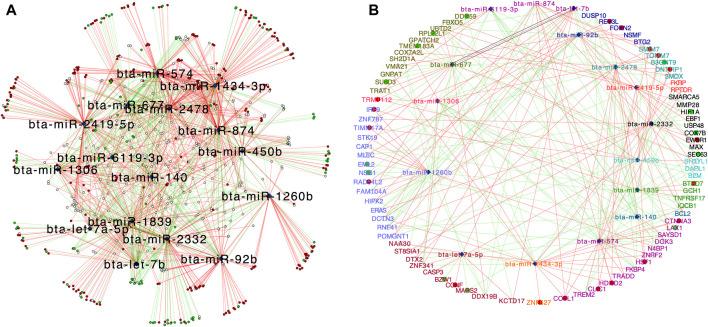
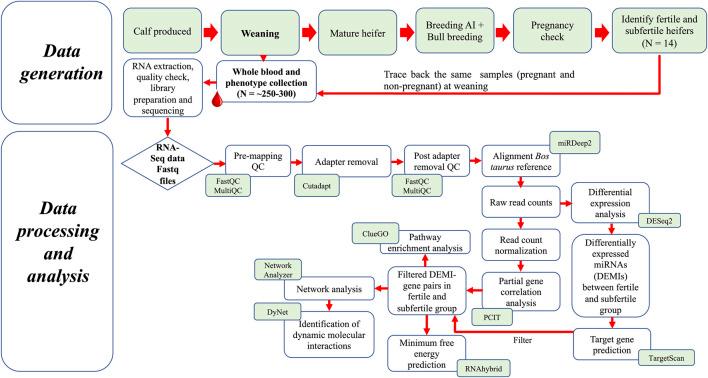
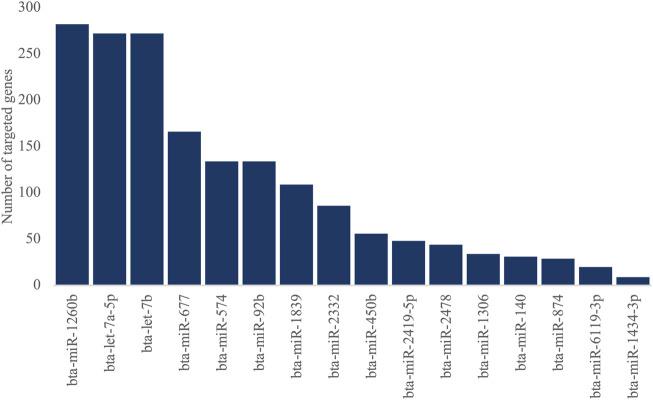
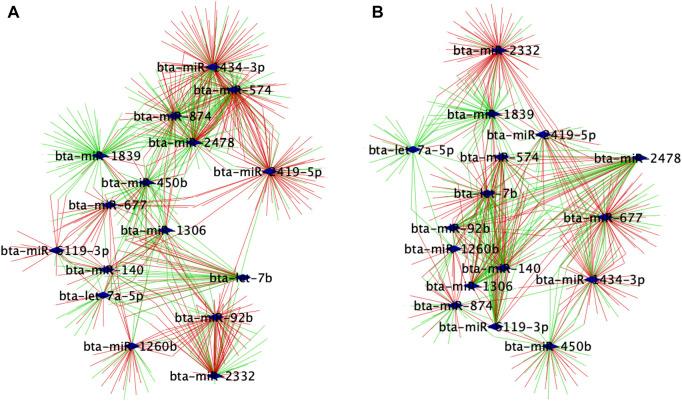
Reproductive performance is the most critical factor affecting production efficiency in the cow-calf industry. Heifers with low reproductive efficiency may fail to become pregnant during the breeding season or maintain a pregnancy. The cause of reproductive failure often remains unknown, and the non-pregnant heifers are not identified until several weeks after the breeding season. Therefore, improving heifer fertility utilizing genomic information has become increasingly important. One approach is using microRNAs (miRNA) in the maternal blood that play an important role in regulating the target genes underlying pregnancy success and thereby in selecting reproductively efficient heifers. Therefore, the current study hypothesized that miRNA expression profiles from peripheral white blood cells (PWBC) at weaning could predict the future reproductive outcome of beef heifers. To this end, we measured the miRNA profiles using small RNA-sequencing in Angus-Simmental crossbred heifers sampled at weaning and retrospectively classified as fertile (FH, = 7) or subfertile (SFH, = 7). In addition to differentially expressed miRNAs (DEMIs), their target genes were predicted from TargetScan. The PWBC gene expression from the same heifers were retrieved and co-expression networks were constructed between DEMIs and their target genes. We identified 16 differentially expressed miRNAs between the groups (-value ≤0.05 and absolute (log2 fold change ≥0.05)). Interestingly, based on a strong negative correlation identified from miRNA-gene network analysis with PCIT (partial correlation and information theory), we identified miRNA-target genes in the SFH group. Additionally, TargetScan predictions and differential expression analysis identified bta-miR-1839 with bta-miR-92b with and , bta-miR-2419-5p with , bta-miR-1260b with , and , and bta-let-7a-5p with , as miRNA-gene targets. The miRNA-target gene pairs in the FH group are over-represented for MAPK, ErbB, HIF-1, FoxO, p53, mTOR, T-cell receptor, insulin and GnRH signaling pathways, while those in the SFH group include cell cycle, p53 signaling pathway and apoptosis. Some miRNAs, miRNA-target genes and regulated pathways identified in this study have a potential role in fertility; other targets are identified as novel and need to be validated in a bigger cohort that could help to predict the future reproductive outcomes of beef heifers.
繁殖性能是影响肉牛产业生产效率的最关键因素。繁殖效率低的小母牛在繁殖季节可能无法怀孕或维持妊娠。繁殖失败的原因往往不明,未怀孕的小母牛直到繁殖季节后的几周才会被识别出来。因此,利用基因组信息提高小母牛的繁殖力变得越来越重要。一种方法是利用母体血液中的微小RNA(miRNA),其在调节妊娠成功的潜在靶基因方面发挥重要作用,从而用于选择繁殖效率高的小母牛。因此,本研究假设断奶时外周血白细胞(PWBC)的miRNA表达谱可以预测肉牛小母牛未来的繁殖结果。为此,我们在断奶时采集的安格斯-西门塔尔杂交小母牛中,使用小RNA测序测量了miRNA谱,并将其回顾性分类为可育(FH,n = 7)或亚可育(SFH,n = 7)。除了差异表达的miRNA(DEMIs),还从TargetScan预测了它们的靶基因。检索了同一小母牛的PWBC基因表达,并构建了DEMIs与其靶基因之间的共表达网络。我们在两组之间鉴定出16种差异表达的miRNA(P值≤0.05且绝对(log2倍数变化)≥0.05)。有趣的是,基于使用PCIT(偏相关和信息理论)从miRNA-基因网络分析中确定的强负相关,我们在SFH组中鉴定出了miRNA靶基因。此外,TargetScan预测和差异表达分析确定bta-miR-1839与……、bta-miR-92b与……、bta-miR-2419-5p与……、bta-miR-1260b与……以及bta-let-7a-5p与……作为miRNA-基因靶点。FH组中的miRNA-靶基因对在MAPK、ErbB、HIF-1、FoxO、p53、mTOR、T细胞受体、胰岛素和GnRH信号通路中过度富集,而SFH组中的则包括细胞周期、p53信号通路和细胞凋亡。本研究中鉴定出的一些miRNA、miRNA靶基因和调控途径在繁殖力方面具有潜在作用;其他靶点被鉴定为新靶点,需要在更大的队列中进行验证,这可能有助于预测肉牛小母牛未来的繁殖结果。

 Zotero 插件