
比较碳离子束和伽马射线辐照诱导大豆((L.)Merr.)表型和基因组突变及特征分析。
Comparison and Characterization of Phenotypic and Genomic Mutations Induced by a Carbon-Ion Beam and Gamma-ray Irradiation in Soybean ( (L.) Merr.).
机构信息
Biophysics Group, Biomedical Center, Institute of Modern Physics, Chinese Academy of Sciences, Lanzhou 730000, China.
University of Chinese Academy of Sciences, Beijing 100049, China.
出版信息
Int J Mol Sci. 2023 May 16;24(10):8825. doi: 10.3390/ijms24108825.
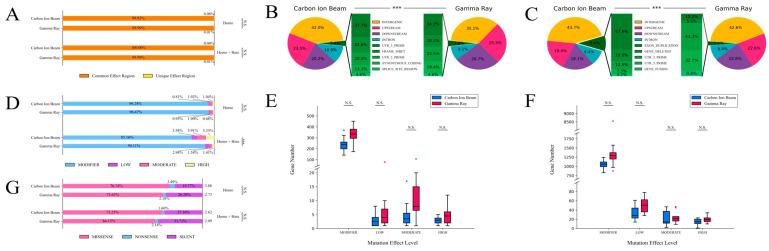
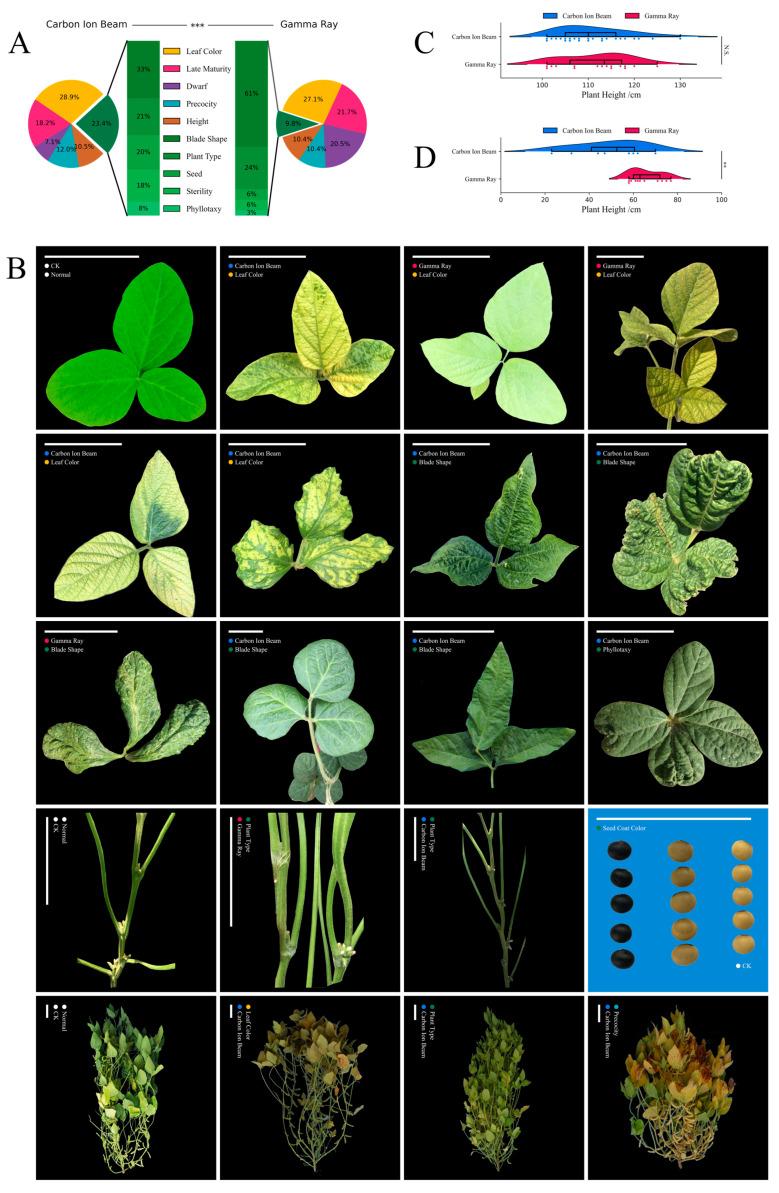
Soybean ( (L.) Merr.) is a nutritious crop that can provide both oil and protein. A variety of mutagenesis methods have been proposed to obtain better soybean germplasm resources. Among the different types of physical mutagens, carbon-ion beams are considered to be highly efficient with high linear energy transfer (LET), and gamma rays have also been widely used for mutation breeding. However, systematic knowledge of the mutagenic effects of these two mutagens during development and on phenotypic and genomic mutations has not yet been elucidated in soybean. To this end, dry seeds of Williams 82 soybean were irradiated with a carbon-ion beam and gamma rays. The biological effects of the M generation included changes in survival rate, yield and fertility. Compared with gamma rays, the relative biological effectiveness (RBE) of the carbon-ion beams was between 2.5 and 3.0. Furthermore, the optimal dose for soybean was determined to be 101 Gy to 115 Gy when using the carbon-ion beam, and it was 263 Gy to 343 Gy when using gamma rays. A total of 325 screened mutant families were detected from out of 2000 M families using the carbon-ion beam, and 336 screened mutant families were found using gamma rays. Regarding the screened phenotypic M mutations, the proportion of low-frequency phenotypic mutations was 23.4% when using a carbon ion beam, and the proportion was 9.8% when using gamma rays. Low-frequency phenotypic mutations were easily obtained with the carbon-ion beam. After screening the mutations from the M generation, their stability was verified, and the genome mutation spectrum of M was systemically profiled. A variety of mutations, including single-base substitutions (SBSs), insertion-deletion mutations (INDELs), multinucleotide variants (MNVs) and structural variants (SVs) were detected with both carbon-ion beam irradiation and gamma-ray irradiation. Overall, 1988 homozygous mutations and 9695 homozygous + heterozygous genotype mutations were detected when using the carbon-ion beam. Additionally, 5279 homozygous mutations and 14,243 homozygous + heterozygous genotype mutations were detected when using gamma rays. The carbon-ion beam, which resulted in low levels of background mutations, has the potential to alleviate the problems caused by linkage drag in soybean mutation breeding. Regarding the genomic mutations, when using the carbon-ion beam, the proportion of homozygous-genotype SVs was 0.45%, and that of homozygous + heterozygous-genotype SVs was 6.27%; meanwhile, the proportions were 0.04% and 4.04% when using gamma rays. A higher proportion of SVs were detected when using the carbon ion beam. The gene effects of missense mutations were greater under carbon-ion beam irradiation, and the gene effects of nonsense mutations were greater under gamma-ray irradiation, which meant that the changes in the amino acid sequences were different between the carbon-ion beam and gamma rays. Taken together, our results demonstrate that both carbon-ion beam and gamma rays are effective techniques for rapid mutation breeding in soybean. If one would like to obtain mutations with a low-frequency phenotype, low levels of background genomic mutations and mutations with a higher proportion of SVs, carbon-ion beams are the best choice.
大豆((L.)Merr.)是一种营养丰富的作物,既能提供油脂,也能提供蛋白质。为了获得更好的大豆种质资源,人们提出了多种诱变方法。在不同类型的物理诱变剂中,碳离子束被认为具有高效性,其线性转移能量(LET)较高,伽马射线也被广泛用于诱变育种。然而,在大豆的发育过程中,以及在表型和基因组突变方面,这两种诱变剂的诱变效应还没有系统的知识。为此,本研究用碳离子束和伽马射线辐照威廉姆斯 82 大豆的干种子。M 代的生物效应包括存活率、产量和育性的变化。与伽马射线相比,碳离子束的相对生物学效应(RBE)在 2.5 到 3.0 之间。此外,当使用碳离子束时,大豆的最佳剂量为 101Gy 到 115Gy,当使用伽马射线时,最佳剂量为 263Gy 到 343Gy。在 2000 个 M 代家族中,用碳离子束共筛选出 325 个突变家族,用伽马射线筛选出 336 个突变家族。关于筛选出的表型 M 突变,用碳离子束时低频表型突变的比例为 23.4%,用伽马射线时的比例为 9.8%。用碳离子束更容易获得低频表型突变。在筛选 M 代的突变后,验证了其稳定性,并系统地分析了 M 代的基因组突变谱。用碳离子束和伽马射线辐照都检测到了各种突变,包括单碱基替换(SBS)、插入缺失突变(INDEL)、多核苷酸变异(MNV)和结构变异(SV)。总的来说,用碳离子束共检测到 1988 个纯合突变和 9695 个纯合+杂合基因型突变,用伽马射线共检测到 5279 个纯合突变和 14243 个纯合+杂合基因型突变。碳离子束导致的背景突变水平较低,有可能缓解大豆诱变育种中由于连锁拖带而产生的问题。在基因组突变方面,用碳离子束时,纯合基因型 SV 的比例为 0.45%,纯合+杂合基因型 SV 的比例为 6.27%;而用伽马射线时,这两个比例分别为 0.04%和 4.04%。用碳离子束时检测到的 SV 比例更高。用碳离子束辐照时,错义突变的基因效应更大,用伽马射线辐照时,无义突变的基因效应更大,这意味着碳离子束和伽马射线引起的氨基酸序列变化不同。综上所述,本研究结果表明,碳离子束和伽马射线都是大豆快速诱变育种的有效技术。如果想获得低频表型的突变、低水平的背景基因组突变和具有更高 SV 比例的突变,碳离子束是最佳选择。



 Zotero 插件