
一种基于吐温20-金纳米颗粒与CdSe/ZnS量子点之间内滤效应的高灵敏度双信号策略用于检测铜。
A Highly Sensitive Dual-Signal Strategy via Inner Filter Effect between Tween 20-Gold Nanoparticles and CdSe/ZnS Quantum Dots for Detecting Cu.
作者信息
Xie Yong, Bian Chao, Han Mingjie, Wang Ri, Li Yang, Xu Yuhao, Xia Shanhong
机构信息
State Key Laboratory of Transducer Technology, Aerospace Information Research Institute, Chinese Academy of Sciences, Beijing 100190, China.
School of Electronic, Electrical and Communication Engineering, University of Chinese Academy of Sciences, Beijing 100049, China.
出版信息
Micromachines (Basel). 2023 Apr 23;14(5):902. doi: 10.3390/mi14050902.
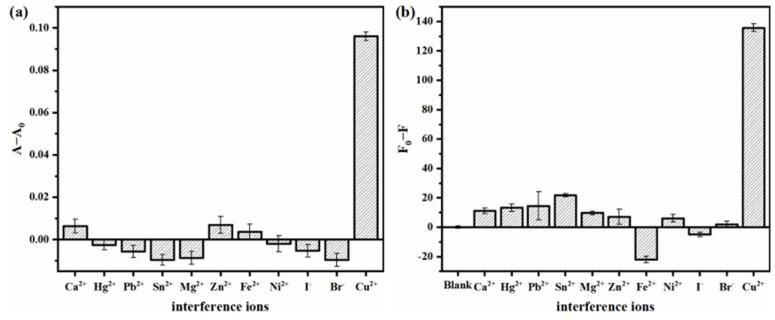
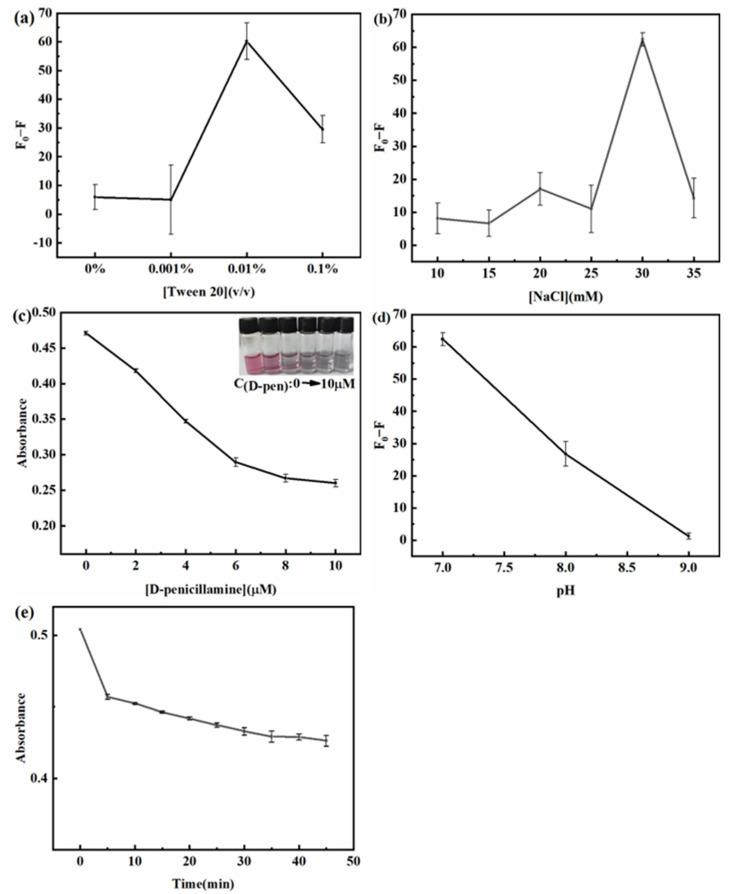
A highly sensitive and accurate dual-signal strategy is developed for trace Cu detection based on the inner filter effect (IFE) between Tween 20-gold nanoparticles (AuNPs) and CdSe/ZnS quantum dots (QDs). Tween 20-AuNPs are utilized as colorimetric probes and excellent fluorescent absorbers. The fluorescence of CdSe/ZnS QDs can be quenched efficiently by Tween 20-AuNPs via IFE. In the presence of D-penicillamine, D-penicillamine induces the aggregation of Tween 20-AuNPs and the fluorescent recovery of CdSe/ZnS QDs at high ionic strength. Upon addition of Cu, D-penicillamine tends to selectively chelate with Cu and then forms the mixed-valence complexes, which consequently inhibits the aggregation of Tween 20-AuNPs and the fluorescent recovery. The dual-signal method is used to quantitatively detect trace Cu, with low detection limits of 0.57 μg/L and 0.36 μg/L for colorimetry and fluorescence, respectively. In addition, the proposed method using a portable spectrometer is applied to the detection of Cu in water. This sensitive, accurate and miniature sensing system has potential in environmental evaluations.
基于吐温20-金纳米粒子(AuNPs)与CdSe/ZnS量子点(QDs)之间的内滤光效应(IFE),开发了一种用于痕量铜检测的高灵敏度和高准确性的双信号策略。吐温20-AuNPs用作比色探针和优异的荧光吸收剂。吐温20-AuNPs可通过IFE有效地猝灭CdSe/ZnS QDs的荧光。在D-青霉胺存在下,D-青霉胺在高离子强度下诱导吐温20-AuNPs聚集以及CdSe/ZnS QDs的荧光恢复。加入铜后,D-青霉胺倾向于与铜选择性螯合,然后形成混合价络合物,从而抑制吐温20-AuNPs的聚集和荧光恢复。该双信号方法用于定量检测痕量铜,比色法和荧光法的检测限分别低至0.57μg/L和0.36μg/L。此外,所提出的使用便携式光谱仪的方法应用于水中铜的检测。这种灵敏、准确且微型的传感系统在环境评估中具有潜力。



 Zotero 插件