
多源固体废弃物对其回填浆液性能影响的研究
Study on the effect of multi-source solid waste on the performance of its backfill slurry.
作者信息
Zhao Xinyuan, Yang Ke, Wei Zhen, He Xiang, Chen Ruiyi
机构信息
State Key Laboratory of Mining Response and Disaster Prevention and Control in Deep Coal Mine, Anhui University of Science and Technology, Huainan, 232001, China.
School of Mining Engineering, Anhui University of Science and Technology, Huainan, 232001, China.
出版信息
Heliyon. 2023 May 16;9(5):e16251. doi: 10.1016/j.heliyon.2023.e16251. eCollection 2023 May.
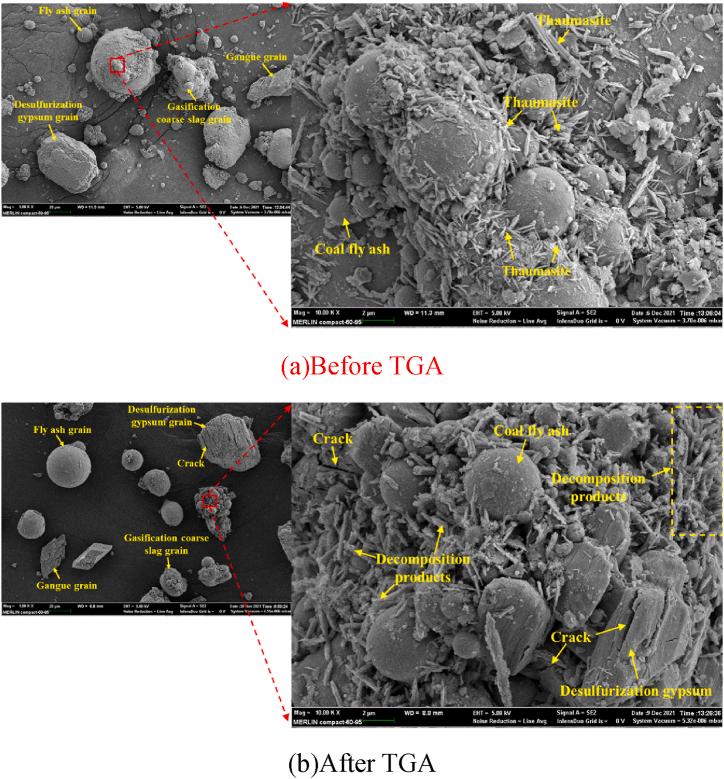
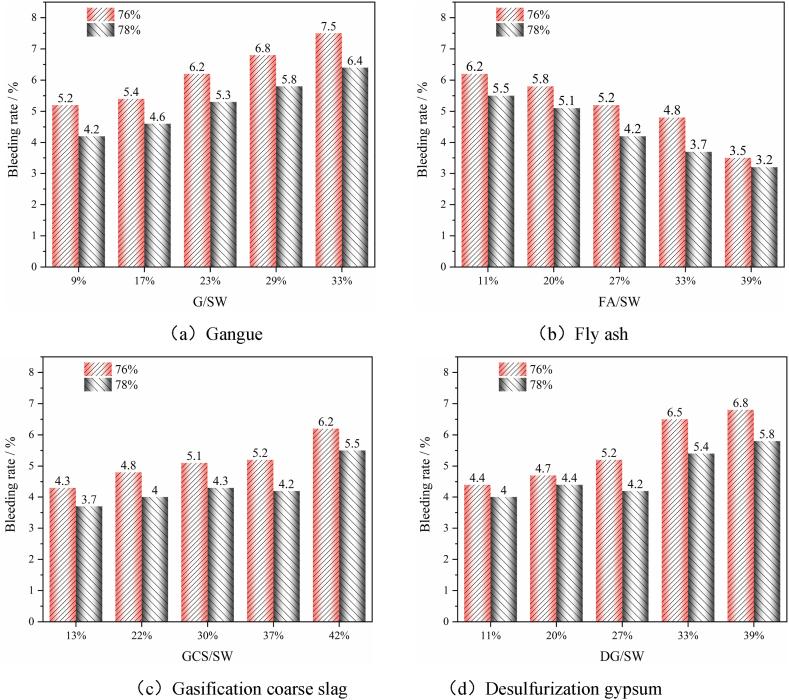
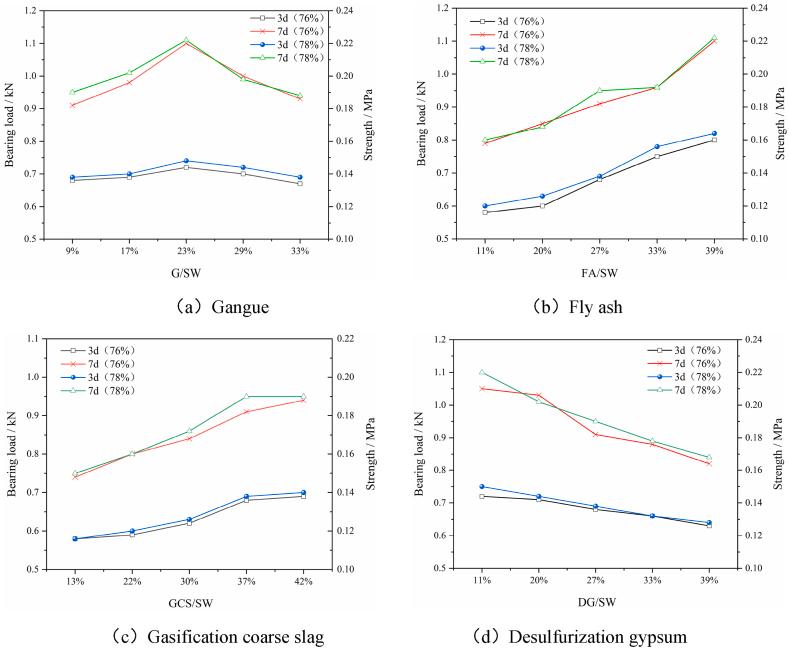
The preparation of slurry from multi-source solid waste for underground backfill adds a way out for solid waste disposal, which is beneficial to reduce environmental impact. In this paper, the effects of gangue, fly ash, gasification coarse slag and desulfurization gypsum on the fluidity, early strength, thermal stability and other properties of the backfill slurry were studied by fluidity test, strength test, Thermo-Gravimetric Analysis (TGA), Scanning Electron Microscope (SEM) and X-ray Diffraction (XRD). The results show that: (1) When G/SW (mass ratio of gangue to solid waste) < 23%, gangue is beneficial to improve the fluidity and early strength of backfill slurry; with the increase of fly ash content, the fluidity of backfill slurry decreases, but its early strength increases; gasification coarse slag has a negative effect on the fluidity of backfill slurry, but it is beneficial to its early strength when GCS/SW (mass ratio of gasification coarse slag to solid waste) < 33%; desulfurization gypsum can improve the fluidity of the backfill slurry, but it is not conducive to the increase of early strength. (2) The compression failure mode of the backfill is mainly divided into the crack-intensive failure, the single main crack penetration splitting failure, and the double main crack conjugate splitting failure. (3) Endothermic dehydration reactions of adsorbed water and crystallization water generally occur at 55-65 °C and 110-130 °C for backfill with different solid waste contents; As the temperature continues to increase, the backfill material undergoes a slow exothermic decomposition reaction; Increasing the content of gangue, fly ash and gasification coarse slag and reducing the content of desulfurized gypsum can make the backfill less weight loss at high temperature and better thermal stability. (4) The main mineral phases in the backfill material are gypsum and quartz, and there are also a small amount of acicular and hexagonal hydration products thaumasite. After high temperature, the thaumasite is dehydrated and decomposed. The research results are helpful to deeply understand the performance of multi-source solid waste for underground backfilling.
利用多源固体废弃物制备用于井下充填的料浆,为固体废弃物处置开辟了一条出路,有利于减少对环境的影响。本文通过流动性试验、强度试验、热重分析(TGA)、扫描电子显微镜(SEM)和X射线衍射(XRD)等方法,研究了煤矸石、粉煤灰、气化粗渣和脱硫石膏对充填料浆流动性、早期强度、热稳定性等性能的影响。结果表明:(1)当G/SW(煤矸石与固体废弃物的质量比)<23%时,煤矸石有利于提高充填料浆的流动性和早期强度;随着粉煤灰含量的增加,充填料浆的流动性降低,但其早期强度增加;气化粗渣对充填料浆的流动性有负面影响,但当GCS/SW(气化粗渣与固体废弃物的质量比)<33%时,有利于其早期强度;脱硫石膏可提高充填料浆的流动性,但不利于早期强度的增加。(2)充填体的压缩破坏模式主要分为裂缝密集破坏、单一主裂缝贯穿劈裂破坏和双主裂缝共轭劈裂破坏。(3)不同固体废弃物含量的充填体在55 - 65℃和110 - 130℃时一般会发生吸附水和结晶水的吸热脱水反应;随着温度继续升高,充填材料发生缓慢的放热分解反应;增加煤矸石、粉煤灰和气化粗渣的含量,降低脱硫石膏的含量,可使充填体在高温下失重减少,热稳定性更好。(4)充填材料中的主要矿物相为石膏和石英,还有少量针状和六方晶系的水化产物碳硫硅钙石。高温后,碳硫硅钙石脱水分解。研究结果有助于深入了解多源固体废弃物用于井下充填的性能。





 Zotero 插件