
赞比亚农村地区的 COVID-19 知识和预防行为:信息-动机-行为技能模型的定性应用。
COVID-19 Knowledge and Prevention Behaviors in Rural Zambia: A Qualitative Application of the Information-Motivation-Behavioral Skills Model.
机构信息
Department of Global Health, Boston University School of Public Health, Boston, Massachusetts.
Section of Infectious Diseases, Boston University School of Medicine, Boston, Massachusetts.
出版信息
Am J Trop Med Hyg. 2023 May 30;109(1):76-89. doi: 10.4269/ajtmh.22-0604. Print 2023 Jul 5.
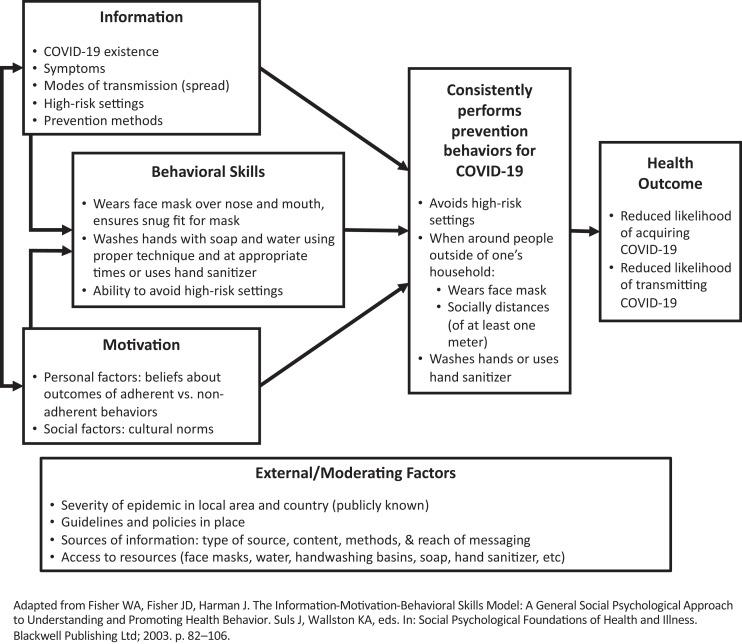
In early 2020, the Zambian Ministry of Health instituted prevention guidelines to limit spread of COVID-19. We assessed community knowledge, motivations, behavioral skills, and perceived community adherence to prevention behaviors (i.e., hand hygiene, mask wearing, social distancing, and limiting gatherings). Within a cluster-randomized controlled trial in four rural districts, in November 2020 and May 2021, we conducted in-depth interviews with health center staff (N = 19) and community-based volunteers (N = 34) and focus group discussions with community members (N = 281). A content analysis was conducted in Nvivo v12. Data were interpreted using the Information-Motivation-Behavioral Skills Model. Generally, respondents showed good knowledge of COVID-19 symptoms, spread, and high-risk activities, with some gaps. Prevention behavior performance was driven by personal and social factors. Respondents described institutional settings (e.g., clinics and church) having higher levels of perceived adherence due to stronger enforcement measures and clear leadership. Conversely, informal community settings (e.g., weddings, funerals, football matches) lacked similar social and leadership expectations for adherence and had lower perceived levels of adherence. These settings often involved higher emotions (excitement or grief), and many involved alcohol use, resulting in community members "forgetting" guidelines. Doubt about disease existence or need for precautions persisted among some community members and drove non-adherence more generally. Although COVID-19 information successfully penetrated these very remote rural communities, more targeted messaging may address persistent COVID-19 doubt and misinformation. Engaging local leaders in religious, civic, and traditional leadership positions could improve community behaviors without adding additional monitoring duties on an already overburdened, resource-limited health system.
2020 年初,赞比亚卫生部制定了预防指南,以限制 COVID-19 的传播。我们评估了社区的知识、动机、行为技能以及对社区遵守预防行为(即手部卫生、戴口罩、保持社交距离和限制聚会)的看法。在四个农村地区进行的一项基于群组的随机对照试验中,我们于 2020 年 11 月和 2021 年 5 月对卫生中心工作人员(N=19)和社区志愿者(N=34)进行了深入访谈,并对社区成员(N=281)进行了焦点小组讨论。在 Nvivo v12 中进行了内容分析。使用信息-动机-行为技能模型对数据进行了解释。总的来说,受访者对 COVID-19 的症状、传播和高风险活动有较好的了解,但也存在一些差距。预防行为的表现受到个人和社会因素的驱动。受访者描述了由于更强有力的执行措施和明确的领导,机构设置(如诊所和教堂)具有更高的遵守率。相比之下,非正式社区设置(如婚礼、葬礼、足球比赛)缺乏类似的社会和领导期望,遵守率较低。这些场所通常涉及更高的情绪(兴奋或悲伤),并且许多场所涉及饮酒,导致社区成员“忘记”遵守规定。一些社区成员对疾病的存在或预防措施的必要性仍存在疑虑,这在更大程度上导致了不遵守行为。虽然 COVID-19 信息成功地渗透到这些非常偏远的农村社区,但更有针对性的信息传递可能会解决持续存在的 COVID-19 疑虑和错误信息。让当地领导在宗教、公民和传统领导岗位上参与进来,可以改善社区行为,而不会给已经负担过重、资源有限的卫生系统增加额外的监督职责。
 Zotero 插件