
预测生育高峰期埃塞俄比亚育龄妇女生育意愿的因素。一项多层次混合效应分析。
Predictors of desire to limit childbearing among reproductive age women in high fertility regions in Ethiopia. A multilevel mixed effect analysis.
机构信息
Department of Health Systems and Policy, Institute of Public Health, College of Medicine and Health Sciences, University of Gondar, Gondar, Ethiopia.
Department of Reproductive Health, Institute of Public Health, College of Medicine and Health Sciences, University of Gondar, Gondar, Ethiopia.
出版信息
BMC Public Health. 2023 May 30;23(1):1011. doi: 10.1186/s12889-023-15952-w.
BACKGROUND
A high fertility rate can have a number of expensive consequences for developing nations, such as limiting economic growth, adversely impacting women and their children's health, and reducing access to quality education, nutrition, and employment. The problem is more obvious in Ethipia's high fertility regions. Therefore, this study aimed to assess predictors of desire to limit childbearing among reproductive age women in high fertility regions in Ethiopia.
METHODS
The analysis was based on secondary data using the 2016 Ethiopian Demographic and Health Survey. Stata version 14 software was used for analysis. A multi-level mixed-effect logistic regression analysis was fitted. Adjusted Odds Ratio at 95% confidence interval was used to show the strength and direction of the association. Statistical significance was declared at a P- value less than 0.05.
RESULTS
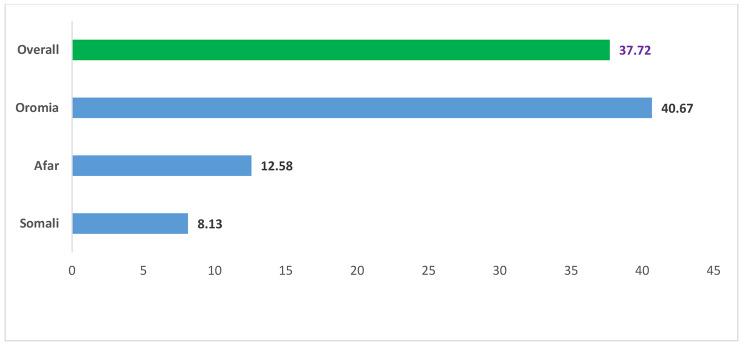
The overall desire to limit childbearing in high fertility regions in Ethiopia was 37.7% (95% CI: 36.28, 39.17). Age; 25-34 (AOR = 3.74; 95% CI: 2.97, 4.73), 35-49 years (AOR = 14; 95% CI: 10.85, 18.06), women education; Primary education (AOR = 0.73; 95% CI: 0.61, 0.88), secondary and higher (AOR = 0.29; 95% CI: 0.19, 0.43), from the community level variables Oromia National Regional state (AOR = 5.86; 95% CI: 2.82, 12.23), high proportion of community level poverity (AOR = 0.67; 95% CI: 0.45, 0.98), and high proportion of community level media exposure (AOR = 1.53; 95% CI: 1.07, 2.19) were statistically significant factors for desire to limit childbearing in high fertility regions of Ethiopia.
CONCLUSION
Nearly four in ten women had the desire to limit childbearing in high fertility regions in Ethiopia. Thus, to fulfill the women's desire to limit childbearing, Ministry of Health and health facilities are needed to increase financial support strategies and Family planning programs that enable pregnant women from poor households to use health services. In addition, increasing community level media exposure are important interventions.
背景
高生育率会给发展中国家带来许多昂贵的后果,例如限制经济增长、对妇女及其子女的健康产生不利影响,以及减少获得优质教育、营养和就业的机会。在埃塞俄比亚生育率较高的地区,这个问题更加明显。因此,本研究旨在评估埃塞俄比亚高生育率地区育龄妇女生育意愿的预测因素。
方法
本分析基于使用 2016 年埃塞俄比亚人口与健康调查的二次数据。采用 Stata 版本 14 软件进行分析。采用多水平混合效应逻辑回归分析进行拟合。使用 95%置信区间的调整优势比来表示关联的强度和方向。P 值小于 0.05 表示具有统计学意义。
结果
埃塞俄比亚高生育率地区的总体生育意愿为 37.7%(95%CI:36.28,39.17)。年龄;25-34 岁(AOR=3.74;95%CI:2.97,4.73),35-49 岁(AOR=14;95%CI:10.85,18.06),妇女教育;小学教育(AOR=0.73;95%CI:0.61,0.88),中学及以上(AOR=0.29;95%CI:0.19,0.43),从社区层面变量奥罗米亚州(AOR=5.86;95%CI:2.82,12.23),高比例的社区贫困(AOR=0.67;95%CI:0.45,0.98),高比例的社区媒体接触(AOR=1.53;95%CI:1.07,2.19)是埃塞俄比亚高生育率地区生育意愿的统计学显著因素。
结论
近四成的妇女希望在埃塞俄比亚高生育率地区限制生育。因此,为了满足妇女的生育意愿,需要卫生健康部和卫生设施增加财政支持策略和计划生育方案,使贫困家庭的孕妇能够使用卫生服务。此外,增加社区层面的媒体接触是重要的干预措施。

 Zotero 插件