
加拿大可步行性和住房负担能力的生态分析:城市规模和邻里物业类型构成的调节作用。
An ecological analysis of walkability and housing affordability in Canada: Moderation by city size and neighbourhood property type composition.
机构信息
Department of Community Health Sciences, Cumming School of Medicine, University of Calgary, Alberta, Canada.
Department of Cancer Epidemiology and Prevention Research, Cancer Care Alberta, Alberta Health Services, Calgary, Alberta Canada.
出版信息
PLoS One. 2023 May 31;18(5):e0285397. doi: 10.1371/journal.pone.0285397. eCollection 2023.
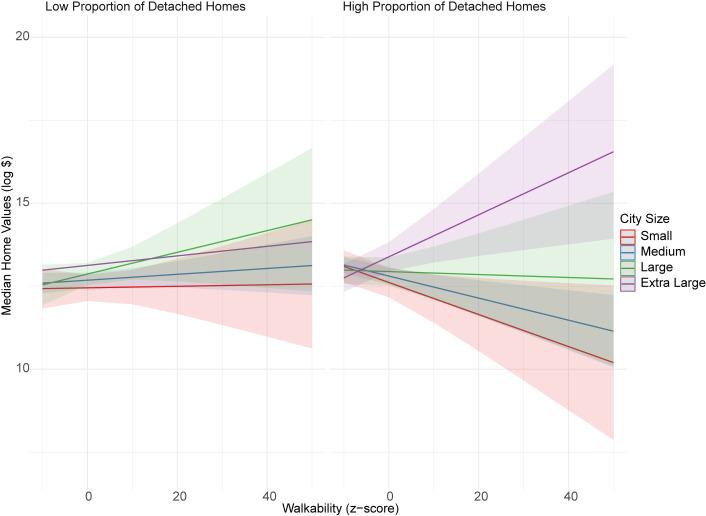
The neighbourhood built environment can support the physical activity of adults regardless of their individual-level socioeconomic status. However, physical activity supportive (walkable) neighbourhoods may not be accessible to those with lower incomes if homes in walkable neighbourhoods are too expensive. The objectives of this study were: 1) to estimate the associations between neighbourhood walkability and home values in Canadian cities, and 2) to test whether these associations differ by city size and residential property type composition within neighbourhoods. We linked built environment data from the 2016 Canadian Active Living Environments (Can-ALE) index with neighbourhood-level structural home characteristics and sociodemographic data from the 2016 Canadian census for 33,026 neighbourhoods across 31 Census Metropolitan Areas. We used multilevel linear regression models to estimate covariate-adjusted associations between neighbourhood walkability and natural-log median home values and tested city size and neighbourhood property type composition as moderators. There were no statistically significant associations between walkability and home values overall. The associations between neighbourhood walkability and home values were jointly moderated by city size and property type composition. For small and medium sized cities, within neighbourhoods containing a high proportion of detached homes, walkability was negatively associated with home values (b = -0.05, 95% CI: -0.10, -0.01; and, b = -0.04, 95% CI: -0.06, -0.02, for small and medium cities, respectively). However, for extra-large cities, within neighbourhoods containing a high proportion of detached homes, walkability was positively associated with home values (b = 0.06, 95% CI: 0.01, 0.10). Our findings suggest that, based on housing affordability, higher walkable neighbourhoods are likely accessible to lower income households that are situated in small and medium Canadian cities. In larger cities, however, municipal interventions (e.g., inclusionary zoning or targeted development of subsidized or social housing) may be needed to ensure equitable access to walkable neighbourhoods for lower income households.
邻里环境可以支持成年人的身体活动,而无论他们的个人社会经济地位如何。然而,如果步行友好型社区的住房价格过高,那么收入较低的人可能无法进入这些社区。本研究的目的是:1)估计加拿大城市邻里步行性与房屋价值之间的关联,以及 2)检验这些关联是否因城市规模和邻里内住宅物业类型构成的差异而有所不同。我们将 2016 年加拿大积极生活环境(Can-ALE)指数的建筑环境数据与 2016 年加拿大人口普查的邻里结构房屋特征和社会人口数据进行了链接,为 31 个人口普查大都市区的 33026 个邻里提供了数据。我们使用多水平线性回归模型来估计邻里步行性与自然对数中位数房价之间的协变量调整关联,并检验城市规模和邻里物业类型构成的调节作用。整体而言,步行性与房价之间没有统计学上显著的关联。邻里步行性与房价之间的关联受到城市规模和物业类型构成的共同调节。对于中小城市,在以独立屋为主的邻里中,步行性与房价呈负相关(b=-0.05,95%CI:-0.10,-0.01;b=-0.04,95%CI:-0.06,-0.02,分别适用于中小城市)。然而,对于特大都市,在以独立屋为主的邻里中,步行性与房价呈正相关(b=0.06,95%CI:0.01,0.10)。我们的研究结果表明,基于住房负担能力,较高的步行友好型社区可能更容易被位于加拿大中小城市的低收入家庭所接受。然而,在较大的城市,可能需要进行市政干预(例如,包容性分区或有针对性地开发补贴或社会住房),以确保低收入家庭能够平等地获得步行友好型社区。
 Zotero 插件