
体重指数对新辅助靶向治疗的HER2阳性乳腺癌治疗反应的影响:一项多中心研究和荟萃分析。
Impact of body mass index in therapeutic response for HER2 positive breast cancer treated with neoadjuvant targeted therapy: a multi-center study and meta-analysis.
作者信息
Chen Lili, Wu Fan, Chen Xiaobin, Chen Yazhen, Deng Lin, Cai Qindong, Wu Long, Guo Wenhui, Chen Minyan, Li Yan, Zhang Wenzhe, Jin Xuan, Chen Hanxi, Nie Qian, Wu Xiong, Lin Yuxiang, Wang Chuan, Fu Fangmeng
机构信息
Department of Breast Surgery, Fujian Medical University Union Hospital, 350001, Fuzhou, Fujian Province, China.
Department of General Surgery, Fujian Medical University Union Hospital, 350001, Fuzhou, Fujian Province, China.
出版信息
NPJ Breast Cancer. 2023 May 31;9(1):46. doi: 10.1038/s41523-023-00552-z.
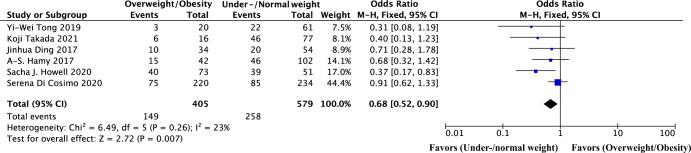
While overweight/obesity has become a major public health issue worldwide, any association between body mass index (BMI) and therapeutic response in neoadjuvant targeted therapy treated HER2 positive breast cancer patients remain unclear. The information from a total of four-hundred and ninety-one neoadjuvant targeted therapy treated HER2 positive breast cancer patients from four institutions were retrospectively collected. Univariate and multivariate logistic analysis was developed to determine the association between BMI and therapeutic response. A meta-analysis of published literature was then conducted to confirm the effect of overweight/obesity on pCR for patients treated with neoadjuvant targeted therapy. Restricted cubic spline (RCS) adjusted for confounding factors demonstrated a decrease pCR with increasing BMI (OR = 0.937, P = 0.045). Patients were then categorized into under/normal weight (n = 299) and overweight/obesity (n = 192). Overweight/obese patients were independently associated with a poor therapeutic response. In the subgroup analysis, a significant negative impact of overweight/obesity on pCR can be observed both in single-targeted (OR = 0.556; P = 0.02) and dual-targeted (OR = 0.392; P = 0.021) populations. Six eligible studies involving 984 neoadjuvant targeted therapy treated HER2 positive breast cancer patients were included in the meta-analysis. The meta-analysis also demonstrated that overweight/obesity was significantly associated with a poor response to neoadjuvant anti-HER2 therapy (OR = 0.68; P = 0.007). Our result show that overweight and obese HER2 positive breast cancer patients are less likely to achieve pCR after neoadjuvant targeted therapy.
虽然超重/肥胖已成为全球主要的公共卫生问题,但在接受新辅助靶向治疗的HER2阳性乳腺癌患者中,体重指数(BMI)与治疗反应之间的任何关联仍不清楚。回顾性收集了来自四个机构的总共491例接受新辅助靶向治疗的HER2阳性乳腺癌患者的信息。进行单因素和多因素逻辑分析以确定BMI与治疗反应之间的关联。然后对已发表的文献进行荟萃分析,以确认超重/肥胖对接受新辅助靶向治疗患者的病理完全缓解(pCR)的影响。对混杂因素进行调整的受限立方样条(RCS)分析显示,随着BMI的增加,pCR降低(OR = 0.937,P = 0.045)。然后将患者分为体重过轻/正常体重组(n = 299)和超重/肥胖组(n = 192)。超重/肥胖患者独立地与较差的治疗反应相关。在亚组分析中,在单靶点人群(OR = 0.556;P = 0.02)和双靶点人群(OR = 0.392;P = 0.021)中均观察到超重/肥胖对pCR有显著负面影响。荟萃分析纳入了六项涉及984例接受新辅助靶向治疗的HER2阳性乳腺癌患者的合格研究。荟萃分析还表明,超重/肥胖与新辅助抗HER2治疗反应差显著相关(OR = 0.68;P = 0.007)。我们的结果表明,超重和肥胖的HER2阳性乳腺癌患者在新辅助靶向治疗后达到pCR的可能性较小。


 Zotero 插件