
烟草特异性致癌原 NNK 通过烟碱型乙酰胆碱受体/原癌基因Src/信号转导与转录激活因子 3 介导的肾素-血管紧张素系统和胰岛素样生长因子 1 受体信号通路诱导肺肿瘤发生。
The tobacco-specific carcinogen NNK induces pulmonary tumorigenesis via nAChR/Src/STAT3-mediated activation of the renin-angiotensin system and IGF-1R signaling.
机构信息
College of Pharmacy and Research Institute of Pharmaceutical Sciences, Seoul National University, Seoul, 08826, Republic of Korea.
Department of Histology, College of Medicine, Jeju National University, Jeju, 63243, Republic of Korea.
出版信息
Exp Mol Med. 2023 Jun;55(6):1131-1144. doi: 10.1038/s12276-023-00994-2. Epub 2023 Jun 1.
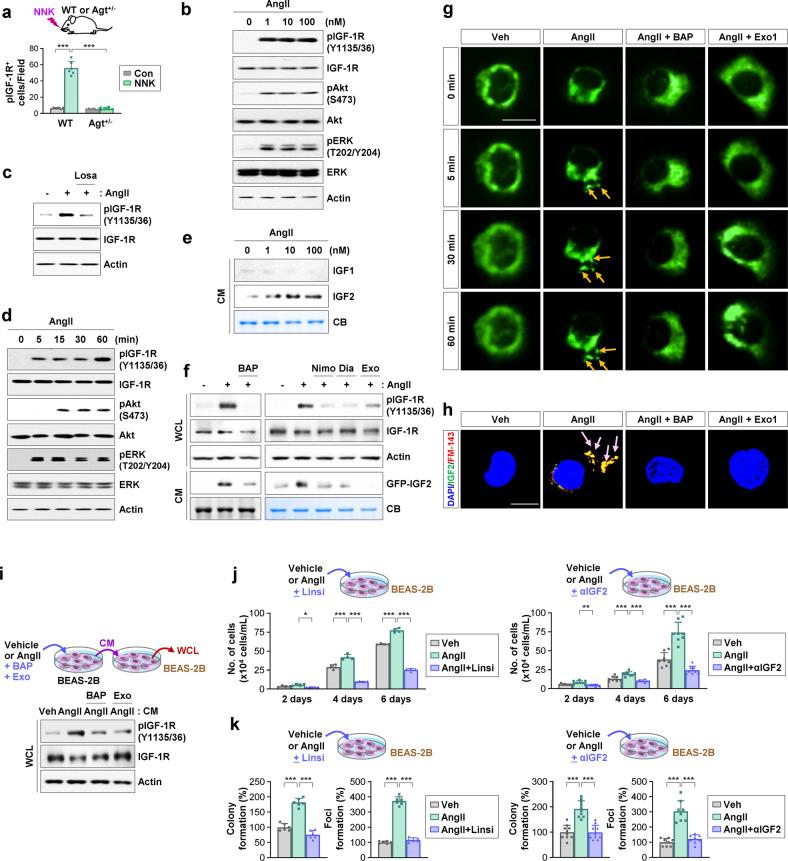
The renin-angiotensin (RA) system has been implicated in lung tumorigenesis without detailed mechanistic elucidation. Here, we demonstrate that exposure to the representative tobacco-specific carcinogen nitrosamine 4-(methylnitrosamino)-1-(3-pyridyl)-1-butanone (NNK) promotes lung tumorigenesis through deregulation of the pulmonary RA system. Mechanistically, NNK binding to the nicotinic acetylcholine receptor (nAChR) induces Src-mediated signal transducer and activator of transcription 3 (STAT3) activation, resulting in transcriptional upregulation of angiotensinogen (AGT) and subsequent induction of the angiotensin II (AngII) receptor type 1 (AGTR1) signaling pathway. In parallel, NNK concurrently increases insulin-like growth factor 2 (IGF2) production and activation of IGF-1R/insulin receptor (IR) signaling via a two-step pathway involving transcriptional upregulation of IGF2 through STAT3 activation and enhanced secretion from intracellular storage through AngII/AGTR1/PLC-intervened calcium release. NNK-mediated crosstalk between IGF-1R/IR and AGTR1 signaling promoted tumorigenic activity in lung epithelial and stromal cells. Lung tumorigenesis caused by NNK exposure or alveolar type 2 cell-specific Src activation was suppressed by heterozygous Agt knockout or clinically available inhibitors of the nAChR/Src or AngII/AGTR1 pathways. These results demonstrate that NNK-induced stimulation of the lung RA system leads to IGF2-mediated IGF-1R/IR signaling activation in lung epithelial and stromal cells, resulting in lung tumorigenesis in smokers.
肾素-血管紧张素(RA)系统已被牵涉到肺癌的发生,但具体机制尚未阐明。在这里,我们证明暴露于代表性的烟草特异性致癌物质亚硝胺 4-(甲基亚硝胺)-1-(3-吡啶基)-1-丁酮(NNK)会通过调节肺 RA 系统促进肺癌的发生。从机制上讲,NNK 与烟碱型乙酰胆碱受体(nAChR)结合诱导Src 介导的信号转导和转录激活因子 3(STAT3)激活,导致血管紧张素原(AGT)的转录上调,随后诱导血管紧张素 II(AngII)受体 1(AGTR1)信号通路。同时,NNK 通过 STAT3 激活通过转录上调 IGF2 以及通过 AngII/AGTR1/PLC 介导的钙释放增强从细胞内储存中释放来同时增加胰岛素样生长因子 2(IGF2)的产生和 IGF-1R/胰岛素受体(IR)信号的激活。NNK 介导的 IGF-1R/IR 和 AGTR1 信号之间的串扰促进了肺上皮和基质细胞的致瘤活性。NNK 暴露或肺泡 2 型细胞特异性 Src 激活引起的肺癌发生被杂合子 Agt 敲除或临床可用的 nAChR/Src 或 AngII/AGTR1 途径抑制剂所抑制。这些结果表明,NNK 诱导的肺 RA 系统刺激导致肺上皮和基质细胞中 IGF2 介导的 IGF-1R/IR 信号激活,从而导致吸烟者的肺癌发生。


 Zotero 插件