
心脏手术后早期心包积液中糜酶激活的影响。
Impact of early pericardial fluid chymase activation after cardiac surgery.
作者信息
Butts Brittany, Goeddel Lee A, Zheng Jingyi, Pat Betty, Powell Pamela, Mobley James, Ahmad Sarfaraz, Steele Chad, McGiffin David, Davies James E, George James F, Melby Spencer J, Ferrario Carlos M, Dell'Italia Louis J
机构信息
Nell Hodgson Woodruff School of Nursing, Emory University, Atlanta, GA, United States.
Department of Anesthesia and Critical Care Medicine, Johns Hopkins University, Baltimore, MD, United States.
出版信息
Front Cardiovasc Med. 2023 Apr 12;10:1132786. doi: 10.3389/fcvm.2023.1132786. eCollection 2023.
INTRODUCTION
Chymase is a highly destructive serine protease rapidly neutralized in the circulation by protease inhibitors. Here we test whether pericardial fluid (PCF) chymase activation and other inflammatory biomarkers determine intensive care unit length of stay, and explore mechanisms of chymase delivery by extracellular vesicles to the heart.
METHODS
PCF was collected from adult patients (17 on-pump; 13 off-pump) 4 h after cardiac surgery. Extracellular vesicles (EVs) containing chymase were injected into Sprague-Dawley rats to test for their ability to deliver chymase to the heart.
RESULTS
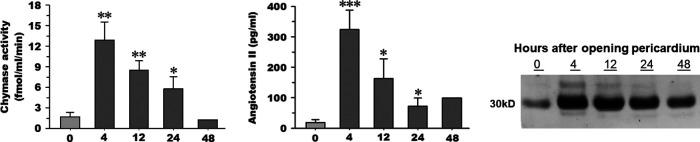
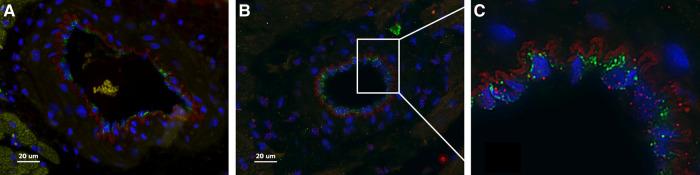
The mean intensive care unit (ICU) stay and mean total length of stay was 2.17 ± 3.8 days and 6.41 ± 1.3 days respectively. Chymase activity and 32 inflammatory markers did not differ in on-pump vs. off-pump cardiac surgery. Society of Thoracic Surgeons Predicted Risk of Morbidity and Mortality Score (STS-PROM), 4-hour post-surgery PCF chymase activity and C-X-C motif chemokine ligand 6 (CXCL6) were all independent predictors of ICU and total hospital length of stay by univariate analysis. Mass spectrometry of baseline PCF shows the presence of serine protease inhibitors that neutralize chymase activity. The compartmentalization of chymase within and on the surface of PCF EVs was visualized by immunogold labeling and transmission electron microscopy. A chymase inhibitor prevented EV chymase activity (0.28 fmol/mg/min vs. 14.14 fmol/mg/min). Intravenous injection of PCF EVs obtained 24 h after surgery into Sprague Dawley rats shows diffuse human chymase uptake in the heart with extensive cardiomyocyte damage 4 h after injection.
DISCUSSION
Early postoperative PCF chymase activation underscores its potential role in cardiac damage soon after on- or off-pump cardiac surgery. In addition, chymase in extracellular vesicles provides a protected delivery mechanism from neutralization by circulating serine protease inhibitors.
引言
糜酶是一种具有高度破坏性的丝氨酸蛋白酶,在循环中会迅速被蛋白酶抑制剂中和。在此,我们测试心包液(PCF)中的糜酶激活及其他炎症生物标志物是否能决定重症监护病房的住院时长,并探究细胞外囊泡将糜酶递送至心脏的机制。
方法
在心脏手术后4小时,从成年患者(17例体外循环;13例非体外循环)中收集PCF。将含有糜酶的细胞外囊泡(EVs)注入Sprague-Dawley大鼠体内,以测试其将糜酶递送至心脏的能力。
结果
重症监护病房(ICU)的平均住院时长和平均总住院时长分别为2.17±3.8天和6.41±1.3天。体外循环与非体外循环心脏手术中,糜酶活性和32种炎症标志物并无差异。经单因素分析,胸外科医师协会预测的发病和死亡风险评分(STS-PROM)、术后4小时PCF中的糜酶活性以及C-X-C基序趋化因子配体6(CXCL6)均为ICU及总住院时长的独立预测因素。基线PCF的质谱分析显示存在可中和糜酶活性的丝氨酸蛋白酶抑制剂。通过免疫金标记和透射电子显微镜观察到PCF EVs内部及表面的糜酶分区。一种糜酶抑制剂可抑制EV糜酶活性(0.28 fmol/mg/分钟对14.14 fmol/mg/分钟)。将术后24小时获得的PCF EVs静脉注射到Sprague Dawley大鼠体内,结果显示注射后4小时,心脏中出现弥漫性人糜酶摄取,并伴有广泛的心肌细胞损伤。
讨论
术后早期PCF糜酶激活突出了其在体外循环或非体外循环心脏手术后不久对心脏损伤的潜在作用。此外,细胞外囊泡中的糜酶提供了一种免受循环丝氨酸蛋白酶抑制剂中和的保护性递送机制。


 Zotero 插件