
甘薯多聚半乳糖醛酸酶基因家族的全基因组鉴定和表达分析。
Genome-wide identification and expression analysis of the polygalacturonase gene family in sweetpotato.
机构信息
Institute of Root and Tuber Crops, The Key Laboratory for Quality Improvement of Agricultural Products of Zhejiang Province, College of Advanced Agricultural Sciences, Zhejiang A&F University, Hangzhou, 311300, China.
Crop Science Department, Njala University, Njala Campus. Private Mail bag, Freetown, 999127, Sierra Leone.
出版信息
BMC Plant Biol. 2023 Jun 3;23(1):300. doi: 10.1186/s12870-023-04272-1.
BACKGROUND
Polygalacturonase (PG), a crucial enzyme involved in pectin degradation, is associated with various plants' developmental and physiological processes such as seed germination, fruit ripening, fruit softening and plant organ abscission. However, the members of PG gene family in sweetpotato (Ipomoea batatas) have not been extensively identified.
RESULTS
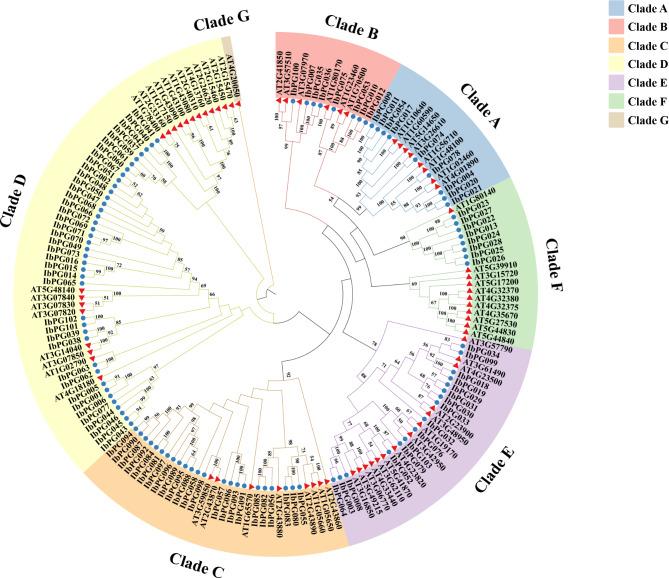
In this study, there were 103 PG genes identified in sweetpotato genome, which were phylogenetically clustered into divergent six clades. The gene structure characteristics of each clade were basically conserved. Subsequently, we renamed these PGs according to their locations of the chromosomes. The investigation of collinearity between the PGs in sweetpotato and other four species, contained Arabidopsis thaliana, Solanum lycopersicum, Malus domestica and Ziziphus jujuba, revealed important clues about the potential evolution of the PG family in sweetpotato. Gene duplication analysis showed that IbPGs with collinearity relationships were all derived from segmental duplications, and these genes were under purifying selection. In addition, each promoter region of IbPG proteins contained cis-acting elements related to plant growth and development processes, environmental stress responses and hormone responses. Furthermore, the 103 IbPGs were differentially expressed in various tissues (leaf, stem, proximal end, distal end, root body, root stalk, initiative storage root and fibrous root) and under different abiotic stresses (salt, drought, cold, SA, MeJa and ABA treatment). IbPG038 and IbPG039 were down-regulated with salt, SA and MeJa treatment. According to the further investigation, we found that IbPG006, IbPG034 and IbPG099 had different patterns under the drought and salt stress in fibrous root of sweetpotato, which provided insights into functional differences among these genes.
CONCLUSION
A total of 103 IbPGs were identified and classified into six clades from sweetpotato genome. The results of RNA-Seq and qRT-PCR suggested that IbPG006, IbPG034 and IbPG099 might play a significant role in tissue specificity as well as drought and salt stress responses, which showed valuable information for further functional characterization and application of the IbPGs.
背景
多聚半乳糖醛酸酶(PG)是一种参与果胶降解的关键酶,与多种植物的发育和生理过程有关,如种子萌发、果实成熟、果实软化和植物器官脱落。然而,甘薯(Ipomoea batatas)PG 基因家族的成员尚未得到广泛鉴定。
结果
本研究在甘薯基因组中鉴定出 103 个 PG 基因,这些基因被系统发育聚类为 6 个不同的分支。每个分支的基因结构特征基本保守。随后,我们根据染色体位置对这些 PG 重新命名。对甘薯与其他 4 个物种(拟南芥、番茄、苹果和枣)PG 之间的共线性研究,揭示了甘薯 PG 家族潜在进化的重要线索。基因复制分析表明,具有共线性关系的 IbPG 均来源于片段复制,这些基因受到纯化选择。此外,每个 IbPG 蛋白的启动子区域都包含与植物生长发育过程、环境胁迫响应和激素响应相关的顺式作用元件。此外,103 个 IbPG 在不同组织(叶、茎、近端、远端、根体、根颈、初始贮藏根和纤维根)和不同非生物胁迫(盐、干旱、冷、SA、MeJa 和 ABA 处理)下差异表达。IbPG038 和 IbPG039 受到盐、SA 和 MeJa 处理的下调。进一步研究发现,IbPG006、IbPG034 和 IbPG099 在甘薯纤维根的干旱和盐胁迫下表现出不同的模式,这为这些基因的功能差异提供了线索。
结论
从甘薯基因组中鉴定出 103 个 IbPG,并分为 6 个分支。RNA-Seq 和 qRT-PCR 的结果表明,IbPG006、IbPG034 和 IbPG099 可能在组织特异性以及干旱和盐胁迫响应中发挥重要作用,这为进一步的功能表征和 IbPG 的应用提供了有价值的信息。



 Zotero 插件