
个性化医疗时代的传染病代谢组学
Metabolomics of infectious diseases in the era of personalized medicine.
作者信息
Rahman Mahbuba, Schellhorn Herb E
机构信息
Department of Biology, McMaster University, Hamilton, ON, Canada.
出版信息
Front Mol Biosci. 2023 May 18;10:1120376. doi: 10.3389/fmolb.2023.1120376. eCollection 2023.
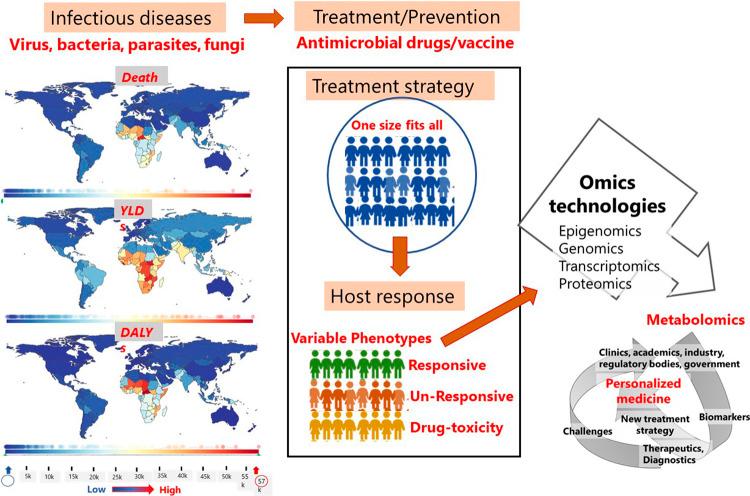
Infectious diseases continue to be a major cause of morbidity and mortality worldwide. Diseases cause perturbation of the host's immune system provoking a response that involves genes, proteins and metabolites. While genes are regulated by epigenetic or other host factors, proteins can undergo post-translational modification to enable/modify function. As a result, it is difficult to correlate the disease phenotype based solely on genetic and proteomic information only. Metabolites, however, can provide direct information on the biochemical activity during diseased state. Therefore, metabolites may, potentially, represent a phenotypic signature of a diseased state. Measuring and assessing metabolites in large scale falls under the omics technology known as "metabolomics". Comprehensive and/or specific metabolic profiling in biological fluids can be used as biomarkers of disease diagnosis. In addition, metabolomics together with genomics can be used to differentiate patients with differential treatment response and development of host targeted therapy instead of pathogen targeted therapy where pathogens are more prone to mutation and lead to antimicrobial resistance. Thus, metabolomics can be used for patient stratification, personalized drug formulation and disease control and management. Currently, several therapeutics and diagnostics kits have been approved by US Food and Drug Administration (FDA) for personalized treatment and diagnosis of infectious diseases. However, the actual number of therapeutics or diagnostics kits required for tailored treatment is limited as metabolomics and personalized medicine require the involvement of personnel from multidisciplinary fields ranging from technological development, bioscience, bioinformatics, biostatistics, clinicians, and biotechnology companies. Given the significance of metabolomics, in this review, we discussed different aspects of metabolomics particularly potentials of metabolomics as diagnostic biomarkers and use of small molecules for host targeted treatment for infectious diseases, and their scopes and challenges in personalized medicine.
传染病仍然是全球发病和死亡的主要原因。疾病会扰乱宿主的免疫系统,引发涉及基因、蛋白质和代谢物的反应。基因受表观遗传或其他宿主因素调控,而蛋白质可进行翻译后修饰以实现/改变功能。因此,仅基于遗传和蛋白质组学信息很难关联疾病表型。然而,代谢物可以提供疾病状态下生化活性的直接信息。因此,代谢物可能代表疾病状态的表型特征。大规模测量和评估代谢物属于被称为“代谢组学”的组学技术范畴。生物体液中的全面和/或特定代谢谱可作为疾病诊断的生物标志物。此外,代谢组学与基因组学一起可用于区分具有不同治疗反应的患者,并开发针对宿主而非病原体的靶向治疗,因为病原体更容易发生突变并导致抗菌耐药性。因此,代谢组学可用于患者分层、个性化药物配方以及疾病控制和管理。目前,美国食品药品监督管理局(FDA)已批准了几种治疗药物和诊断试剂盒用于传染病的个性化治疗和诊断。然而,由于代谢组学和个性化医疗需要多学科领域人员的参与,包括技术开发、生物科学、生物信息学、生物统计学、临床医生和生物技术公司,所以定制治疗所需的治疗药物或诊断试剂盒的实际数量有限。鉴于代谢组学的重要性,在本综述中,我们讨论了代谢组学的不同方面,特别是代谢组学作为诊断生物标志物的潜力以及小分子用于传染病宿主靶向治疗的情况,及其在个性化医疗中的范围和挑战。


 Zotero 插件